

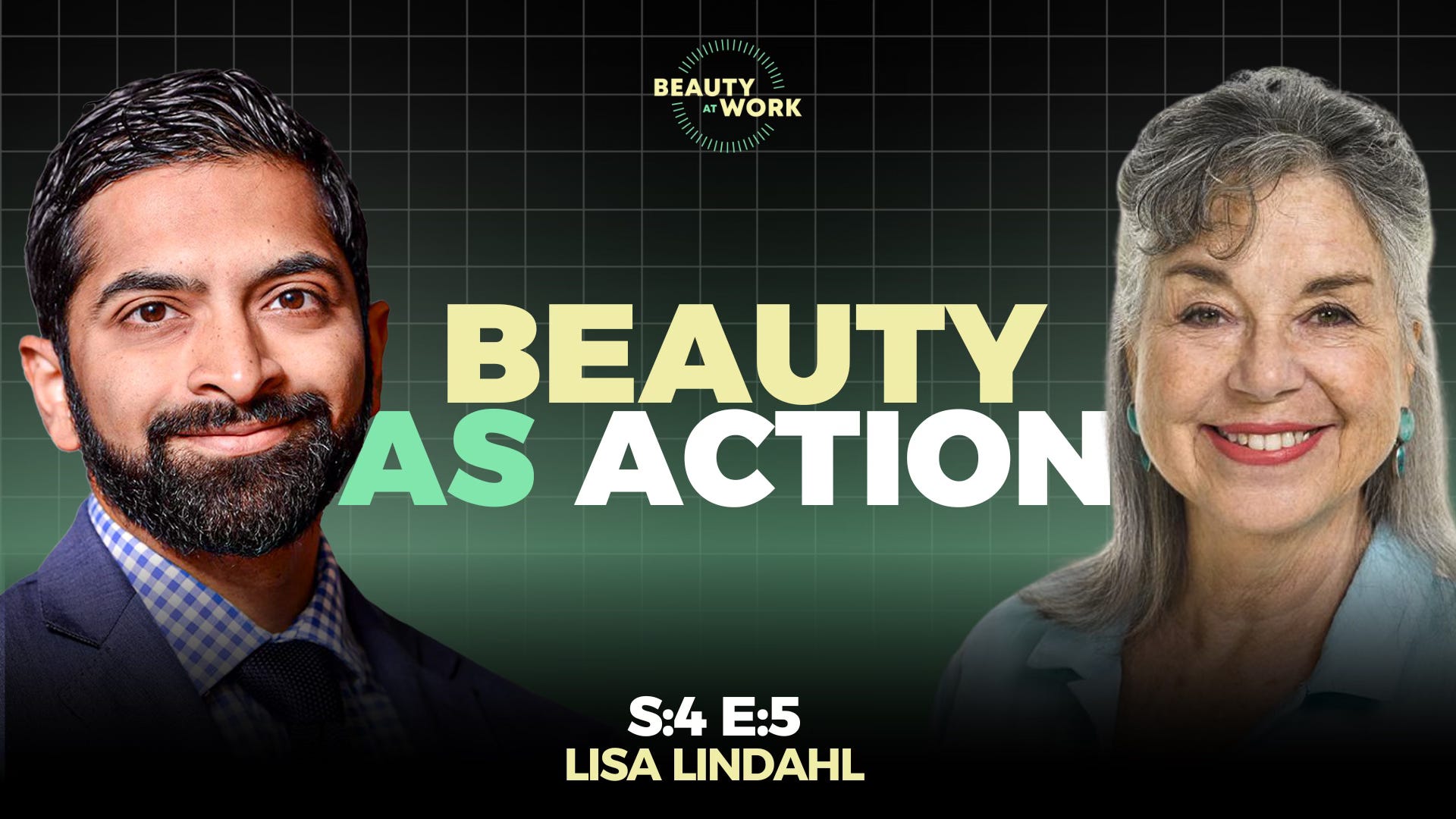
In 1977, Lisa Z. Lindahl revolutionized the world of sports. Frustrated with the lack of comfortable breast support for women runners, Lisa came up with a crazy idea: a jockstrap for women. What she, Hinda Miller, and Polly Smith ended up creating was something entirely new—a body-affirming garment that acknowledged movement as dignity and made the world of athletics accessible to women like never before.
Her work is now archived at the Smithsonian, exhibited at The Met as a “revolutionary piece of women’s undergarments,” and honored by her induction into the National Inventors Hall of Fame (2022). She later co-founded Bellisse, co-inventing the Compressure Comfort® Bra for breast cancer survivors. Lisa is also the author of Beauty as Action and the memoir Unleash the Girls.
Years after transforming women’s athletics, Lisa had an epiphany that would revolutionize the course of her own life: “Beauty is what really matters.”
She has spent the decades since then trying to unpack what this means. And the conclusion she has arrived at is that “true beauty” is harmony. Beauty for her is not glamour or perfection, but at its core, is about resonance. In music, harmony arises when different notes support and enrich each other. In life, beauty arises when our choices, relationships, and creations reflect a deeper coherence.
In a culture rooted in fear, competition, and accumulation, that kind of harmony is rare. We are trained to optimize, to quantify, to compare, to consume. But Lisa argues that those logics erode our capacity to see and be seen, and they strip our work of its soul.
Lisa sees beauty as a verb—beauty needs to be put into action—and has developed a set of 16 practices and habits that help people cultivate beauty in their own lives, which she shares in our conversation.
You can listen my interview with Lisa in two parts here and here, watch the video of the full conversation below, or read the unedited transcript that follows.
(preview)
Lisa: When I invented the sports bra, I was just solving my own problem. Because I was just starting graduate school and I thought, “How am I going to earn a living?” I thought maybe it could be a nice little mail-order business on the side—because if I wanted it, I bet some other women did.
Brandon: Right.
Lisa: Well, oh my.
Brandon: Yeah, you didn’t think you’d be starting a revolution?
Lisa: No, I didn’t.
(intro)
Brandon: I’m Brandon Vaidyanathan, and this is Beauty at Work—the podcast that seeks to expand our understanding of beauty: what it is, how it works, and why it matters for the work we do. This season of the podcast is sponsored by Templeton Religion Trust and is focused on the beauty and burdens of innovation.
Many of us want to change the world, but what happens if you change the world and still find yourself searching for what truly matters? In 1977, Lisa Lindahl invented the sports bra—a product that revolutionized women’s athletics around the world. For that invention, she was inducted into the National Inventors Hall of Fame, joining luminaries like Thomas Edison and the Wright brothers. But years after building a successful company and achieving the kind of recognition that most inventors can only dream of, Lisa found herself standing by Lake Champlain, wondering why contentment still felt out of reach. Then came a surprising revelation: beauty is what really matters. That insight led her from the world of business to a lifelong exploration of what she calls true beauty—beauty that she sees as not about being glamour or cosmetics, but about harmony, relationship, compassion, creation, and a belief that beauty may be what can truly heal the world.
Lisa is the author of Beauty as Action, which explores beauty not as appearance but as harmony, and a memoir, Unleash the Girls, which recounts the unlikely story of inventing the sports bra while in graduate school—and what it taught her about creativity, resilience, and purpose. Let’s get started.
(interview)
Brandon: All right, Lisa, welcome to the podcast. Thanks for joining us. Great to have you on the show.
Lisa: It’s wonderful to be here. I am so excited about this work you’re doing. I’ve been so interested in beauty, what I call true beauty, for so long. When I saw what you were doing, I was just really, thank you. I’m so excited.
Brandon: Well, yeah, thanks for reaching out. I mean, your book on true beauty is really quite amazing. We’ll jump into that and talk about that a little bit. To get started, I’d love it if you could share with us a story of an encounter with beauty that you had perhaps as a child or in your early life that you still remember and that takes you back.
Lisa: That’s easy-peasy because this is a memory that I’ve carried with me all my life. We were living in an area that if I walked across my backyard and down the hill, there was a river that went along. And when I was about nine or ten years old, I would walk down — in the winter, this river would freeze. I would walk down and put on my ice skates and get on the river and skate on it where it ended up in a big lake. But there was nobody on this river. One day, I’m on my skates. I’m on the river, skating on it. It’s so quiet. Everything was just encased in ice. There must have been a big snowstorm or ice storm. I don’t know. I’m skating along. I looked down, and there’s a branch of a pine tree that had fallen in the water. The water had frozen all around it. Every needle was encased. The ice was black. It was just the most beautiful piece of art embedded in this frozen water. I stopped. There’s nobody around. It was me, the forest, and the river. It was so beautiful. That’s my memory. I mean, literally, I have remembered that forever.
Brandon: What about it stayed with you? I mean, yeah, it sounds magnificent. Many of us might have such experiences and we say, “Well, all right. That was nice,” and move on. But what do you think has lodged that within you in this way?
Lisa: Well, it was the quiet. It was daytime, and there was no sound other than the creaking maybe. I was aware of no sound other than my ice skates, my breathing. Looking at this, it’s like being in a piece — I mean, now this is my later self saying, “Oh, I was like being in a piece of art.”
Brandon: Wow.
Lisa: But that’s my later self, kind of. I mean, I still remember that. I had an earlier experience also when I was much younger, like maybe three or four, standing on my mother. My mother had a balcony off of her bedroom, a porch. I’d gone out to it. Because I remember the bars of the railing on this little second-story porch were at my nose. It was sunny. It was summer, I guess. I was looking at the leaves being ruffled by the wind and the light on the leaves and their movement. All of a sudden, Brandon, all of a sudden, I was one with that. The minute I became aware, oh my gosh. It was done. The minute that thought, I had a thought. I’ve differentiated myself again.
Brandon: Right. Yeah, it pulls you out of the experience when you reflect on it, analyze it, and recognize what’s happening.
Lisa: Recognize, that was the case here. That never left me, that sense of we are all — I had experienced being one with the universe.
Brandon: Wow. Extraordinary. You do write about this sense of harmony, this sense of connection, in your book Beauty as Action. I want to first actually ask you a little bit about your other book. Most people know you as the inventor of the sports bra.
Lisa: This is what I’m famous for.
Brandon: That’s right. That’s right, yeah. And you’re shaking your head.
Lisa: I had no idea. When I invented the sports bra, I was just solving my own problem. Because I was just starting graduate school and I thought, “How am I going to earn a living?” I thought maybe it could be a nice little mail-order business on the side—because if I wanted it, I bet some other women did.
Brandon: Right.
Lisa: Well, oh my.
Brandon: Yeah, you didn’t think you’d be starting a revolution?
Lisa: No, I didn’t. Truly, I did not understand for decades—I’m not exaggerating—for decades, how significant the sports bra was, is.
Brandon: Well, tell us about the origin of what led you to invent it. What was the problem you were facing, and then how did this solution emerge?
Lisa: I was in my mid-20s, maybe a little younger, and I didn’t have a driver’s license. I had a job. I was sitting in a lot, so I was gaining weight. I wasn’t comfortable with that. A friend said, “Hey, try this jogging thing.” Everybody is jogging. It’s what we called it at the time. “If you just run a mile and a quarter three times a week, you’ll lose weight.” So I went, oh, okay, I can do that. Because it didn’t require getting to a gym or anything else. It was being outside which I loved. I liked that idea. This was before there were even necessarily particular shoes for jogging and running. I just put on my sneakers and went out the door. I fell in love with it. I got hooked. I got hooked.
By 1977—we’re talking 1977—I was running about 30 miles a week, 5 or 6 miles a day. My bouncing breasts were uncomfortable, and my bra straps are slipping down. Then I had a friend I ran with who was a guy, and he’d be ahead of me. The Vermont summers can get hot. He’d pull off his shirt and tuck it behind in his shorts. I thought, I’m jealous. I got this clangy bra on and sweat. Anyway, it started as a joke. My sister called me from — she was living in California at the time. She called me and said, “I just started running.” We didn’t call it running then. It was still jumping. She said, “My boobs. I’m so uncomfortable with my bouncy boobs. What do you do?” I said I’ve tried anything. I don’t know. She said, “Why isn’t there a jockstrap for women?” We laughed. We thought that was so funny. I said, yeah, same concept, different part of the anatomy, right?
Brandon: Right, right, right.
Lisa: So we laughed and we hung up. I sat down and I thought, “That’s not such a silly idea.” I was in graduate school at the time, so I had notebooks and pencils around. I sat down and I wrote down all the things that such a bra would have to do. It would have to support the breasts. It wasn’t about lifting and separating and making them more attractive. It was about support. It would have to have straps that didn’t fall down. It would have no hardware to dig in or chafe. I forget, there’s a whole list somewhere. I thought, “Yeah, this is such a product that we’d have to do.” But I don’t sew. I mean, sewing is not one of the ways I create. I can do a lot of things, but in eighth grade, I flunked sewing. Really, it was, I guess, a home-ec class or something.
My friend, Polly, who was in the same class in eighth grade, she excelled. In fact, when she grew up, she became quite an accomplished costume designer. But that summer, she was doing the costumes for the Shakespeare Festival up here at UVM, at the university here. She was renting a room from me because I lived in Burlington, Vermont. She lived in Manhattan. She had this summer big. So she said, “Hey, can I live in your guest room?” I said, “Sure, of course.” So I had this idea. I’m downstairs, and I had this idea about the bra. I walked upstairs to her room and knocked on the door. “Polly. Would you mind?” She just rolled her eyes because neither one—
We went to school together starting in eighth grade, and we would cut gym classes together. Neither one of us were good. We were not into sports at all. So she thought this thing with me running, she just really rolled her eyes. She didn’t know what that was about. She said, “Oh, yeah, right. I’m not going to—” I told her what I wanted to do and she goes, “No, no, no.” I said, “Why not?” She said, “There’s only one thing more difficult to create than a bra, and that’s a shoe.” I said, why? And she said, “Because it’s about different parts of the body. It’s not just drape and design. It has to support different parts of the body that are connecting.” But I knew my friend, Polly, and I knew that that design challenge is what would hook her. She has no interest in running or anything else. But then she’s like, “So how would it—?” We sat down and started sketching. Then we started making prototypes up at the costume shop at UVM. There’s even a plaque in the costume shop about the sports bra. First sports bar was made here.
Brandon: Wow.
Lisa: And the prototype that really worked was when — in fact, we went and bought two jockstraps, cut them apart, sewed them back together again. I went running in it and I went, “Oh my God.” I mean, that was the wrong fabric and everything else, but we had the concept done. We had the engineering done, if you will.
Brandon: Yeah, wow. Then how did it take off? How did this go from something that you just found was helpful for you to a worldwide necessity?
Lisa: Well, because the need was there. I was right in one thing, in terms of, “Well, if I want this, I bet that other people do.” If I had done market research — what I think is really funny is, if I had done market research, I would never have started a business. Because the market research would have told me that bra sales had been flat for decades and that the existing lingerie companies that were making bras were just fighting for market share, grabbing from each other. But there’s no increase. In fact, bra sales were declining. Because, let’s remember, this was 1977—with all us weekend hippies were not wearing our bras. Actually, there’s the whole trope about burning bras, which actually never really happened. But it was an attitude.
So if I had done that market research, I would say, oh, no. But I didn’t because it had never occurred to me. Because I was not interested in going into business. I had an art studio. I was back in graduate school, studying education. This was going to be a nice little mail-order business on the side that would help me get through graduate school. Meanwhile, Polly was very clear that she’d help make this and she’d be supportive, but she was not interested in going to business. She had a gig she was going to back in New York. She became a costume designer for Jim Henson in Sesame Street and has eight Emmys at the moment.
Brandon: Wow.
Lisa: So she was clear that she didn’t want to go into business, but that she would help from Manhattan. Her assistant that summer was a woman named Hinda Miller. Well, then she was Hinda Schreiber. She was interested in going into business. Because here’s the thing that I’ve recently come to accept. I’m a visionary. I see connections. But then when it comes to turning it into doing this, I want to hand it off. Okay. Liz, go make it happen.
Brandon: Right, right, right.
Lisa: Hinda was great because she just wanted to figure out how to get this thing manufactured. Because we put this little ad in and, all of a sudden, all these orders were coming in. In fact, one was from Macy’s lingerie department. I’m going, “No way.” So Hinda found — we understood that we didn’t want to start a manufacturing business. We weren’t going to do that. Cottage industry was out because of quality. We can’t. And as Polly was very clear, this is sewing stretch on stretch. It’s very difficult. This is, how much detail do you want?
I mean, we found another entrepreneur in South Carolina. There were a lot of mills in that time, but they were all going out of business because production — that was the beginning of production leaving this country. There was a couple who was starting their own cut-and-sew operation, and they were willing. We were one product in three sizes: small, medium, and large, in one color. Nobody who’s real business was going to take us on. But this couple said, “Oh, yeah. Great. We’ll do that.” So we subcontracted out the making. Then my living room and dining room became the warehouse and office, until my landlady said, “No, this is not okay.” We had to actually go rent offices. I mean, it was phenomenal how we did it. I mean, we were young.
Brandon: So how long did it take from your initial prototype to recognizing, gosh, there’s a huge market for this, and the demand is overwhelming and so on?
Lisa: Not long at all. Within the first year, we knew we had a tiger by the tail.
Brandon: Wow.
Lisa: Then years later, one of our employees did this retrospective. She looked at the sales growth and she said, “Do you guys realize that you’ve been growing 25% per year?”
Brandon: Wow.
Lisa: What? The other weird thing, neither one of us were really business people or aspired to be entrepreneur. We didn’t know things. Like, we didn’t realize that the fact that we’re profitable every year was unusual. That’s the main goal. You have to make a profit.
Brandon: Well, talk about where you see — I suppose maybe one thing I’d love to get your thoughts on is a distinction between invention and innovation. It’s one thing to invent something, but I wonder if you see innovation as a distinct process or a distinct phenomenon.
Lisa: Well, it’s interesting. Because how does invention happen without innovation? I think the very concept of invention, the creation, I don’t know that I’ve ever separated—
Brandon: See the distinction between those two, yeah.
Lisa: Yeah.
Brandon: I think one way in which people distinguish this is invention as simply having to do with something new, that hasn’t been done before, et cetera, and innovation as more having to do with the making it widely accessible, its diffusion, its actual availability, accessibility, et cetera. I wonder if you see those as related or separate phenomena.
Lisa: See, all those things you just said in my mind would not be associated with innovation. To me, innovation is new. It hasn’t been before. It hasn’t existed in that configuration. It hasn’t existed at all or in that particular configuration. Innovation is new. Bras had existed before. The bra is nothing new or different. But how we put it together and its purpose, a need that had not been recognized, that’s how I think—
Brandon: I suppose there are a lot of things, a lot of products, where perhaps the novelty, the newness is there, but people still are not seeing a widespread need for it, or are not resonating with it, or it’s not meeting an immediate demand, et cetera, or it’s not taking off, right? I think there’s a lot of tension there. In your case, that didn’t seem to be an issue. It seems like very quickly, after you recognize the need in your own life, it resonated with so many women around the world and revolutionized sports.
Lisa: Right.
Brandon: I want to ask you where you see the beauty in innovation. Would you use the word beauty to any aspect of innovation?
Lisa: I have to think about that. I mean, for me, I ran that business for—I don’t know—12 years, over a dozen years, before selling it. After I had sold it, I started thinking about what really matters. I had a degree of financial security. I had a new husband. I built a lovely house on Lake Champlain. I felt so lucky. Also, why did I have this feeling inside me: why wasn’t I content, I guess? It wasn’t that I was unhappy. Because that’s not the place at all. But there was this something.
I had also started my volunteer work with the Epilepsy Foundation of America, and I found that very fulfilling and very important. I write about this in my book. One day, I was standing looking at the window in my studio at Lake Champlain. It was a gray day. It wasn’t a traditionally pretty day. I was struck by the beauty of the lake and the wind and the leaves. It just hit me. I knew beauty is what really matters. True beauty is what really matters. I thought, what the hell? I mean, in the same moment, I thought, “What the hell does that mean? What? What am I saying? What?” I started thinking about it and I thought, well, it always. There is always beauty. It’s eternal. It’s eternal. Then I spent a long time thinking about, “What the hell?”
Brandon: Wow. So it’s having an insight, but not quite knowing. I mean, you recognize this was true, and yet a part of you is just bewildered by what it means.
Lisa: So I started doing a lot of reading. I had always been interested in philosophy. I read Kierkegaard and all this other stuff. I started looking at beauty, and there was very actually little written about beauty. Then you could say, well, let’s change the word to aesthetics. Still, I mean, there’s standards of taste and stuff like that. It furrowed my brow. It’s like, wait a minute. Wait a minute. Why did I think that beauty is what really matters? Part of it was that it was eternal, that it didn’t take mankind’s interference to create. In fact, often that got in the way. I went back to school. I had never finished my graduate degree because Jogbra, the business, got in the way.
Brandon: Sure.
Lisa: So when I was, I guess, in my late 50s, I was reading sort of what I call a woo-woo kind of magazine. There was an ad for a program that was all about culture and spirituality. I thought, “Oh, that’s really—” What it listed and what it was talking about matched all the books on my bedside table, kind of. I went, I’m going to go. So I packed my bed. I did. I applied. I was so amazed. I applied.
Brandon: Where was this?
Lisa: I was living in Vermont at the time. This was Holy Names University in Oakland, California.
Brandon: Wow. Okay.
Lisa: Catholic University.
Brandon: Okay.
Lisa: I packed my bags, went out of my big fancy house on Champlain, and went and lived in a dorm.
Brandon: Wow. How did you feel as you were doing that? I mean, were you just wondering? Were you like, did you have moments of wondering, “What the hell am I doing here,” and, “This isn’t making any sense?” Or was it very clear to you that this is really some kind of calling? Did you find yourself satisfied in that pursuit?
Lisa: Well, I felt like I found a path. And up until then, I had gone to retreats and meditation centers. I did a few things with Deepak Chopra and his crowd. I found that all very. It fed me, but I was still niggling on this thing about beauty, you know. I was alone. I mean, it wasn’t like I had a group of people that I got to hung out with and we all sat around and talked about, well, is beauty really eternal, or what is it? Also, I’ve written a lot because I have always been a writer privately, mostly. I mean, I did a lot of the marketing stuff for Jogbra and all that kind of stuff, but all my writing had been private. I was reading and writing, but where was the sharing or learning from others? Where were my people? So going back, I finished my graduate degree. It was amazing. I mean, this program had some of the most amazing people come in and speak to us. I did find my people there. But I did have a home and a husband in Vermont.
Brandon: Right.
Lisa: So talk about balancing.
Brandon: Yeah, wow.
Lisa: So my master’s thesis was on beauty, the importance of beauty. I was so excited when it got accepted as a thesis because I thought, “Okay, maybe I’m not crazy.” And that was in 2007. I’d had the epiphany about beauty probably around 2000 — I don’t know. Early 2003, I don’t know. One of the things I’m fond of saying and at the time I found so annoying was that, to talk about beauty, everybody thinks you’re talking about what is, in fact, glamour.
Brandon: Right. Yeah.
Lisa: I say in my book and I say to people, when I talk to them about beauty, I say, “I’m talking about cosmology, not cosmetology.”
Brandon: Right. That’s great. That’s great. I mean, yeah, you search for beauty online. You type it into Google, and you get beauty products and the cosmetics industry, right? That is our immediate association with the word. It’s really been captured by either that or by fashion, or on the other side, by maybe high art, right? And so Mozart. But yeah, you’re talking about something else. And so, what is true beauty? How would you define or articulate that?
Lisa: Can I cheat?
Brandon: Yeah, yeah, that’s right.
Lisa: Because I did, I said it well in here somewhere. True beauty is about harmony. Harmony implies a lot of different parts, right?
Brandon: Yeah.
Lisa: The analogy I like to use is musical notes. Every musical note is a little different. They can come together and create cacophony—ugh, sound awful—or they can come together and blend and support each other and create beauty. So true beauty is about harmony. So when you look at the leaves blowing in the wind and the sunlight is on them and it’s all coming together, all those same elements could be a hurricane, just the cacophony, if you will. But there’s beauty there too as well. So that’s what I came to. I was worried at first because I thought, “Oh, that’s so simple.” But so what?
Brandon: Yeah, I think that, yes, sort of that sense of harmony becomes the sense of fit, the ways in which things come together, things resonate, seems really critical. I think you draw a link between the decline of beauty, or at least the decline of the importance of beauty, and the decline of civilization. You really see this as it’s not just something that matters for us to personally feel a sense of harmony, but you think this really has broad implications. Could you sketch that out? Why does this matter?
Lisa: To me, it is so clear. I mean, the three part, what beauty is, is about passion, relationship and — there’s a third one that is escaping me at the moment. We are so much now a culture of what I think of as fear, ugliness, and competition, rather than openness, being supportive, building. We’re not about building relationship or building connections. And so much of it is that we’ve become — I’ll try not to make it too broad. We’ve become a culture of accumulation rather than connection. I think a lot about the demise of community, which modern civilization is seeing. You know, it used to be people could sit on their porches and talk to their neighbors. Well, there are no porches anymore. Community is now online. We’re not meeting in person and having this chat. Actually, among certain crowds, there’s been discussion about, can you have spiritual connections online?
Brandon: Right. Yeah.
Lisa: Yes. Actually, yes, you can. But you have to understand that that’s possible and that that’s something you’re willing to be open to and share and make happen.
Brandon: Why does talking about beauty—I mean, true beauty in the sense in which you’re describing it—matter in today’s context?
Lisa: Because again, it’s back to this whole concept and idea of harmony. I mean, beauty is the manifestation of harmony. I guess we talk about harmonics and such. The opposite of harmony is a lot of what we’re experiencing now—conflict, disagreement. There will always be disagreement. A disagreement in and of itself is not a problem. It’s an opportunity.
Brandon: You told me you were in grad school, and you recognized that you were called to do this work on beauty. You wrote this thesis. Where’s your journey led you since then in terms of following this path of beauty? What does that look like in your life?
Lisa: So much philosophy is, you know, a lot of words. Blah, blah, blah, blah, blah. Beauty is something you do, something you feel, something you are, something you create. So rather than just be blah, blah, blah, I said, well, what does practicing beauty — how do you create more beauty? What does that even mean? There are like 16 practices, and it requires no interesting equipment or expense of this or that. For instance, the first practice is to see. All that means is getting off of automatic pilot and really taking in the light on the leaves or the smell of the air. Another one is, so it’s practicing. Another one is practice cultivating awe. You see, but how do you respond? How do you take it in? Another is operating in a “both-and universe” rather than the “either-or universe.” Another one is practice feeling compassion. I mean, what does compassion really mean? How do you actually practice it? That’s always a challenge. Being wary of the “truth” is another practice.
Brandon: I mean, off these 16 practices, do you find some of them are ones that you’re particularly gravitating to these days?
Lisa: No, they’re all operative at different points at times. Like when I wrote, be wary of the truth. It was way before there were such polarizing entities in the world. “This is true. This is the way it is, blah, blah, blah,” versus, “No, it’s this way.” So I talk about what is truth.
Brandon: One of the challenges I think a lot of people have with trying to emphasize something like beauty, in this sense in which you mean it, is it feels to people—at least the kind of critique I get—this is sort of naive. It’s sort of wishful thinking. It’s nice to be compassionate, blah, blah, blah, but we have real conflict in the world. We have to win, and we have to make sure that our side, our perspective gets to influence people. We have the whole concern about economic survival and the challenges that people have. And if you’re working through three jobs, you don’t have the time to sit and attend to trees and so on, right? And so there are a lot of pressures that make it seems really challenging for people to take this seriously, and they lead us to, I think, trivialize beauty. So I wonder if you have any suggestions for what it would take to, in the face of those sorts of challenges — whether it’s political challenges, whether it’s human rights challenges in society, whether it’s individual pressures to survive, I mean, what can people do in the face of that that wouldn’t feel naive and pollyannaish, and yet can help them perhaps recognize something about this deeper truth you’re trying to draw us to?
Lisa: Rather than think of it as naive, think of it as thoughtful, looking at it again. True beauty is not about appearance at all. Well, because we could get into the — yes, visuals are important, but we’ve trivialized beauty so much. But may I be so bold as to read you just this a little bit.
Brandon: Please, yeah.
Lisa: Beauty is a common thread throughout all experience and backgrounds. The way of beauty is non-religious, non-political, and intends no ethnic bias. Practicing true beauty will help evolve human consciousness. Any individual can do it. I really mean that whether, it’s so not about our standard of importance now is way out of whack. We’ve lost community. Community begins with family. The family is the first most intimate form of community. Then it’s the neighbor or the person that’s delivering. We have gone almost out of our way to isolate and to separate and to differentiate. Now there’s a lot of work being done about how the consciousness of other entities, we humans, we think we’re in charge. We’re better than and more — well, I can’t say that word. That’s not the case. Trees are sentient. Mushrooms talk to each other, sends messages around. They just have different languages, different ways of communicating, but they do communicate. And who the hell are we? Anyway, we have to get over ourselves. By paying attention to what I’m calling true beauty is a methodology to do that, to really shift the paradigm.
Brandon: It seems like it really is — it is pretty radical. Because, again, I think one of the dominant ways in which we engage with beauty is to want to possess the beautiful object, right? People argue that if beauty is that de-centering and unselfing, then how come the Nazis loved beauty so much, et cetera, right? And so you can have one way of encountering beauty in which you consume it, you possess it. It’s an amusement. It’s something that might make you feel intense pleasure. But it’s not really transforming you. It’s not really leading you beyond yourself. It’s not de-centering you. And so I think that is another challenge. And again, it is an obstacle that I regularly encounter, with an objection that I encounter with people I talk to about beauty, which is that isn’t it just about beautiful things that you can possess? Or doesn’t it just draw you deeper into either this kind of selfishness or consumerist mindset or even a denialism—where you have a nice experience, and then so what? Ultimately, why does it matter? Versus the kind of beauty that is perhaps maybe more, perhaps you might call spiritual or transcendent, right? It seems like there really is a distinction. I don’t know how to help people overcome that hurdle. I wonder if you have any thoughts there.
Lisa: I do. But let me refer to this stool and see if this speaks to what you’re talking about. I have this image of a three-legged stool. The number three has been significant in all of humankind’s history: the virgin, the mother; the crone, the father; the son, the Holy Ghost; the Jnana, Bhakti, Karma. I mean, I’m not probably pronouncing those right. This idea of three: truth, beauty, and justice. If you take away one of those, the stool topples. It becomes unbalanced. That’s where we are. Because as humans, we tend to do is we tend to privilege one of those concepts, like whatever it is. Truth is more important than beauty. Beauty is more important than anything else. Then things get out of whack. So I started thinking about — well, actually that’s what brought me to: what if beauty is the seat of the stool that these other three hold up? And when justice falls out or something else — I think that’s what’s happened to us. I’m not sure I’m answering your question.
Brandon: I think you are, yeah. Yeah, I would say that that kind of danger of beauty being untethered from truth or from justice. Then it’s sort of this free-floating thing, which can then be co-opted by whatever our own pursuits are, right?
Lisa: Some of the stuff, one of the things — I mean, I know you have children. When I look at what is on the screens these days, especially this time of year, it’s all about — I mean, it’s all murder, horror, scary,
fear. It’s all about elevating and encouraging fearfulness. That’s not beautiful. That is not true beauty.
Brandon: Lisa, you’ve lived with epilepsy for most of your life. Could you say anything about how that has shaped your sensibility about beauty?
Lisa: You know, I’ve never actually thought about that. I have what’s called an invisible disability. That has taught me a great deal. Because I look and act and appear like anybody else, I can get away with it. But I have to be way more thoughtful. I just wrote a piece called The Things She Worries About. I worry about the basement floor. If I’m alone in the house and if I fell on the basement floor, I’d crack open my head. Now, that has actually happened—not in the basement, but in a bathroom. Maybe this is related to the beauty thing. I don’t know. But I’ve learned to become aware of — I’m not on automatic pilot as much as most people are. I have to think before I go swimming. I’ve almost drowned two or three times because I didn’t think before I jumped in the water. Does that stop me from swimming? No. I have to learn. So I don’t know. I don’t think I’m answering your question, except that curiosity is a really important attribute. When you have something you have to deal with that most people don’t, I mean, most people don’t—
Brandon: Yeah, I suppose it certainly makes sense that it would dispose you in some way towards being innovative and creative and having to figure out how to make things work, especially if you want to be resilient and not just be resigned to difficulty, right?
Lisa: Yep.
Brandon: Please, yeah.
Lisa: No, I don’t want to actually say that.
Brandon: I also just was thinking in terms of a recognition of — you mentioned the attentiveness, that you have to constantly cultivate. But also, I imagine a sense of vulnerability, a keener sense of the body, of embodiment. I think there might be a connection to beauty there.
Lisa: I will say this. I have traveled all over the world. I’ve had by myself often. I have had convulsions, the tonic. There are many different kinds of seizures. The one that most people think of is when you fall and you shake. That’s a tonic, clonic seizure. They’re very dramatic, and they’re scary for the people witnessing them. I have had those sorts of seizures in restaurants, in airports, in the backseat of taxi cabs. No one has ever harmed me, stolen from me. And the fact that I was in those situations is on me, especially the taxi cab one. I got an early morning flight. I knew I wasn’t 100%. I should never have gotten on the plane. I really wanted to go to this meeting, so I did. I got off the plane. I knew I was not okay. I got into this taxi.
I remember looking at the taxi driver’s name because I thought, “Oh, man, if I have a convulsion here, I’m restrained, a woman, alone in her high heels and skirt, at the backseat of a cab.” It was some foreign name that I was never going to remember or anything else. That’s the last thing I remember until I woke up on a gurney in Bellevue Hospital in New York City. I woke up because I felt someone pulling my skirt down. This is the days of miniskirts and panty hose, just a little bit. I kind of went, Brandon, I woke up. My briefcase was with me. My purse and my wallet was with me. The driver had not even taken out the fare from the airport from my wallet.
Brandon: Wow.
Lisa: So this guy had seen me in the backseat, changed the location, took me to the hospital emergency room, dropped me off. That’s been my experience. I have sat in an airport, where I’m waiting to get on a flight and had a convulsion sitting there and thinking it was important. I took out my wallet before I went out to open it up so they’d know who I was. It’s what I was thinking, because you’re not thinking.
Brandon: Right, right, right.
Lisa: Nobody touched my wallet. My experience of humankind is that it is basically good. I choose to believe that because that’s been my experience. Is there a lot of crap going on in the world now? Yes. I want more of the message of the true beauty that is available to us is being handed down to, shown to our children, the upcoming generations, rather than this vampires and Halloween, and all this stuff, you know. Oh my God.
Brandon: Well, that’s great. Well, I mean, in that vein, I suppose if there’s maybe one practice you might recommend to our listeners and viewers to really learn how to live more fully into this sort of true beauty, what is perhaps one starting point you might recommend?
Lisa: The number one practice, which is practice seeing. Just turn off that automatic pilot. I mean seeing broadly. It’s not just visual. When someone says something that rubs you the wrong way, how do you respond? Are you going to ehh right back? Or are you going to go, where’s that coming from? There are actually three practices. One is practicing compassion, seeing, practicing compassion. Of course, I forget.
Brandon: I think creation, right, was the other?
Lisa: Creating. Right. I’ve just re-read Beauty as Action. Because I wrote it so long ago that I thought, “Oh, I should reread this.” So I reread parts of it. It’s easy. It’s not difficult. I mean, I do. I wish everybody would at least read it. Whether or not you take it on or not is a whole other thing.
Brandon: Yeah, I can’t recommend it enough. It just resonates so much with everything we’ve been doing on this podcast. Certainly, the spirit that animates the work I’m doing is deeply resonant there. So I definitely recommend it to our viewers and listeners. The practices that you’ve recommended are really important, I think, for all of us.
Lisa: Well, that’s why I’m so excited with what you’re doing. I mean, I’m, “Oh, wow. Beauty’s time has come.”
Brandon: Right. Well, let’s hope so.
Lisa: Thank you.
Brandon: Well, Lisa, thank you for your time and for your insights. It’s been fantastic.
Lisa: Well, I hope we can keep in communication and to keep this role and to keep it going.
Brandon: Absolutely.
Lisa: Anything I can do to help, let me know.
Brandon: We’ll do, yeah. Also, we’ll guide our listeners and viewers to your website. Is there anything else you’re working on these days that you would like to share, or anything that you want to add?
Lisa: Life—I’m working on life. Life and living this. No, there are things in the works, but I’m not at liberty to talk about them yet. So check back. There’s stuff in the pipeline.
Brandon: Wonderful. All right. Thank you, Lisa. It’s been a real treat.
Lisa: Thanks, Brandon, so much. I appreciate it.
(outro)
Brandon: All right, folks. That’s a wrap for this episode. If you enjoyed the episode, please share it with someone who would find it of interest. Also, please subscribe and leave us a review if you haven’t already. Thanks, and see you next time.