

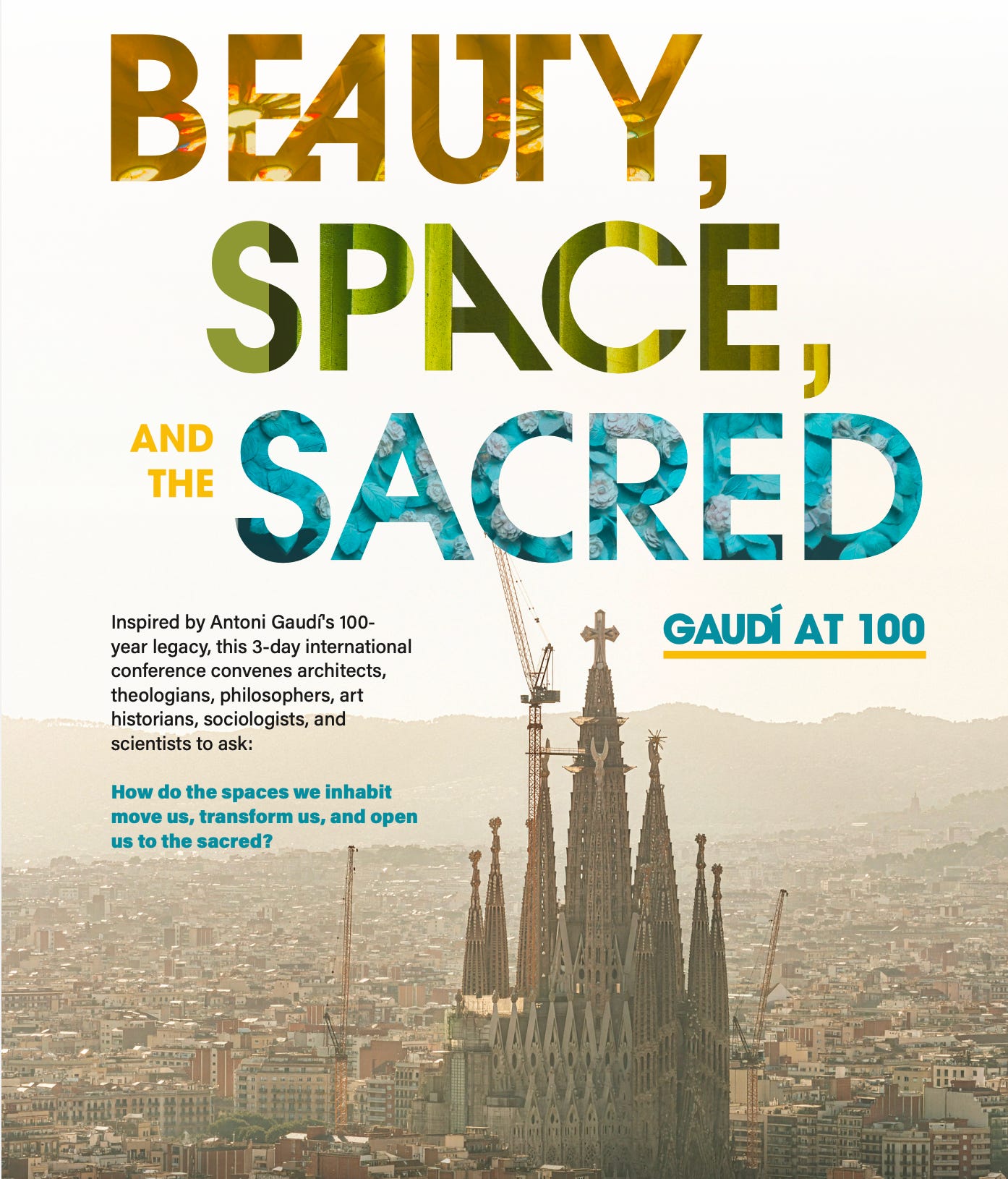
We are living through a moment in which the public conversation about beauty, meaning, and the built environment is being reshaped in many ways: by growing research in neuroscience and psychology on arts and health, by the global restoration of sacred monuments, and by renewed attention to the human need for awe and wonder. More and more seriously, we find ourselves pursuing the question Dostoevsky provokes via his character Prince Myshkin in The Idiot: Can beauty save the world?
There is perhaps no time more apt to ask this question than this year, 2026, as we mark the centenary of Antoni Gaudí: one of the most innovative, visionary, and inspiring architects of the modern era.
Between November 5-7 my colleagues and I organized a conference at The Catholic University of America in Washington DC, to celebrate Gaudi—which we found especially fitting since his cause for canonization is underway in the Catholic Church—and also to draw on his inspiration to pursue a multidisciplinary inquiry into how the spaces we build and inhabit transform us, and open us to the sacred.
We brought together scholars and practitioners from a wide variety of disciplines that are seldom in the same room: architecture, philosophy, psychology, sociology, neuroscience, theology, cultural heritage, design, art history, music, arts and health, and even astronomy.
Our hope for the event was that our guests wouldn’t just think and talk about beauty but also experience it and be moved by it. While I can’t quite convey the full experience of the gathering in this post (certainly not the meals by the Michelin-starred Catalan chef who played a key role in the helping us encounter beauty!), what I can share is the videos and summaries of our panels. We weren’t able to record the individual papers that were presented in the concurrent sessions but hope to make them available in some other way in the future. You can find photos of our conference at https://www.canbeautysavetheworld.com/gaudiat100 and learn more about the broader project on that site.
This conference was organized in partnership with the Washington Delegation of the Government of Catalonia, with the generous support of our sponsors: the Walton program at the school of architecture and allied arts, the National Endowment for the Humanities, John Templeton Foundation, Templeton Religion Trust, The Gibbons Institute for Human Ecology, SShape, Hereford Dooley Architects and Trevor Resurrection. My heartfelt thanks to my co-organizers Ana Maria Roman Andrino, Julio Bermudez, and Isabelle Potworowski, and the team that helped us put the event together: Kristin Hurd, Lorenzo Cardim DeAlmeida, Ana Botelho, Genevieve Buono, Tony Falcone, Nate Svogun, Julie Park, Tripanne Manuel, and the university’s Advancement team.
Opening remarks
Brandon Vaidyanathan, Peter K. Kilpatrick, Michael Utsunomiya, Pepe Moncayo, Fr. Aquinas Guilbeau
The evening began with a vocal quartet singing Bruckner’s Locus iste and Byrd’s O sacrum convivium. After my introduction to the aims of the conference, the President of the Catholic University of America, Dr. Peter Kilpatrick, offered a welcome. He offered his perspective as a scientist, and noted that we encounter beauty more in near-symmetry rather than in perfect order. Every snowflake shares a hexagonal structure, but each one is unique because of tiny defects and deviations. Species evolve only because DNA copies imperfectly. He said the same principle could be found in Gaudí’s buildings and in Notre-Dame’s unequal towers, where small departures from symmetry reflect the genius of human artistry.
Michael Utsunomiya of the Delegation of the Government of Catalonia described Gaudí as an exemplar of Catalonia’s restless creativity, which is characterized by on the one hand a respect for craft and tradition, and on the other, a drive to experiment. The centenary, he said, provokes us to ask not only what Gaudí’s legacy left behind but what it makes possible in the future.
Barcelona-born chef Pepe Moncayo, who once rode past the Sagrada Família every day on his way to work, offered us an exquisite Catalan dinner as an artisan’s tribute to an artist.
1. Working on a Masterpiece
A conversation between Amilcar Vargas and Philippe Villeneuve, moderated by Mark Ferguson
Two caretakers of World Heritage sites described opposite routes to the same goal: keeping a masterpiece authentic while millions walk through it. Amilcar Vargas manages Casa Batlló, a house in Barcelona that Gaudí remodeled in the early 1900s. He described it as a privately owned monument that is run on a people-centered approach. The Bernat family (of Chupa Chups lollipops fame) bought the house in 1993. Restoration is funded primarily by income from tickets, with about two million visitors a year. That approach frees it from lowest-bid rules and keeps local artisans employed. The house stayed open during its latest restoration, finished in 2025, and made the work part of the visit.
Philippe Villeneuve has been chief architect of Notre-Dame de Paris since 2013 and led its reconstruction after the 2019 fire. He explained why Notre-Dame was rebuilt exactly as it stood before the fire. Viollet-le-Duc was dismissed for a century and has been recognized as a genius since 1979; Gaudí admired him and drew on his reading of Gothic structure. Villeneuve called the result a paradox—an “authentic restitution” as he put it. His job is to preserve, not create, he said, and argued that adding a contemporary spire would be like putting a red nose on the Mona Lisa. Both Vargas and Villeneuve raised the challenge that monuments cannot be made to obey modern building codes.
2. XTA: Empirical Theological Aesthetics
Matthew Niermann, Mark McInroy and Ian Church; moderated by Julio Bermudez
This panel introduced the new field of experimental theological aesthetics (XTA) which entails testing old claims about sacred space with methods such as eye-tracking, biometric sensors and surveys. Julio Bermudez, who founded the field with Matthew Niermann, opened with the provocative question that animates this field: can you measure the immeasurable?
Mark McInroy offered a theological perspective. Christianity, he argued, is aesthetic twice over. Its God appears to the senses in the Incarnation, a point he drew from the Byzantine theologian Theodore the Studite. Following Hans Urs von Balthasar, he noted that beauty is a property of being itself, and not ornamental. Aesthetic experience therefore leads deeper into reality rather than away from it.
Ian Church described experimental philosophy of religion. His research finds that people judge suffering less pointless once it has narrative context—and this opens up an important avenue for churches to help people in their suffering.
Niermann presented early results from a study of 60 Catholics, 60 Protestants and 60 non-religious participants. Each walked through a Catholic cathedral, an evangelical church and an art museum in Southern California. There were remarkable similarities between the three groups in how they rated beauty and awe, but their eyes were drawn differently in each of the sites. More beautiful spaces made every group more inclined to consider the meaning of life; beauty was thus a cognitive amplifier. One surprise was that a small cross beside the stage of the evangelical church drew every group’s eyes.
3. Remarks from Jordi Faulí
Jordi Faulí (by video link from Barcelona)
Jordi Faulí is the seventh chief architect of the Sagrada Família since Gaudi, and explained how Gaudí made the project survive him. He knew that he would not live to see it completed, so concentrated on one facade (the Nativity) so his successors would have a model to follow. He developed a small set of geometric forms, which served to guide his successors. Much of the talk walked us through the innovative geometrical forms that Gaudí provided, turning to nature as his source of inspiration. Columns generated by two opposite twists produce tree-like structures, leaving the nave feeling like a forest. He developed hyperboloid skylights and windows to gather and diffuse daylight. The sacristy dome served as the model for the six central towers. The eighteen towers will rise in a pyramid toward the tower of Christ. The three facades differ in form to express their themes: the joyful Nativity, the bare, bone-like Passion, and the Glory facade still to come. New techniques, including prefabricated post-tensioned stone panels, built the central towers. Cathedrals, he said, have always worked at the edge of technology.
4. Attuned to the Divine: Acoustics and Sound of Sacred Spaces
Jonathan Berger, Brian A. Butcher and Nima Farzaneh; moderated by Isabel Potworowski
Moderator Isabel Potworowski opened with the idea of atmosphere as attunement (a word first used for tuning instruments). She traced it through Peter Zumthor’s chapels and baths, where reverberation and silence are designed.
Nima Farzaneh reconstructed the soundscape of Isfahan’s great seventeenth-century square. Drums at the bazaar gate, clock bells, the call to prayer and coffee-house storytellers organized the city’s day-to-day life. Modelling suggests the pierced plaster of a palace music room trims reverberation, while a clap under the Shah Mosque’s dome returns several distinct echoes.
Jonathan Berger played various acoustic reconstructions within sacred spaces. Guillaume Dufay’s motet for the 1436 consecration of Florence’s cathedral would have turned to mud under the new dome, he argued; the composer could not have known the acoustics. In Jerusalem, the guards’ pounding on the floor of the Holy Sepulchre works like a test signal, revealing each space’s decay. He ended with the Sagrada Família during the Pope’s visit in 2026, where children singing outside were amplified to sound as if indoors.
Brian Butcher took the theme to its limit with a scholastic case against the use of microphones in worship. Singing is the voice’s natural amplification, he said, and a microphone separates voice from body and ignores the room. He recounted how while on the Camino he sang in every church and found that the stones sang back.
5. Social Scientific Perspectives on Beauty, Space, and Spirituality
Victor Counted, Robert Brenneman and Nicholas Boys Smith; moderated by Brandon Vaidyanathan
This panel brought to bear social-scientific data showing that beauty in buildings is a widely shared need, not just a luxury or a matter of taste.
Psychologist Victor Counted described attachment to place as a relationship that can be broken by loss or disrupted by change. Beauty is a way to repair this relationship; it helps us see a familiar place anew and tend to it.
Sociologist Robert Brenneman drew on his research on religious buildings in Guatemala and Vermont. A Pentecostal congregation near Guatemala City built a church for $4,000 on rented land and laid an $800 white tile floor, which for their members was a great luxury that they could not afford in their own homes. In a lakeside Catholic parish in Guatemala, every family contributed one day’s labor every month, and fourteen local artists painted the Stations of the Cross. What such initiatives do is put beauty within reach of ordinary people and generate what he calls “building energy.”
Nicholas Boys Smith, founder of Create Streets in the UK, offered a strong argument that good design is not subjective. His polling data from several cities gives him the confidence that if you show a hundred people a place, you can predict how seventy or eighty will respond. He cited studies linking street trees, facade variety and scenic surroundings to outcomes of better health and neighborliness. Strikingly, these preferences endure across a wide variety of sociodemographic factors including politics and class.
I added findings from our recent US-UK population survey of almost 11,000 people. About three-quarters of the religiously unaffiliated in the US, and two-thirds in Britain, find beauty in sacred architecture. Access to beautiful places, though, is related to income and education.
6. The Search for Beauty and the Sacred: Building Cathedrals in the 21st Century
Craig Hartman and James McCrery; moderated by Michael J. Crosbie
The final panel of the day featured two architects who showed us how differently a new American cathedral can help us access beauty and transcendence. Craig Hartman presented the Cathedral of Christ the Light in Oakland, and James McCrery presented the Cathedral of the Most Sacred Heart of Jesus in Knoxville, Tennessee.
Hartman’s client asked for a building that honors 2000 years of Catholic history while also conveying it belongs to the third millennium and to Oakland. Hartman decided to begin from nature and light. Two intersecting spheres of timber are wrapped in a glass veil, and bring the congregation together around the central altar. There is no pictorial stained glass; instead, daylight passes through laser-cut perforations to form an image of Christ that he replicated from a 900-year-old relief at Chartres. The building can be cooled without air conditioning and sits on isolators that allow it move during earthquakes. He argued that beauty is what makes a community preserve a building over centuries.
McCrery’s bishop wanted a church that was unmistakably Roman and Catholic, and at the same time Southern and welcoming to its Protestant neighbors who are the majority demographic in the area. The structure he develops integrates three traditional types: the basilica, the Greek-cross votive church, and the cruciform plan under a dome, and includes a long front porch. McCrery described its marble sourced from Italy and micro-mosaic patterns as offerings returned to God.
7. Neuroscience and Architecture
Anjan Chatterjee, Greg Luongo and Milton Shinberg; moderated by Navneet Anand
This session asked what science can say about why some spaces move us, and how designers can apply these scientific findings.
Neurologist Anjan Chatterjee recounted how he initially planned a visit of two hours at the Sagrada Família in 2018 but ended up staying until it closed. His research shows how our brains evolved for environments that are rather different from the structures we are building, and we can see this more clearly when we examine the effects of electric light and constant noise. His research identifies that three qualities that can explain most of how people rate interiors: coherence, fascination and hominess. Research also finds that people find nature-themed rooms pleasing even when it doesn’t reduce stress, though patients in an addiction-recovery facility did report less stress in such a room. People, he argues, like their nature tamed. And one of the main reasons sacred spaces are so effective is because they slow us down.
Architect Milton Shinberg took us to Gaudí’s childhood in Riudoms and showed us how the forms and patterns he encountered there shaped his architectural innovations. He showed us, for instance, how the columns of Park Güell resemble the gnarled olive trunks Gaudí grew up with and the ways in which the bone-like facade of Casa Batlló resembles the human skeleton.
Greg Luongo from HKS described the work their team has been doing in hospitals. He argued that hospitals need to be seen as civic places and underscored the importance of reducing anxiety in these spaces. He shared with us a virtual-reality study still in progress, in which participants wearing EEG caps viewed computer-generated facades on a Detroit street. Early results show that fractal patterns scored highest for awe and Art Deco patterns for belonging.
8. Gaudí, Culture and Spirituality
Msgr. Melchor Sánchez de Toca (by video link from Rome)
Msgr. de Toca is a relator at the Vatican’s Dicastery for the Causes of Saints and a leading voice in Gaudí’s cause. He talked about the conversion that marked Gaudí’s life: the young Gaudí was a successful, fashionable architect—a dandy who had drifted from the faith of his childhood, but mentors and clergy in his life drew him back. From 1914 he dedicated himself to working only on the Sagrada Família, living in poverty beside the site. When a tram struck him in 1926, he was mistaken for a beggar.
Gaudí talked about scripture and nature as the two books that informed his life. Whoever studies nature’s laws in order to build by them becomes a co-worker with the Creator. Msgr. de Toca talked about how Aquinas’s criteria for beauty are reflected in Gaudí’s work: for instance, the role of proportion in the basilica through the numbers 7.5 and 12, and the pyramid-like silhouette that recalls Montserrat. Aquinas’s criterion of clarity is found in Gaudí’s emphasis on light. The basilica, he added, is not so much a picture Bible as a guided initiation into mystery, culminating in the liturgy.
9. Curating Beauty
Julie Carmean and Ian Koebner; moderated by Michael Utsunomiya.
Moderator Michael Utsunomiya noted that “curate” comes from the Latin for “to care for”. He described interviews with staff at Casa Batlló in which a conservator talked about documenting each choice for the sake of a successor who may follow decades later.
Julie Carmean, an arts educator with the National Endowment for Humanities, led the audience through an exercise of slow looking. We spent several minutes with Jasper Francis Cropsey’s 1860 painting Autumn – On the Hudson River, first observing, then sharing observations and listening to each other, then reflecting, before she told us about the painting’s history. She shared research from Harvard’s Project Zero which shows how this process can new build habits of attention and engagement with art and help create the conditions for awe and empathy.

Ian Koebner from Rutgers University offered a distinction between outer architecture (e.g., the structure of a building) and from inner architecture (the structure of experience), and argued that the two are largely independent. He also talked about Carnegie Hall’s Well-Being Concert series and experiments conducted there to show the impact of the arts on wellbeing. His main example was a concert in a gymnasium at a juvenile detention center in the Bronx, where the use of drapes, cushions, and colored light transformed the space completely for an hour.
10. Outer Space, Sacred Space, and Inner Space: The Architecture of Awe
Roberto Chiotti, Massimo Robberto and Andrew Newberg; moderated by Katie Bank
Our closing panel of the conference examined awe at three scales: the cosmos, the brain, and a church.
Astronomer Massimo Robberto told us about how church vaults, from fifth-century Ravenna to Giotto’s chapel in Padua, were painted as starry skies. The Sagrada Família, however, has no dome to paint with stars, and today’s understanding of astronomy includes not only stars but galaxies in an expanding universe. How can the cathedrals of today represent this reality that modern science has uncovered? Drawing on the work of colleague his Marco Bersanelli of the University of Milan, Massimo showed a remarkable coincidence: the curve that charts the universe’s expansion over 13.8 billion years bears a striking resemblance to the curved profile of the basilica’s tower of Jesus Christ. From the cross down, the tower is able to depict the passage of time from the beginnings of the universe to the present. It’s even more striking when we consider that Gaudí did not plan this.
Andrew Newberg introduced us to the discipline of neurotheology, which examines the study of the brain and religious experience. From about 2000 accounts of intense spiritual experiences, his team finds five recurring elements: intensity, clarity, unity, surrender and lasting change. Brain scans then link these dimensions to particular regions of the brain, distinguishing areas that become more active from those that go quiet during feelings of oneness.
Finally, architect Roberto Chiotti described St. Gabriel’s Church in Toronto, designed around the eco-theology of Thomas Berry. Berry’s only instruction to guide the construction of the church was a question: how will you address the sun? The church faces south to gather winter sunlight. Roberto described how he designed colored skylights to cast light that travels down the concrete walls during Mass, at the speed of the earth’s rotation, producing a spectacular display of light during the course of the liturgical celebration.
We opened our conference with Dostoevsky’s question: can beauty save the world? We could not, of course, settle this in three days. But our discussions and experience offered a way of addressing this question drawing inspiration from Gaudí’s method.
Gaudí took on a church he knew he would not see completed, concentrated on a single facade so his own generation had something whole to finish, and left the rest to people he would never meet. Villeneuve at Notre-Dame talked about how his job is more to transmit rather than to create. At Casa Batlló, a conservator records each decision for the colleague who may work on the structure decades into the future. All of this offers a way of understanding beauty primarily not as something to possess but something to tend and to hand on. What architects, designers, and curators hand on in this transmission is more than stone and brick and glass, but rather, a place where someone we will never meet may stop in their tracks, be moved to silence, and pulled out of themselves to something beyond.
Let me leave you with a couple of questions. Think of a space that opened you to something larger than yourself. What do think it was about that place that caused this to happen? And does a space need to be sacred, or even beautiful, to open us to the transcendent?
Whether you attended the conference or just read the post or watched the videos, I’d love to hear what you think. And let me know too what other events and themes we should consider in the future.