

Whatever we might think of work, many of us don’t think of it as beautiful, and don’t expect to. We might find it useful, sometimes enjoyable, sometimes meaningful, but more often, it’s a grind. “TGIF!” we like to rejoice.
We think of beauty, on the other hand, as something confined to galleries and sunsets and weddings; it’s certainly not for the office.
For the past four years I’ve run a podcast and platform called Beauty at Work, and many I’ve talked to assume it’s about how you dress in the office! That’s certainly not what it’s about. I’m trying to change the public conversation around beauty, particularly in relation to work, and part of what I’ve been exploring here is how beauty offers us a new lens to examine what’s motivating and meaningful and worthwhile about the work we do.
Between March and May of 2026, as part of a large study of beauty in everyday life, my team and I conducted nationally representative surveys of nearly 5,000 Americans and more than 5,700 Britons, fielded by Gallup. We asked people how often they have encountered beauty in their work and in what dimensions of work they find beauty. The answers we found confirm my intuition about beauty and motivation at work, and establish a strong connection to flourishing that those of us concerned with wellbeing at work ought to pay more attention to. Let me walk you through some highlights of our findings.
How often does work feel beautiful?
Not very often, it turns out. Of the fifteen areas of life we asked about, work came near the bottom in both countries. A third of Americans and more than two-fifths of Britons say their work never feels beautiful. Only a small minority find beauty in their work five or more times a week. Work is where most of us spend the largest share of our waking hours, and it should concern us that for a great many of us, it is a place without beauty.
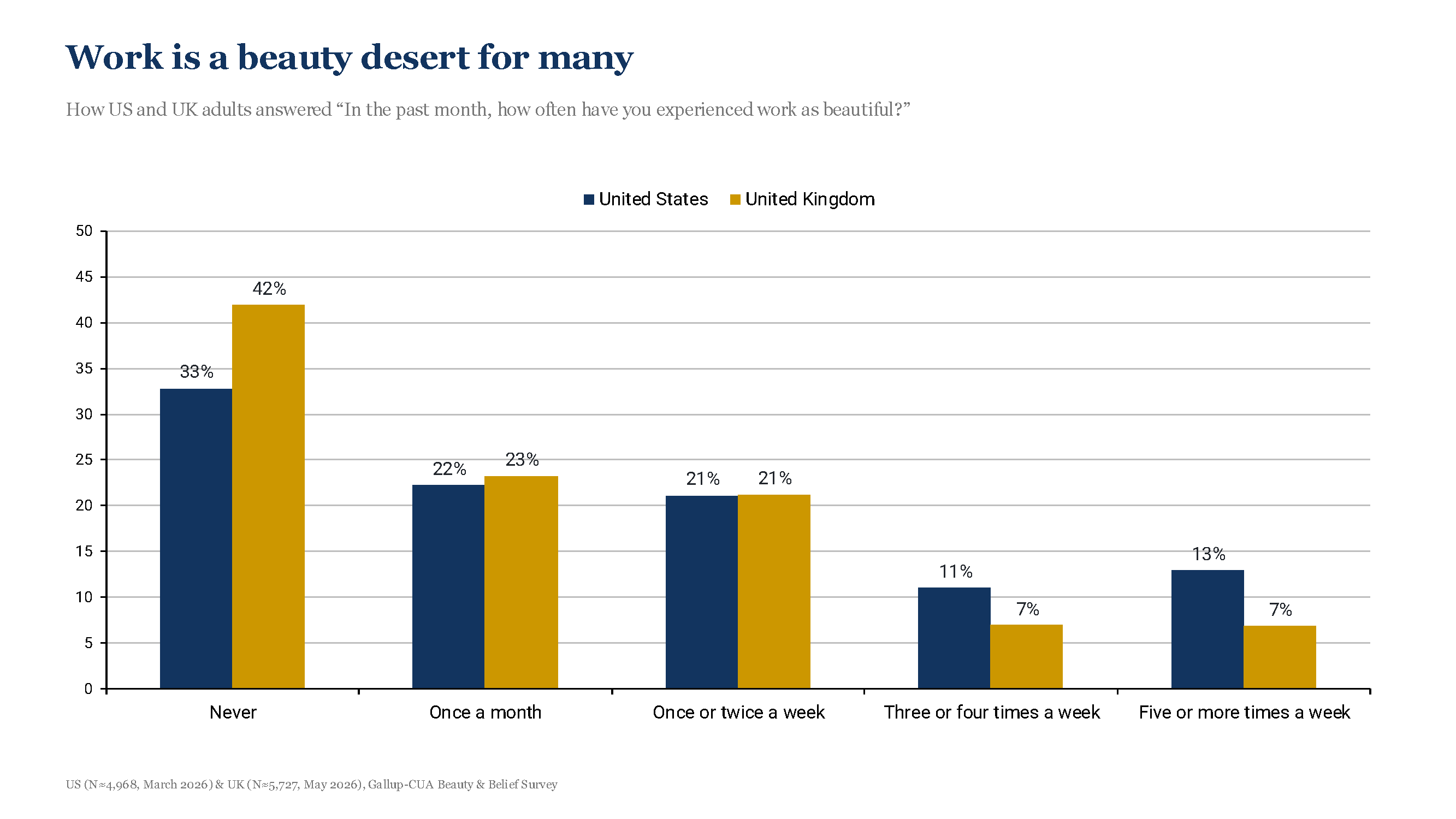
Beauty at work is not a luxury of the well-paid. It turns out to be remarkably even across the income scale: people who feel financially strained are about as likely to find beauty in their work as the comfortable are. Flourishing, by contrast, drops steeply with financial strain.
Beauty does vary by work situation, though. Among people with daily work to speak of, it seems to be those with the most autonomy or agency who find the most beauty in it.
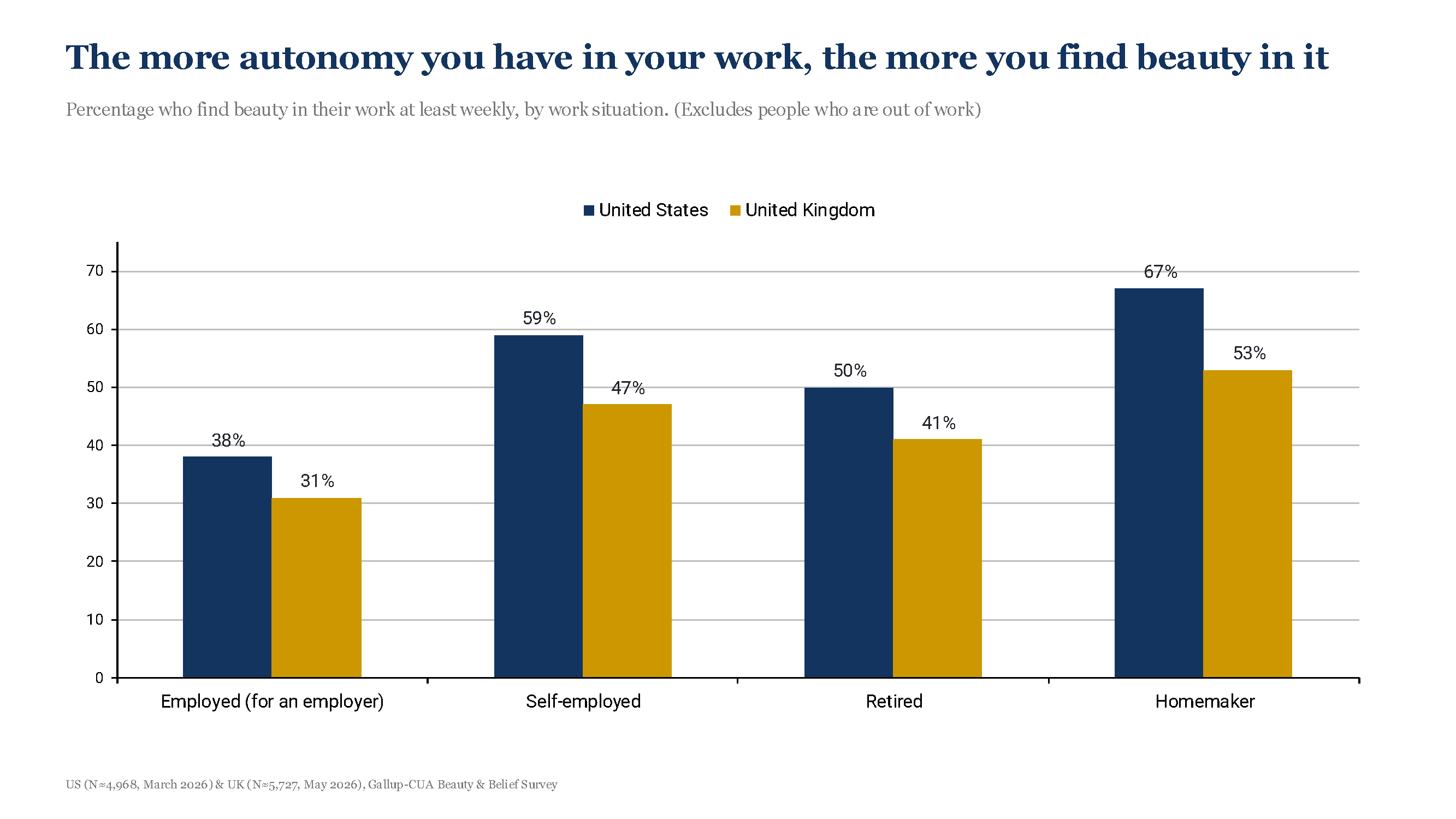
Homemakers and the self-employed report beauty at work most often, the retired come next, and paid employees, who have the least say over how their days go, report it least of all. This holds true in both countries, though Britons sit below Americans throughout, as they do on nearly every beauty measure. Having some ownership over the shape of your work seems to matter for whether we find it beautiful.
People who are out of work, especially those unable to work because of disability, report both the least beauty in their daily activities and, by a wide margin, the lowest flourishing of any group. I have kept them out of the comparison above because their situation is its own story, driven by far more than work, but it would be wrong to leave them unmentioned.
(Note: Setting the out-of-work group aside doesn’t really affect the overall picture. Among working adults, the share who never find it beautiful is about a third in the US and four in ten in Britain, which is essentially the same as for the population as a whole. The beauty desert is not an artifact of who counts as working.)
The people whose work feels beautiful are doing far better
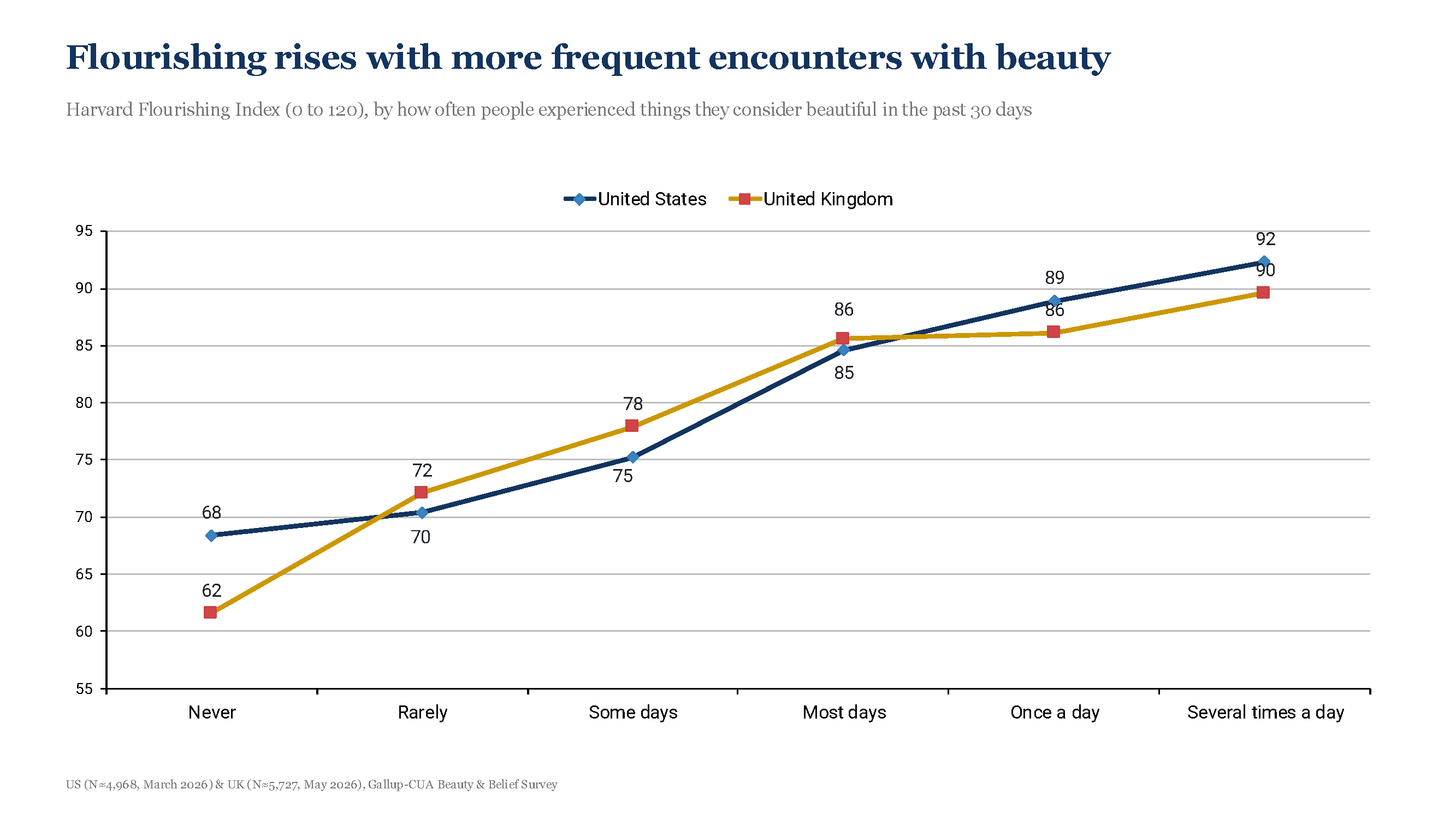
In our study, we measure wellbeing using the Harvard Flourishing Index, which spans happiness, health, meaning, character, close relationships, and financial stability. Plotting this measure against how often work feels beautiful, we see a straightforward linear relationship: people whose work feels beautiful five or more times a week score around fifteen points higher, on a 120-point scale, than those whose work never does. The pattern is nearly identical in both countries.
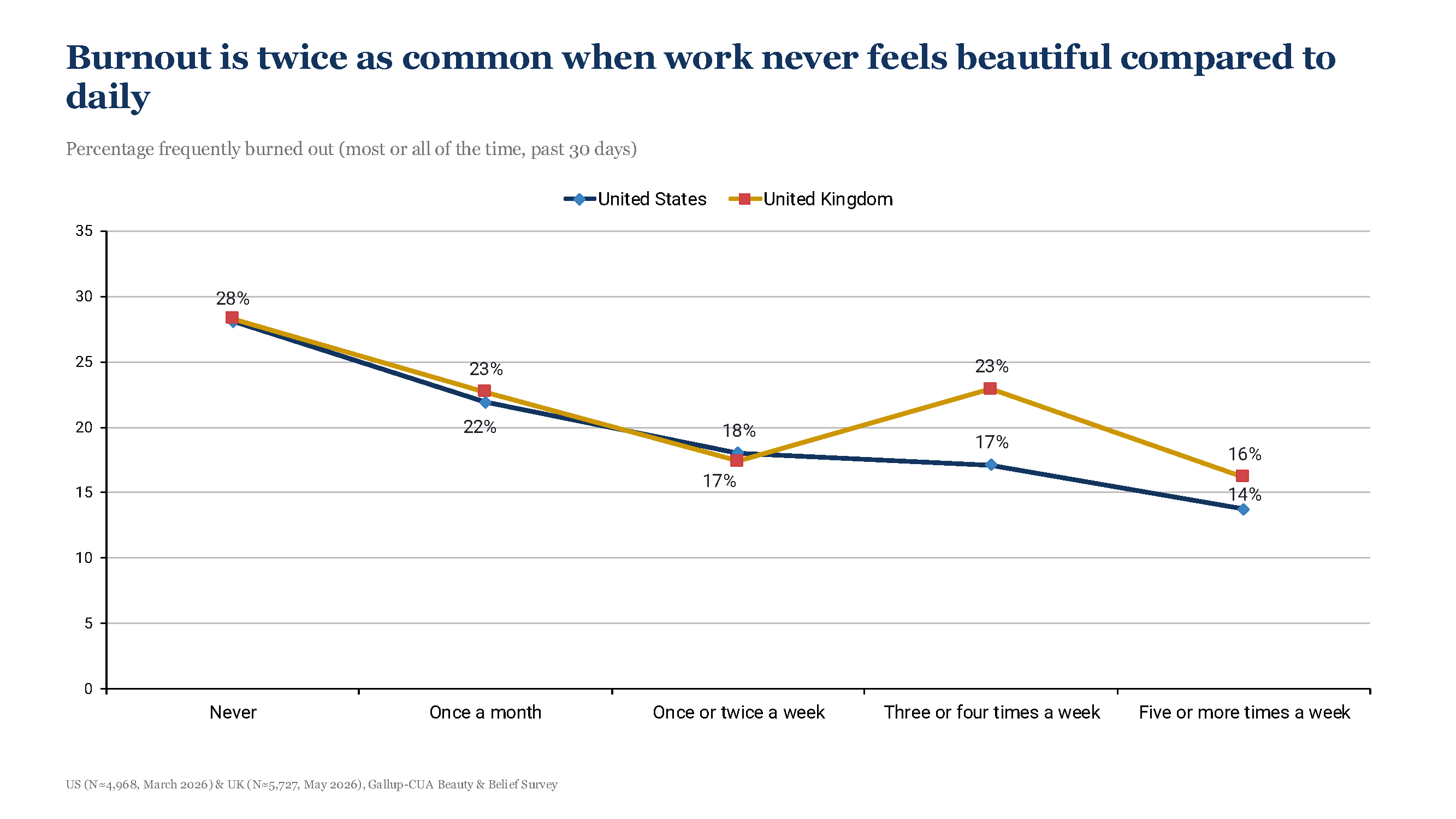
And it runs the other way for psychological distress. Those who never experience beauty in their work report significantly higher psychological distress (nearly double the rate, in fact) than those who encounter it regularly, and the association holds net of controls. Further, among people whose work never feels beautiful, frequent burnout is about twice as common as among those whose work feels beautiful five or more times a week. The same negative slope holds overall in both countries.
As I’ve noted in my previous posts based on this dataset: these are snapshots at a single point in time. They show that beauty at work and wellbeing are correlated, but they cannot prove one causes the other. Perhaps finding beauty in work protects people from burnout. Perhaps people who are already flourishing find it easier to see beauty in their work. Most likely the causal arrow runs both ways. But the relationships are strong, they hold up after accounting for age, sex, education, income, and personality, and they replicate across two countries. How often your work feels beautiful is an indicator that no organization I’m aware of currently bothers to measure.
Where exactly is beauty found at work?
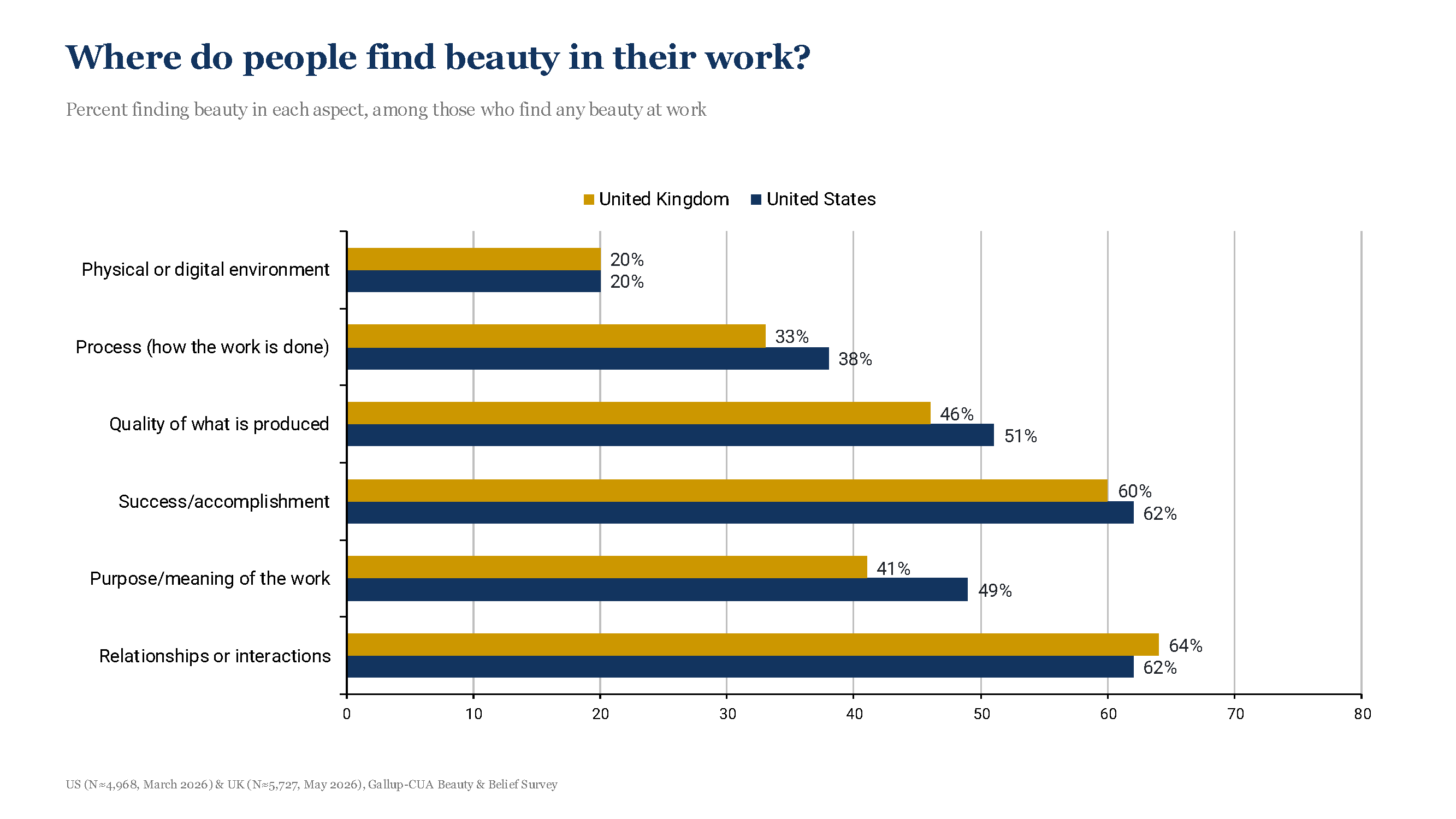
We asked the people who do find beauty at work where they find it, and offered six possibilities: in the purpose of the work, the way it is done, the quality of what is produced, relationships with people, the physical or digital environment, and moments of success or accomplishment. The most common answers are relationships and accomplishment.
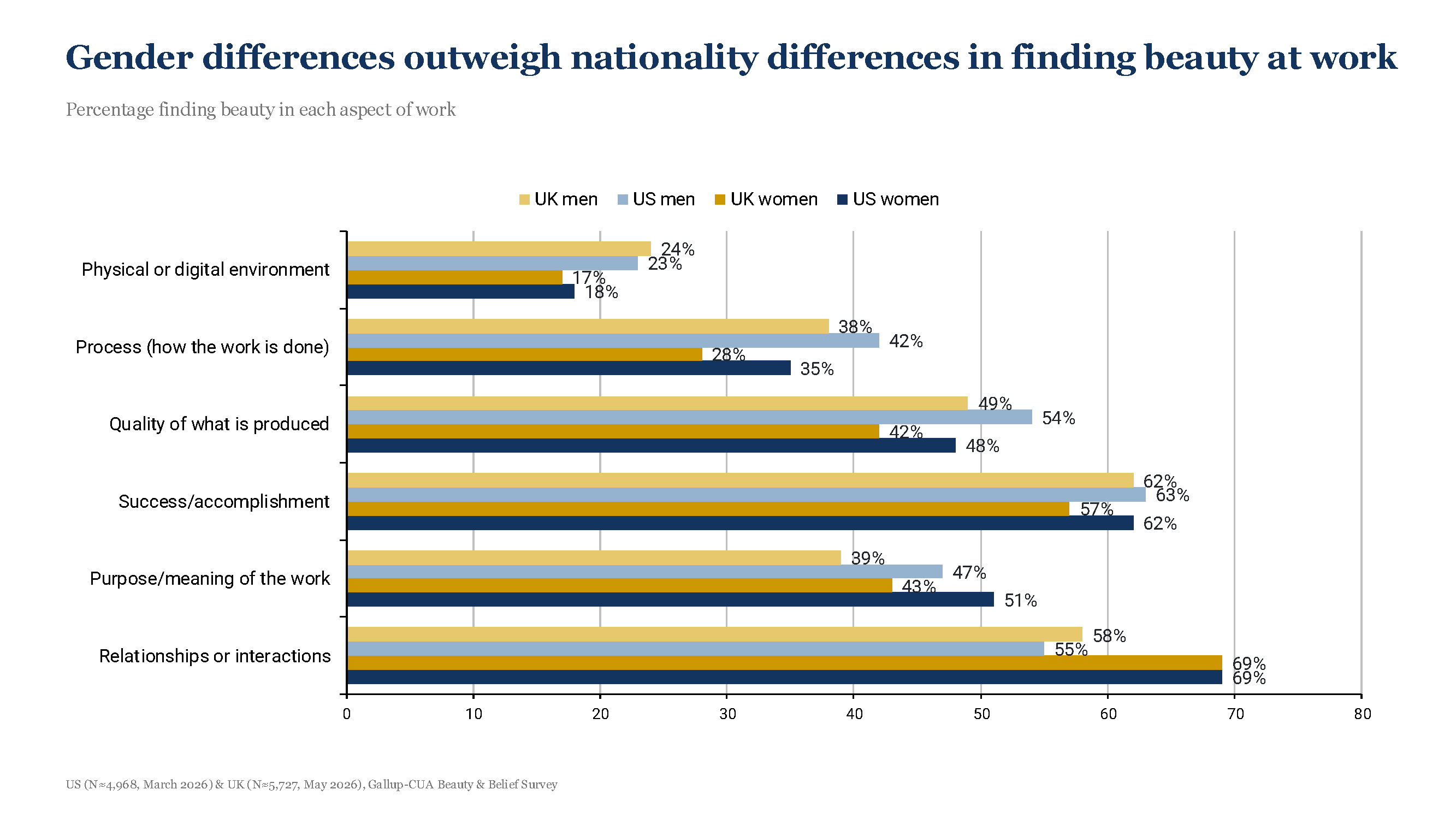
Men and women diverge here, the same way in both countries. Women are markedly more likely to find beauty in relationships and interactions at work. Men on the other hand seem to lean toward the craft, the process of the work, and the quality of what is produced. Beauty in accomplishment is the shared ground: men and women on both sides of the Atlantic find beauty in a job done well in almost equal measure.
Not all forms of beauty at work are equally important
When it comes to their relationship to human flourishing, not all forms of beauty at work are equal. Finding beauty in success and accomplishment is the factor that has the strongest statistical relationship.
To be more precise here: our survey asked where people find their work beautiful, so this is about finding beauty in success or accomplishment, not about success or accomplishment itself. This is not an obvious aesthetic criterion in the way we might consider quality or craft. The reason I included it as an option is because in my earlier research on beauty in science, many scientists identified the sense of accomplishment as an immediate example when asked about where they encountered beauty in their work—when an experiment finally worked, or when they discovered a particular mechanism or made a discovery that nobody previously had. I didn’t expect to find that this would be the factor that mattered the most for the general public in both countries—nor, to be honest, am I fully clear I understand how people are interpreting this.
The beauty found in success or accomplishment is also the only factor that remains statistically associated with flourishing after you account for everything else, including how often their work feels beautiful and the respondent’s personality. Finding beauty in relationships and in the quality of the work matters in raw correlations, but those connections fade under fuller statistical controls, leaving beauty in accomplishment as the one that still stands on its own. Beauty in the purpose or meaning of work adds little once everything else is accounted for. And beauty in the physical environment adds essentially nothing; in Britain it is even faintly negative. You cannot, it seems, decorate your way to a flourishing workforce. (We checked this carefully, including by removing the purpose dimension from the analysis to be sure it was not crowding out the others, and beauty in accomplishment still came out on top.)
Now it could be the case that there’s a difference here between what people report and what their bodies might tell them. As previous research has shown, we might report that we are drawn more to certain environments than others, while physiological measurements conducted at the same time reveals our bodies feel differently. So the value of beauty in one’s physical environment may affect us in ways that we’re not fully aware of.
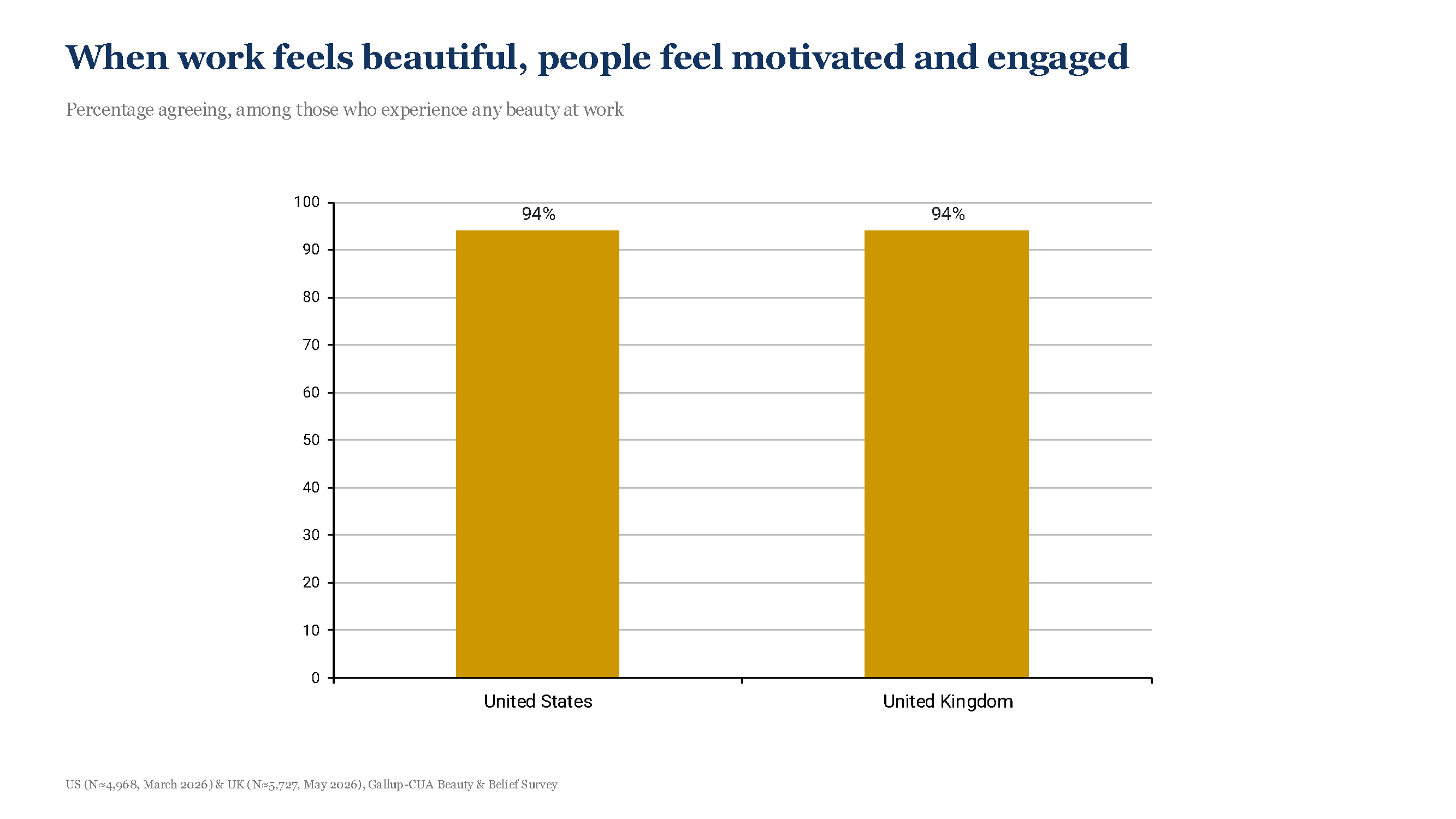
Among people who experience any beauty at work, 94% in both countries agree with the statement that “When my work feels beautiful, I feel more motivated and engaged in what I am doing.” Whatever beauty at work is, people themselves report that it pulls them toward their work.
Implications of our findings
If you lead an organization and care to help people working there encounter their work as beautiful, the practical implication of our results is that the first place to start is NOT to start putting art on your walls and make the office prettier. Rather, it is this: people flourish, and feel most engaged, when their work allows them to regularly delight in a thing accomplished well—something that matters to them that comes to fruition. Much of modern work has been sliced into fragments where the task is never quite finished and the result never quite seen. What our data suggest is that this is not just an efficiency problem; it may be a beauty problem, and downstream, a well-being and engagement problem.
For many people, work is the place that beauty goes to die. This is not something to take lightly, given how much beauty matters for our flourishing. But we can hope that this is less an iron law than a design choice, and design choices can be made differently.
The Beauty and Belief study surveyed nationally representative samples of 4,968 US adults (March 2026) and 5,727 UK adults (May 2026) through Gallup, funded by the John Templeton Foundation. Everyone was asked about their main daily work, including homemakers, students, volunteers, and retirees. All figures are weighted, and the relationships described are cross-sectional. A full report with Gallup is forthcoming. If you would like to explore what these questions might reveal inside your own organization, do get in touch.