

Pope Leo XIV just released his first encyclical, Magnifica Humanitas: On Safeguarding the Human Person in the Time of Artificial Intelligence. It is the most substantive engagement any pope (or perhaps any institutional leader) has yet made with how technology shapes human life. The encyclical is about a lot more than AI or technology, and it’s well worth a read, whether or not you’re Catholic or a person of faith, since it offers important considerations for thinking about our collective flourishing and the future of humanity.
In March 2026, my team and I fielded a nationally representative survey of nearly 5,000 Americans through Gallup. The Beauty and Belief survey, funded by the John Templeton Foundation, was designed primarily to study aesthetic experience, meaning/spirituality, and well-being, but we did ask a few questions about people’s views and usage of AI and social media. So our data, to some extent, are able to speak to concerns the Pope raises in the encyclical: particularly, whether AI is fostering dependency, substituting for relationships, eroding agency, and harming the young.
From our initial analyses, the picture that emerges is mixed, at least at this point in time. Daily AI chatbot users do not score lower on well-being, agency, religious engagement, or creative practice, for instance, compared to non-users. But one of the Pope’s main concerns—that technology may substitute for human connection among those whose social relationships are already fragile—is where the data raise a red flag. And it is noteworthy that the broader population, including the heaviest AI users themselves, seem to share Pope Leo’s concern about this technology.
What follows are preliminary findings from the US data. Peer-reviewed papers are in preparation, and the results of a parallel national survey of the UK population are forthcoming.
Who’s using AI?
We asked survey participants “How often, if at all, did you use AI chatbots like ChatGPT, Google Gemini, Microsoft Copilot, Deepseek, Grok, or others in the past 30 days?” To be clear, there are plenty of other forms of AI besides chatbots and LLMs, but this is what most people nowadays think of when we talk about AI so it’s worth measuring.
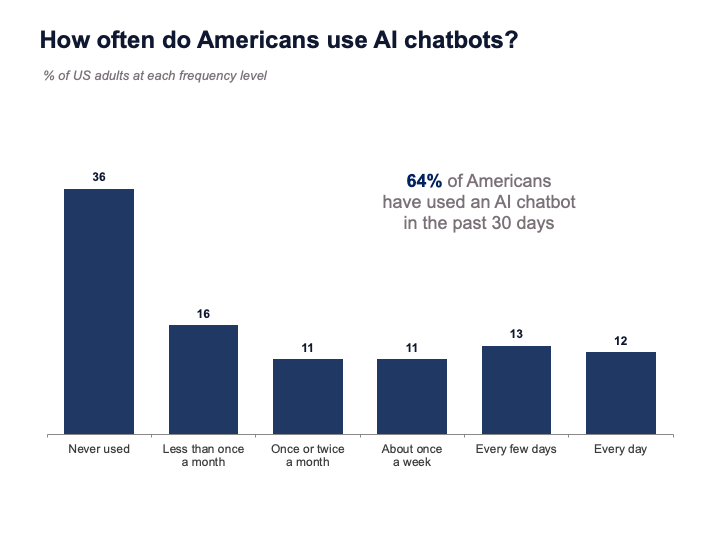
Sixty-four percent of American adults reported using an AI chatbot at least once in the past 30 days. Twelve percent used one every day, and nearly a third have never used one.
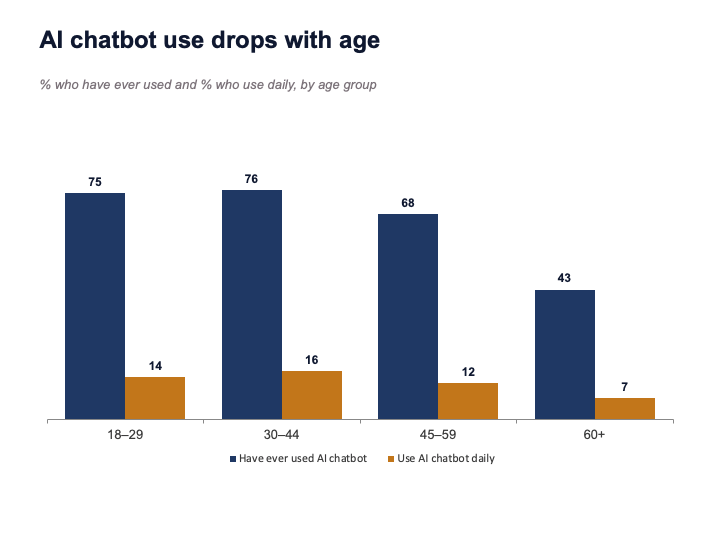
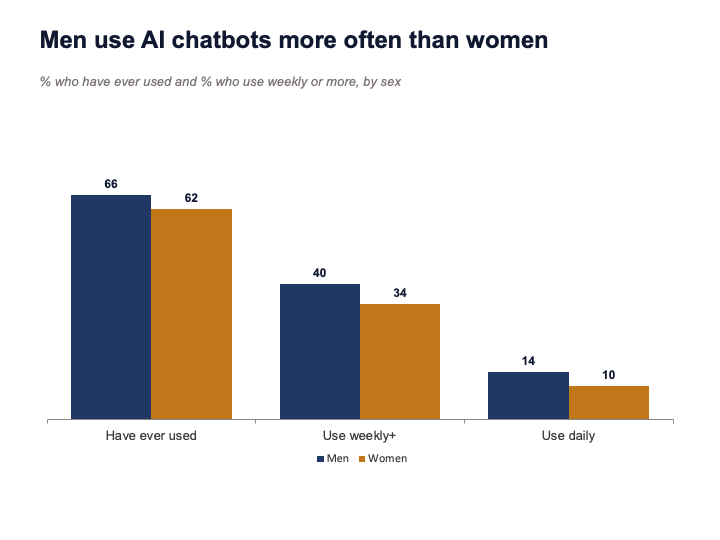
There is, of course, an age gradient, but it’s not as steep as I expected. We find that 75% of 18-29 year-olds have used AI chatbots in the past month, which aligns with other recent probability-sample estimates (AP-NORC, July 2025: 74%; UPenn-Gallup, Oct 2025: 74%, but is lower than a Yahoo/YouGov survey reporting 82%, likely because opt-in online panels overrepresent the most digitally engaged respondents). Three-quarters of adults under 45 have tried AI chatbots; among those over 60, 43% have. Men use AI chatbots somewhat more than women (14% daily vs. 10%), and the gender gap is most pronounced among the youngest adults (where 17% vs 11% respectively use it daily).
A technology that did not exist in consumer form four years ago is now used at least weekly by roughly a third of American adults. It is apt to call this, as Pope Leo frames it, a “change of era.”
Dependency
The encyclical warns us that the convenience that new technologies afford us is not without cost:
“The speed and simplicity with which information, complex analyses, media content and practical assistance can be accessed undoubtedly makes life easier. Yet they can also encourage excessive reliance and the search for ready-made answers, and weaken personal creativity and judgment” (§100).
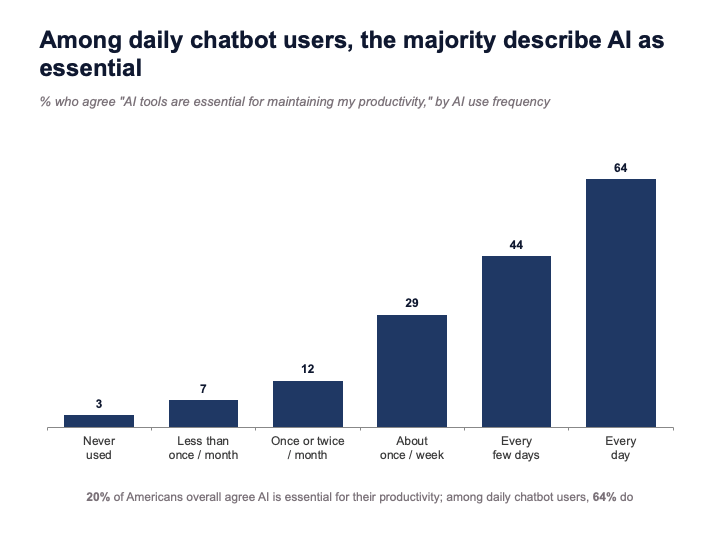
We asked Americans whether AI tools are “essential for maintaining my productivity.” Among daily users, 64% agree. Among never-users, 3% do. That relationship survives statistical controls for age, sex, education, income, marital status, region, employment, personality, and social media use. Daily users describe their relationship with AI as something they have come to need. We can’t tell from our data what their occupations are or what they’re using it for, and whether it’s deskilling them or becoming a substitute for thinking or writing or judgment.
When it comes to creativity, 30% of Americans have used AI to create art, music, writing, performance, or designs in the past 12 months. Among this group, 56% agree with the statement that “AI tools help me produce more creative work than I could on my own.” Our data cannot tell whether they think what AI helps them produce is genuinely theirs, or whether the experience of “creativity” is shifting in ways worth worrying about, but what we can answer is that AI is not (yet) displacing traditional creative practices. Of the Americans who used AI to create something, 99% have also done analog creative work in the past year, such as painting, playing music, writing fiction or poetry, woodwork, etc.
Personal judgment is harder to measure directly in a survey, but the Harvard Flourishing Measure that we use includes three items that come close: how strongly someone feels they understand their purpose in life, whether they “act to promote good in all circumstances,” and whether they “are always able to give up some happiness now for greater happiness later” (measuring delayed gratification). Once we account for the fact that AI users tend to be younger, more educated, and different from non-users on personality and circumstance, AI use turns out to be essentially unrelated to these outcomes.
Social media use shows a different pattern. Heavy social media users, compared to otherwise-similar lighter users, show small signs of what researchers have called “cognitive depletion” including less ability to delay gratification and more feeling that “everything was an effort.” These social-media associations are not particularly strong, but they go in a consistent direction with prior research on heavy social media use.
The data don’t yet show the deskilling Pope Leo and others warn us about, though these measures are worth watching as AI use becomes more widespread—and the danger especially is “never-skilling,” i.e., if younger generations become dependent on AI use without acquiring skills and expertise in the first place.
The creation of dependency on technologies for the sake of profit is a pervasive problem that the encyclical identifies: “When business models thrive on human weakness, the person is treated as a means rather than as an end” (§170). That this is fundamentally a business model problem rather than a technology problem is a point that both Sherry Turkle and Bob Putnam made in my conversation with them in 2025. The creation of dependency is by design, and is a form of exploitation.
This mechanism is especially pernicious in the case of social media, which has been explicitly engineered around variable-ratio reinforcement, infinite scroll, and push notifications. AI dependency in our data is functional (people come to rely on AI to do things) but social media dependency tends to be affective (people reach for it to escape boredom, anxiety, or loneliness). Our survey, unfortunately, isn’t designed to measure the latter sort of thing, but we can at least compare where serious psychological distress is concentrated.
Technology and Distress
The following chart shows the percentage of Americans who score above the standard clinical cutoff for serious psychological distress according to the Kessler-6, used worldwide as a screening tool for diagnosable mental health conditions. About 12% of our weighted sample scores above the threshold. (This is quite elevated relative to the nearly 6% rate in recent federal in-person surveys, but online surveys consistently produce significantly higher psychological-distress estimates than interviewer-administered surveys. Further, young-adult distress has remained elevated since the pandemic, and our data were collected during a period of significant macroeconomic and geopolitical strain, which is reflected in the steep income gradient on the psychological distress measure).
When it comes to psychological distress, we find that AI use doesn’t seem to make a difference. Whether someone has never used AI or uses it every day, the rate of serious distress is between 11-14%. On the social media side, the rate rises from 6% (among those who use it under 30 minutes a day) to 25% (among those using it four or more hours a day), roughly a fourfold increase. Even after adjusting for demographics, employment, and personality, the heaviest social media users meet the clinical distress threshold at about twice the rate of the lightest users.
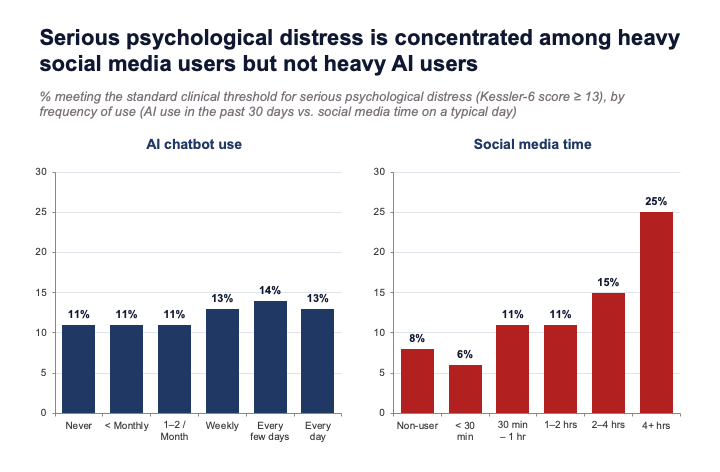
This is consistent with other recent studies. The social media literature continues to find consistent associations with worse mental health outcomes. Gallup polling found that by 2023 teens averaged nearly 5 hours a day on social media, a pattern coinciding with the steep rise in adolescent mental health concerns over the past decade. A systematic review and meta-analysis published in JMIR in late 2025, on the other hand, examined randomized trials of AI chatbots for adolescent and young adult mental health and concluded that they seem to show modest benefit in reducing psychological distress. But the AI literature is mixed. Other recent research shows daily AI use to be associated with increased depressive symptoms. Common Sense Media’s 2025 report finding 72% of teens have used AI companions, and the APA’s 2025 advisory warning that AI companion chatbots can cause harm to vulnerable users, make clear that AI use carries risks of its own, especially for emotional reliance among young people. For such demographics, the use case may be closer to social media than the productivity-oriented AI use we see in the general adult population, and may serve to foster dependency, distress, and disconnection.
AI and human (dis)connection
As Pope Leo notes:
“The artificial imitation of care or support can become particularly risky when it enters contexts where real relationships and emotional bonds are lacking. Here, the danger is not so much that a person may believe they are communicating with another person, but rather that they may gradually lose the very desire to form genuine human connections” (§100)
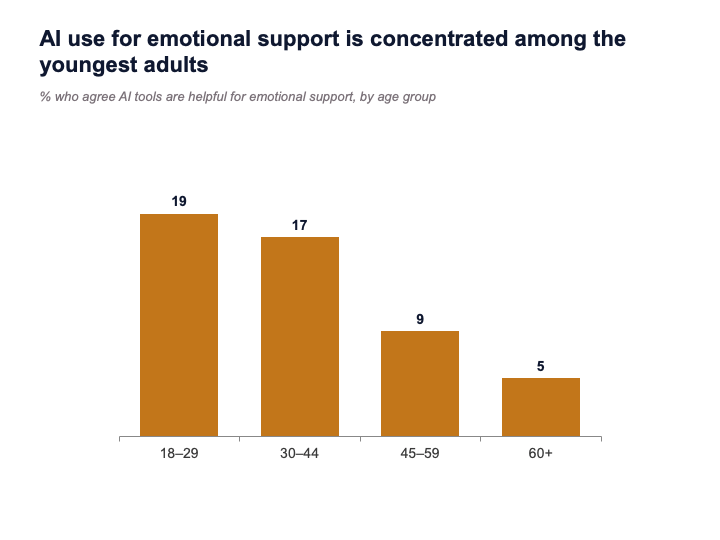
Twelve percent of Americans agree that AI is “helpful for emotional support.” When we look at the underlying age distribution here, it is concentrated among the youngest adults (19% of those under 30, compared to 5% of those over 60).
Of those who find AI tools helpful for emotional support, 23% score above the standard clinical screening threshold for serious psychological distress on the Kessler-6, which is more than twice the rate among Americans who don’t use AI for emotional support (11%). Much of this gap reflects who turns to AI for emotional support: younger people, those higher in anxiety, those with fewer close relationships. But the gap remains substantial after we control for plausible alternative explanations we could think of including age, sex, education, income, marital status, region, employment, personality, social media use, and general AI use. Adjusting for all of these factors, those using AI for emotional support are still nearly twice as likely to be in serious psychological distress than those not using it this way.
Two cautions are warranted here. First, our data are a snapshot at a point in time. We can’t tell whether technology is causing the depletion or whether people who are already depleted are reaching for technology. Longitudinal and experimental research is needed to assess causality. It’s likely that the relationship here is mutually reinforcing: distressed people reach for AI, which substitutes for human contact in ways that may deepen isolation and drive further reliance. Second, general AI use shows no relationship with these outcomes; it is using AI for emotional support that is the concern here.
Pope Leo is right to be concerned about what technology might be doing to us here. As are most Americans.
The majority of Americans are worried about AI
A majority of Americans (57%) agree that “the long-term risks of AI outweigh its potential benefits for humanity.” It is shared across nearly every category of person we measured. Sixty-two percent of 18-29-year-olds hold this view, the highest of any age group (which makes sense given all the recent booing of commencement speakers who promote AI).
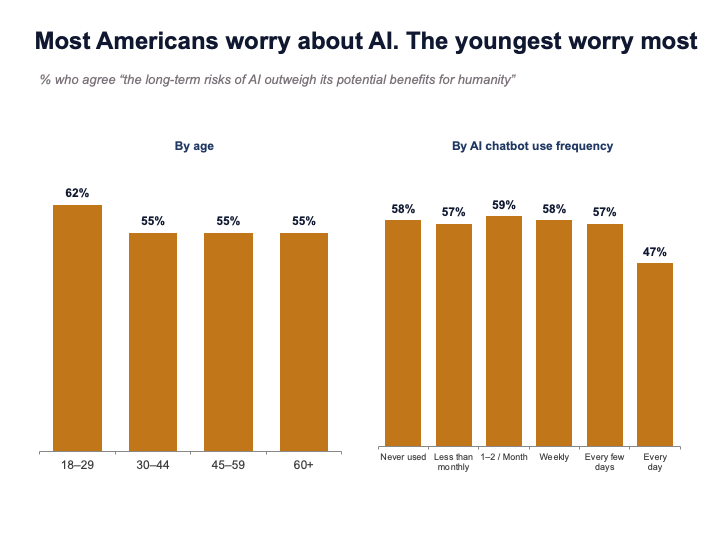
The high level of concern is consistent across use frequency of AI chatbots from never-users (58%) to weekly users (58%), and only drops among daily users to 47%. Even there, nearly half of the heaviest users believe the technology they use every day, on balance, do more harm than good.
Daily AI users aren’t eager techno-optimists. Of the 12% of Americans who use AI chatbots every day, almost a third (31%) say both that AI is essential for their productivity and that its long-term risks outweigh its benefits. They use it, they have come to need it, and they are worried about it. Another 16% of daily users hold the concern without finding the tool essential. Only about a third of daily users (34%) endorse AI’s value without the concern.
People increasingly cannot stop using a technology they themselves judge dangerous. Even when we look only at AI users, the youngest are the most worried (60% of 18-29 users). The standard picture of young people as eager early adopters is not what we’re finding. The young are simultaneously among the heaviest users and are the most concerned. They are not naive about what they are using and seem to distrust it but are choosing it anyway.
Given these findings, the Pope is right about “the urgent need to promote technologies that strengthen interior freedom by fostering education in digital sobriety and the protection of minors, thus countering models that exploit vulnerability” (§170).
Evaluating AI today
Drawing on John Paul II’s Redemptor Hominis, Pope Leo asks:
does AI “make human life on earth ‘more human’ in every aspect of that life? Does it make it more worthy of man?” (§129)
The latest data from the US population say: in some respects yes, in some respects no. The broad worries about AI hollowing out human flourishing find limited support at the population level—at least at this point in time.
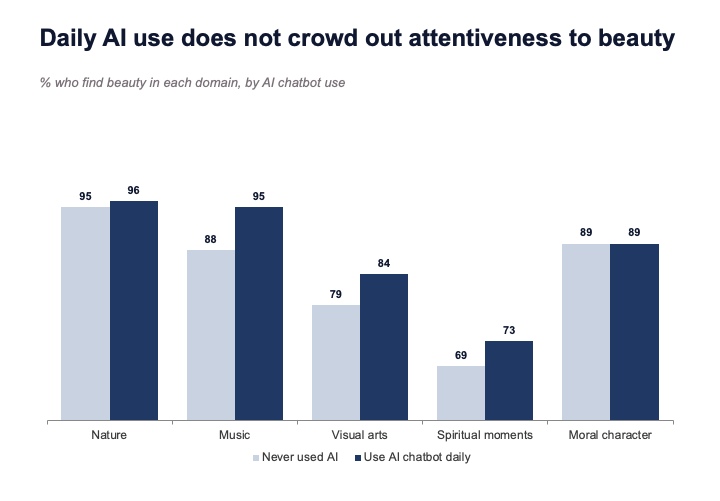
For instance, AI use is not crowding out attention to beauty. When we consider daily AI chatbot users versus never-users, across five domains—nature, music, visual arts, spiritual moments, and moral character—AI use, at least at this point, is not inhibiting people’s encounters with beauty in the world. The same is true for social media frequency. We also looked at items that get at attention and time: whether people report experiencing beauty in their daily lives, noticing beauty in ordinary moments, and feeling awe and wonder. On these measures, neither technology is meaningfully associated with diminished attention to beauty in everyday life. I must confess I found this surprising.
AI use is also not currently displacing religious practice. AI users look slightly less religious than non-users in raw comparison, but this is because younger people use AI more and are less religious to begin with. Once we include controls, AI use shows no detectable relationship with how often people attend religious services, how important they say religion is to them, or their sense that what they do in daily life is worthwhile. We also don’t see any statistically significant differences between Catholics who attend Mass at least once a week and others when it comes to use and views of AI and social media.
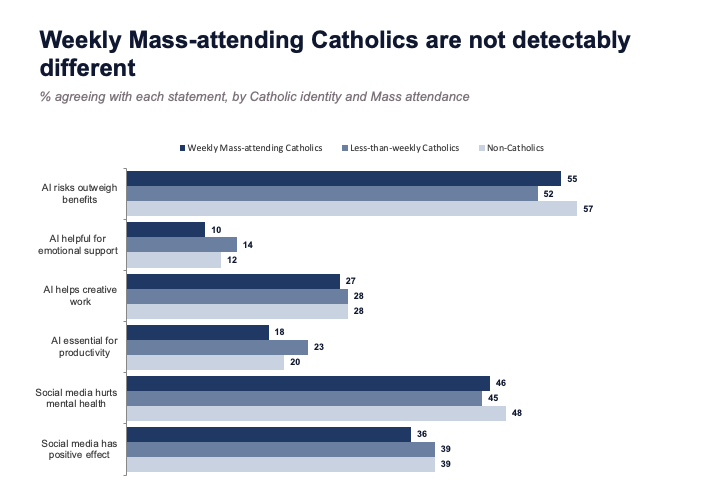
But while AI users are not less religious on these institutional measures, they are more religiously mobile and more spiritually active in other ways: daily users are more than twice as likely as never-users to say they belong to a different religion now than they did five years ago (13% vs 5%), more likely to say religion has become more important to them in the last five years, and more active in private spiritual practices such as meditation, prayer, yoga, and finding spiritual meaning in nature and exercise. They also report reflecting more often on the meaning of life and yearning more strongly for spiritual experiences. These patterns hold net of demographic, personality, and social media controls. On average, the more frequent AI users look more like spiritual seekers than secular rationalists.
Nevertheless, the encyclical’s concern that AI may substitute for human relationships among those whose relationships are already absent seems to be borne out in our data. And the broader public is more aligned with Pope Leo’s concern than the public conversation about AI might suggest, evident in our finding that most Americans, especially among the youngest adults, believe the long-term risks of AI outweigh its potential benefits.
In light of our data, then, one of the key arenas in which technology needs to be urgently “disarmed,” as the Pope puts it, must be in its relationship to the vulnerable who are likely to be manipulated by it.
Magnifica Humanitas offers several clear criteria to help us evaluate new technological innovations in view of their contribution to the common good. Several of its themes—on the idolatry of AI; on loneliness, faith and love in an age of machines; and on preserving human agency and human connection in an age of AI—have been the focus of recent conversations on the Beauty at Work podcast. I’m especially grateful that the encyclical offers careful claims which are testable, and allows evidence to actually engage with them. Already, scholars such as Allison Pugh and Sherry Turkle and others have documented the forms of relational substitution, dependency, and de-skilling produced by these technologies—not to mention the broader forms of extractiveness and exploitation (which I’ve referred to as the DEF logic that governs business and tech) involved in the production process).
The encyclical’s deepest concerns about AI, however, lie beyond what survey data can capture. It raises vital questions about whether these new technologies are reshaping public truth and how the political economy of their development is concentrating power in ways that threaten human freedom and the common good. We need to urgently mitigate these challenges as best as we can. But we’d do well to approach them in the spirit of (Tolkien’s) Gandalf’s words that the Pope leaves us with:
“It is not our part to master all the tides of the world, but to do what is in us for the succour of those years wherein we are set, uprooting the evil in the fields that we know, so that those who live after may have clean earth to till.”