

I usually write here about the power of beauty to move us toward meaning and flourishing. But this is a more personal piece about the shadow side of beauty, and how it can mislead us. If you don’t know who He-Man is: he was the musclebound hero of a 1980s cartoon and toy line (and every so often, a movie). Very much the sort of thing a kid could build an entire inner world around. I was that kid.
My best friend in third grade was the short, skinny kid who sat a row ahead of me in class. Ajay was the first classmate to invite me over to his place. I rarely visited other kids’ homes until then—I usually just played outside with neighbors—so taking a different bus home with him after school a few days later felt like an adventure. Stepping into his place, it turned out, would be a portal into a new world.
Ajay’s mother, as well as his brother, Vijay, who was a year younger, welcomed me at the door when we arrived, hugging me like a long-lost relative. “Come, come!” the boys urged me in as their mother hurried off to finish cooking. We washed our hands and sat around the table, as their mother brought out some dal and roti—a North Indian staple which our family, which is from the South, seldom ate. It was the sort of meal I had seen heroes eat in Bollywood movies, and maybe that’s why it tasted exquisite. Their home was orderly, with couches and side-tables and display cabinets that looked as though they were from a magazine, and their dining table, it struck me, was actually used as a table, where they ate together as a family. At my place, each of us ate on our own, and our dining chairs remained covered in the dusty plastic in which they came from the furniture store; like our cabinets, they served mostly as storage space for stacks and stacks of Daddy’s files.
Ajay’s family lived in an elegant apartment complex about a fifteen minute drive from our place in Muscat, the capital of Oman. My parents moved there shortly after I was born, for better work and steadier income than they could find in India. Daddy worked as an engineer, and Mummy as a doctor until about a year earlier when my younger brother was born. They preferred to keep to themselves and seldom had visitors. Mummy didn’t like cooking and she made it known; she had, after all, spent years preparing to be a doctor, graduating from one of India’s top medical schools with a gold medal, not expecting to become a full-time homemaker in a foreign country. For my part, I hated her cooking. A staple meal was a warm sludge of spinach served with rice, washed down with a cold sludge of pulpy apple-orange juice. The mothers and children I saw on TV were always smiling, while Mummy usually frowned as she fed me. “My duty is to feed you,” she would say, which made me feel like a burden.
At Ajay’s table, as I watched the brothers devour their own servings, praising their mother like the heroes in a Bollywood scene, I wondered what it must be like to live in a home where you enjoyed your mother’s cooking and where your parents encouraged you to bring your friends over to play—and as I would soon learn, even bought you toys.
“Hey, you want to play with He-Man?” Ajay asked after we ate.
“He-Man? What’s that?” I laughed. It sounded like a grammatical error: I-boy, you-boy, he-man.
“What? You don’t know He-Man?” Ajay asked in surprise. He thrust a half-naked action figure into my hands.
He-Man is a powerful warrior in a land called Eternia, who wields a magic sword that transforms him from a puny prince into the most powerful man in the universe. He has thick, blond, shoulder-length hair with blunt bangs, brown loincloth, brown boots, an X-shaped chest-plate, and biceps the size of his head.
The only action figures I had ever seen before were GI Joes—tiny, green, immobile soldiers with no personalities—which someone gifted me when I was younger. He-Man action figures, on the other hand, were beautiful. They were sturdy and well-sculpted and at least twice the size of the GI Joes; you could move their heads and arms and legs, and they came with detachable weapons.
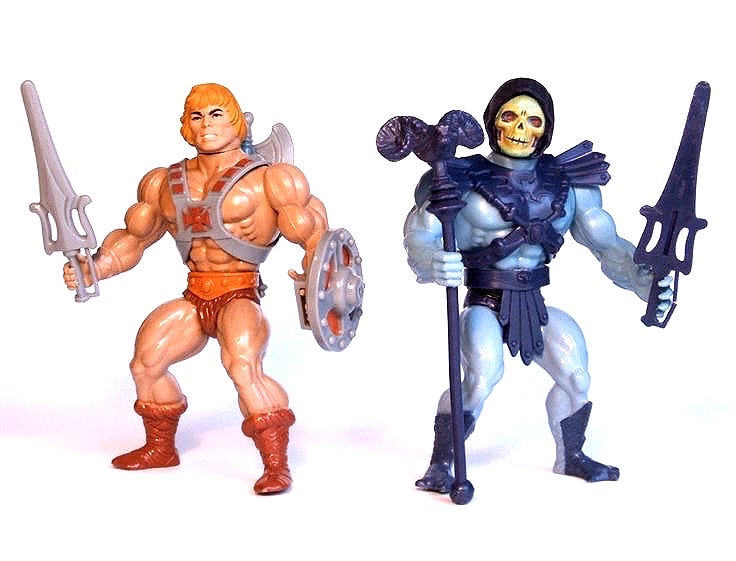
While his brother came over with another toy—He-Man’s nemesis, the blue Skeletor—Ajay popped in a VHS tape. “You have to see the cartoon,” he insisted. The experience of watching a cartoon show about a powerful hero and being able to play with the same toys was extraordinary. After one episode, I was hooked. I returned home thinking I absolutely had to watch more of this show, and started renting them at the video store.
He-Man toys, Ajay told me, weren’t available in Muscat. He bought his toys in India, in a city which he described as an enchanted land with pink sand, palaces, and toy stores galore. It may as well have been Eternia.
The boys had a small collection of toys, but I liked He-Man himself the best. Rotate him at the waist and he snapped back, delivering a powerful punch. His legs were slightly bent so you could make him walk. He could hold a sword in one hand and a shield in the other. Making him hold his sword aloft, I sang out his catchphrase: “By the power of Grayskull! I have the power!” before pummeling the evil Skeletor. I felt powerful holding the toy.
***
A few weeks later, I accompanied Daddy one evening to Al Fair, a new department store near our place, to pick up some craft supplies for school. Wandering down a couple of aisles from the Stationery section, I discovered they had toys. Shelves and shelves of toys. And as I scanned the section casually, I stopped in my tracks. Right in front of me, staring at me through the window packaging, was a brand-new action figure of He-Man. Not just the version Ajay had but “Battle Armor He-Man,” with more accessories. Next to it, three rows of He-Man toys were arrayed on the shelf, including several characters that Ajay didn’t have.
Giddy with excitement, I pulled Battle Armor He-Man off the shelf and ran to my father. “Daddy, Daddy! Look they have He-Man toys. Can you buy this for me? Even Ajay doesn’t have this one!” He looked at the price tag and scowled. A single toy cost about ten times the price of a video cassette rental. “No, no, it’s very, very expensive! Don’t buy such useless things. Such a waste of money!”
“Please, please Daddy!” I insisted.
“No, these toys are all worthless. Don’t waste your time playing stupid toys.”
The excitement drained out of me. I felt paralyzed, holding the toy—I couldn’t imagine putting it back. I started to cry and begged him repeatedly, not caring about the scene I was making, but he refused. “No! Go put it back!” he shouted eventually. “You have to focus on studying, not playing useless toys!”
Sulking at home, I couldn’t stop thinking about the toys, and fantasizing how elated Ajay would be when I took the toys over to his place. I tried to reason with Daddy; I told him that Ajay’s father bought them for him (neglecting to mention that they bought their toys in India, where they were much cheaper). Ajay’s father, Daddy reminded me, was a “rich man” with a Mercedes Benz, while we were “just poor middle-class people.” My father owned only four sets of shirts and trousers and could barely meet the fees at the private school he was sending me to. I understood none of it. I only knew I wasn’t getting the toy. I cried even more, resenting Daddy for his refusal, for the unfairness of it all.
I couldn’t appeal to my mother for help because by this time, she had started acting strangely, slipping in and out of a world the rest of us couldn’t see. She told us she saw a stranger in our apartment, who suddenly vanished. On another occasion she heard someone at the door and then went chasing through the building to find him. She also started talking to invisible entities. Daddy seemed not to notice; he was seldom home. My own reaction was some combination of fear, bewilderment, and disgust. It made the life I glimpsed in Ajay’s family feel impossibly distant.
I tried a couple of more times to get Daddy to buy me a He-Man toy when we returned to Al Fair, but he refused each time, ever more sternly, and threatened not to take me to the store if I persisted. I resigned myself to staring at them longingly, pulling them off the rack, imagining playing with them, and putting them back. The toys became totems for me—they were charged with the power of a magical world in which there was a clear good and evil, where good was ultimately triumphant—and they grew in their appeal as the chaos in my own life intensified.
***
“Did your teachers tell you are a good boy?” Daddy would ask me every evening. Work hard, do well at school, and you’ll be recognized as a good boy. It was the recipe he’d followed his whole life, though even at nine, I had begun to notice how little it had returned him, with his complaints about how poor we were, his regular layoffs or reassignments, and how our apartments seemed to be getting smaller and not bigger with each new job.
Still, I tried to follow his maxim, and typically did pretty well at school. But that year my teachers were especially awful. They went out of their way to be unapproachable, strict, and swift to punish. They were like traffic cops, sworn to maintain order as they directed us in straight lines with our fingers on our lips from classroom to auditorium to the field outside for marching drills.
One day, a few weeks after I discovered He-Man toys at Al Fair, our classroom ran out of chalk, and the teacher, a plump woman in a gaudy sari, scanned the room and settled on me: “You boy, go and get some chalk from another class.”
“Yes teacher,” I replied automatically, and ventured out into the hallway.
Classes were in session all around me. I entered one of the rooms, not thinking to knock. It was silent as the class was engrossed in a test. “What do you want?” the teacher snapped.
“Teacher, chalk, teacher…” I stammered.
“No! Can’t see we are having a test? Get out!”
I walked slowly from class to class, peering into windows; I didn’t find an empty room, and I didn’t want to interrupt another class and get yelled at again. I roamed the floor above and below ours, and by the time I returned empty handed, the teacher had already managed to find chalk from somewhere. She was furious to see me.
“Useless fellow! Wasted the class time roaming around, haa?”
Before I could utter a word, her hand lashed across my face. The ringing in my ear felt worse than the sting on my cheek, and the warm tears that followed were a strange relief.
“Kneel down, and put your hands up for the rest of the class. Horrible fellow!”
I knelt in front of the class, trying not to look at anyone. Fortunately, the bell for the class period rang soon after, and I returned to my seat and tried to pretend nothing happened.
On tests, I usually scored full marks, but evidently it wasn’t enough to escape humiliation. Corporal punishment was our teachers’ default reaction to both sins of commission and of omission. Forget to do your homework, forget to get your parents to sign something, and you’d be eligible for some sort of beating. I hated the capriciousness of it all, which left me wondering whether there was any point to being a “good boy” in such a world.
***
That evening, still seething, I was flipping through the pages of my school planner where I had recorded my homework assignments for the next day, and noticed the pages at the back for absence notes that had to be signed by parents. On the few days I had been ill, Daddy simply wrote “Sick” and signed his name.
An idea occurred to me. I tore a couple of sheets from a notebook and practiced his signature repeatedly until I could imitate it. Then I wrote the next day’s date and “Sick,” imitating his hand as well as I could, added his signature, and closed the planner as though sealing a pact: I was not going to school the next day.
We lived on the middle floor of a three-story walk-up. The next morning, instead of heading downstairs to wait outside for the school bus, I went upstairs. The windows of our flat didn’t face the front of the building so my parents couldn’t see if I was outside. I knew from being late once that if I wasn’t there, the bus driver wouldn’t wait. I hid upstairs until Daddy left for work. And then, I was free.
Mummy was home with the baby and never ventured out. So, I left my schoolbag in the utility closet on the top floor and wandered to the shopping complex. I felt like I was walking on air.
I ventured to Al Fair where the He-Man toys lived. I pulled them off the shelves and imagined playing with them. Eventually I had to put them back since I couldn’t afford them. I bought a packet of chips with my lunch money and wandered around until school let out, and returned home.
At school the next day, I borrowed a classmate’s notes to catch up. I now had a new route to freedom. Skipping school became routine. Every few weeks, I wrote “Sick” in my calendar and forged Daddy’s signature. Each time I returned home from the store, I couldn’t stop thinking about the toys. If only I could buy them. I don’t know what I wanted more—the fun of playing with Ajay and Vijay, or the boys’ admiration and even envy that I possessed toys they didn’t have.
***
One evening, I watched Daddy after work placing his wallet and keys on the coffee table. As he walked away, I decided that if he wasn’t going to give me money for the toys, I would take it. “All my money is for your future only,” he liked to say, especially when refusing me something I wanted. I convinced myself I was just taking an advance. I took a deep breath. As soon as I heard him turn on the shower, I scooped up the brown leather wallet, pulled out several colorful Rials, and quickly placed it back on the table and ran to my room to hide the bills in my bag, my heart pounding the whole time.
The next day, I skipped school again and bought my first two He-Man toys: Battle Armor He-Man and Skeletor. Now I could play with them at home just like I did at Ajay’s place.
A few days later, I took more money and bought more toys. The third time, I took too much; he noticed he was missing money that he had planned to use for something, and yelled at me. I denied it at first, and eventually handed a few bills back to him, less than what I stole, insisting that was all I’d taken.
Daddy figured out the new toys that I claimed I borrowed from friends were purchased with money I stole from him. He started hiding his wallet, but I watched him carefully. And every few days, when he bathed, slept, or watched TV, I would steal small amounts so he wouldn’t notice.
Mummy didn’t seem to care. She made sure I did my homework, and made sure to cook and feed me, but otherwise became increasingly withdrawn, talking to people no one else could see, and sometimes went into a trance, staring at the wall.
I began to build my own world with the toys I procured, but as much as I enjoyed playing with them, and the feeling of recreating Eternia, there was something more fundamental driving me. I wanted not just what Ajay had; I wanted to be Ajay. I wanted to have a family that would welcome kids over and show them the same hospitality that Ajay’s family had shown me. But I couldn’t have Ajay’s life, or home, or mother. The best I could do was to try to get the toys he had and desired.
***
One weekday afternoon when visiting the toy aisle in Al Fair, I saw a new action figure: Orko, He-Man’s tiny sidekick—a little magician with a red robe and pointy hat, who regularly got into trouble for doing something he shouldn’t have done.
Ajay didn’t have Orko either. And I didn’t have enough (stolen) money to pay for it. So I decided to steal it.
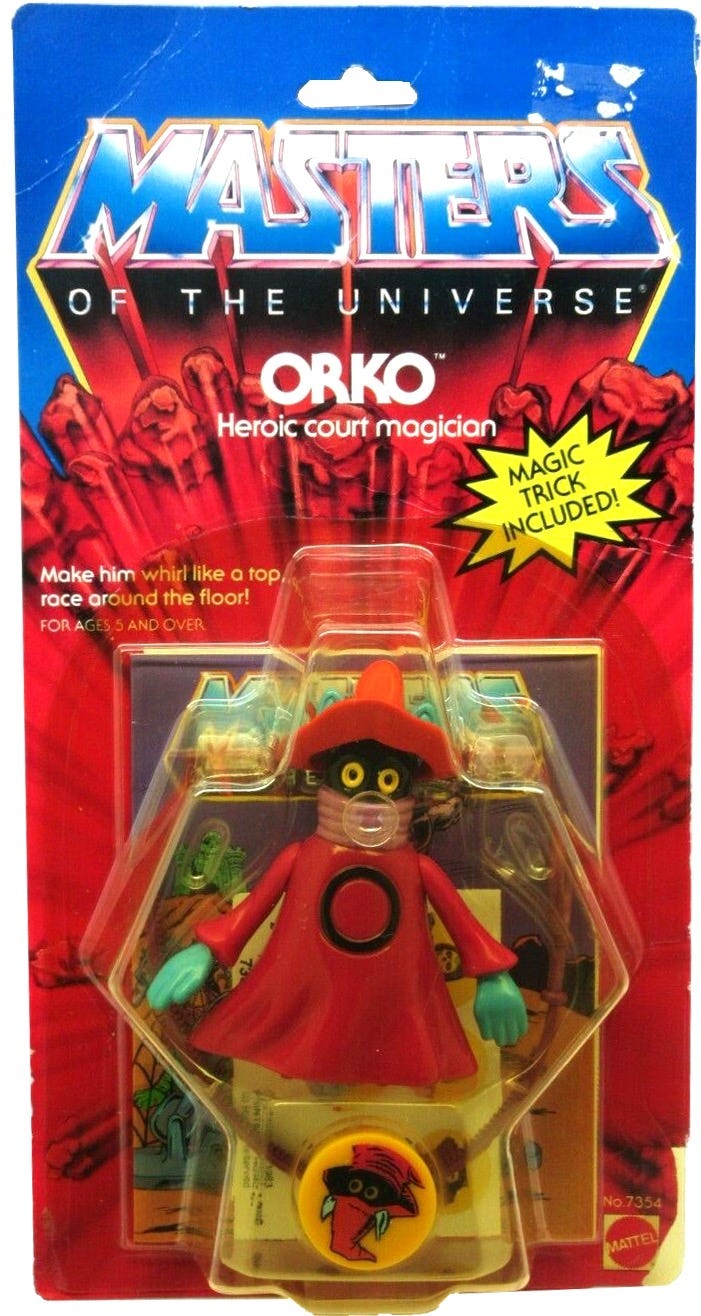
The store was nearly empty. After making sure nobody was watching, I peeled off the cardboard backing from the plastic, slid out the toy, and placed the empty package at the back of the rack. I slipped the toy into my pocket and untucked my shirt. I could feel my hands sweating. I walked to another aisle and bought a candy bar with the money I had in my other pocket. Once I left, I trotted home as quickly as I could. It was exhilarating.
The next time I visited Ajay, my schoolbag was stuffed with my spoils, about eight or nine toys. The boys’ eyes widened when I pulled out new toys that they didn’t have in their collection. And they seemed to pop out of their skulls altogether when I added what the toys cost in Al Fair. “Wow, so expensive! Our dad would never buy them,” Ajay said. “It’s so much cheaper in India.”
I nearly blurted out that my dad would never buy the toys either.
The next day, I took my toys to class to show off. Friends who knew how expensive the toys were also expressed how lucky I was. I even let my friends borrow some of the toys, hoping it would make the lie seem real. “Man you’re so lucky your parents bought these for you,” a classmate told me, and I nodded along, trying to imagine my parents in the light in which I portrayed them, liberally lavishing me with toys.
I never told anyone I stole them, or that I bought them with money I stole from Daddy. And the toys themselves couldn’t give me what I wanted—the hospitality and belonging that I experienced at Ajay’s home.
Something about the whole experience of sharing the toys with my friends seemed awfully disappointing, but I couldn’t figure out why. Wasn’t this what I wanted?
***
Every He-Man episode had an explicitly stated moral at the end, like “The people who succeed are those who work hard,” or “When you boast, you ruin the fun for everyone.” If there was ever a message like “crime doesn’t pay,” I didn’t notice.
About three months into my thieving career, Daddy discovered the string of fake signatures in my planner. “What is this? Come here!” he shouted. My heart pounded. “Who taught you to do this? Lousy rascal! Who is spoiling you?”
I was puzzled. His immediate instinct was that some other kid had been “spoiling” me. “Nobody,” I insisted. He raised his hand as if to slap me—it was only a threat that he didn’t carry through.
“Who is it? Who is spoiling you?” he shouted again. “It must be that useless fellow downstairs!”
He meant Zafar, the only other kid in our building. He lived one floor below us, and I had played with him a couple of times and hoped to be able to share my toys with him the way Ajay had with me, but we went to different schools and I rarely saw him. Still, I was hoping one day we’d play together with my new toys, and he’d admire me for them.
“That useless fellow is spoiling you! I know it. I will go teach him a lesson!”
I protested desperately, hot tears streaming down my face, but Daddy wouldn’t believe me. He slammed the door and went downstairs and complained to Zafar’s parents, accusing the boy of having instigated my misdeeds—forgery, truancy, and theft. I collapsed on my bed, sobbing, imagining Daddy yelling at him, imagining Zafar’s parents scolding and beating him in turn.
I wasn’t allowed to play with Zafar anymore. The last memory I have of him was as he glared angrily at me a couple of days later while waiting outside for his school bus, and I looked away quickly. I had seen innocent children get punished in movies and at school, but this time I was the one who’d caused it. I felt nauseous.
As my truancy and forgery ended, so did the weekday trips to Al Fair. But it didn’t stop my stealing: if anything, the incident left me more resentful toward Daddy, and I kept taking from his wallet, ensuring he didn’t notice.
***
A few months later, Daddy switched jobs again and we moved to another apartment. One afternoon, Mummy claimed there was a magician in our flat who would materialize from time to time, and was responsible for our move. She dealt with other invisible visitors as well, and spoke to them throughout the day, sometimes in Tamil, sometimes in Hindi, sometimes in English, her eyes wide open, lips curled into a scowl.
Her hallucinations became more frequent, but it would take nearly ten years for Daddy to get her psychiatric care. “She is just blabbering nonsense,” Daddy would say, laughing it off as quirky behavior. When he suggested taking her to a psychiatrist, she snapped, “You think I am a mad woman? I am a doctor! A doctor! Gold medalist!” He chuckled helplessly in response, and retreated into his work.
I wondered at first whether some magician or evil power was really haunting us. But as the episodes continued, fear turned into anger. The memory of the woman who once taught me to ride a bicycle, beaming with delight, was pushed into some far corner of my mind. In her place was this wild-eyed, scowling woman, asserting that there was nothing wrong with her. What weighed on me was less my concern about her for her than the fear of any of my friends seeing her like this. I pleaded with her to stop talking to herself, and over time, my asking turned to shouting.
***
By the time I turned eleven, Ajay and I grew more interested in video games and stopped playing with our old toys. Our friendship had also changed. Ajay couldn’t spend as much time entertaining friends anymore; his parents grew stricter as his grades in school declined. The sense of longing that his home had awakened in me, however, didn’t disappear; it settled on someone new, and that someone was my new best friend, Hameed.
Hameed was also a classmate; he lived about a 20-minute walk from our new place, and I visited him a couple of times a week. To get to his place, you had to veer off the paved main road and onto a dusty expanse in an older part of town. His family lived in a narrow two-story building; they occupied the entire house, but the tiny rooms made the place feel smaller than my parents’ apartment. Yet, it was a haven; it felt like what I thought home ought to feel like. It always welcomed me with the aroma of Hameed’s mother’s biryani, which ranks among the best I’ve eaten in my life. We sat together on the floor and ate with our hands.
His parents were strict but warm; they always made sure I was comfortable and well-fed when I was visiting, and always asked after my parents, whom they had never met. I never heard Hameed talk to or about his parents with anything but reverence. And I wondered what it might be like to live in a home where you respected your mother and father instead of resenting them.
I liked Hameed not just because we shared pursuits in common, but also because I looked up to him. I admired the way he helped around the house, his sense of responsibility for his siblings, and how his parents trusted him to train and sell the pigeons they raised on their terrace. I recognized in him a quality that I sensed in superheroes like He-Man, an inner strength—uprightness, character, honesty: the sort of thing that required discipline and sacrifice and discomfort. I was content to admire it from a distance.
Hameed and I enjoyed wandering through the cramped shops of his neighborhood. Our favorite store was a little audio cassette shop run by a mustachioed man from Kerala. It was hardly bigger than a storage closet, its shelves stacked floor to ceiling with pirated audio tapes in several languages.
It was 1991, and my sixth-grade classmates and I were obsessed with Michael Jackson. We’d spent weeks failing to replicate his moonwalk across our tiled school floors, and eagerly anticipated the release of his new album, Dangerous.
One evening as Hameed and I walked into the store, Michael Jackson’s eyes greeted me through the Dangerous album cover. “Wow, it’s here already!” I said, louder than I meant to. I could already feel the thrill of being the first one in class to own it, and imagined basking in my friends’ admiration.

I had some leftover lunch money in my pocket, but didn’t have enough for the cassette. I could have waited to go home and pilfer the cash from Daddy’s wallet, but I was too impatient—I needed to have it now. So I decided to steal the cassette.
I put the Dangerous album back on the shelf and tried to distract the shopkeeper by asking if he could play me a Hindi cassette that was on the back shelf. While he turned around and reached up to grab it, I pocketed the Michael Jackson album. Then I hummed along to the tune he played, studied the cassette cover he gave me, and returned it to him, saying, “Okay, never mind, I don’t want it.”
As I turned to leave, the shopkeeper shouted, “Eh, you! Put it back!” Just as my heart leaped, he grabbed me by the ear, twisted it, and demanded the cassette back again. He said he saw me pick it up and noticed that it wasn’t back in its spot.
My heart was pounding faster as I pulled it out. I couldn’t bring myself to look at Hameed. And then gravity of the situation assaulted me: I never thought about what might happen if I were caught, especially as a foreigner. My parents, like Hameed’s, were Indian guest workers on work visas in Oman. Hameed knew nothing about my stealing. More questions raced through my mind: Would the shopkeeper call the police? Would I get expelled from school? How would it affect my parents? And what would happen to Hameed? Why I did I have to do this? Why was I so stupid?
The storekeeper snatched the Dangerous album from me as I held it up. “Get out of here and never come back!” he shouted. “Bloody rascals! Get out!”
We bolted out the door. Hameed, scuffling alongside me, said nothing.
Both my ears were burning, and not just from being twisted. My stomach felt as though it was being lacerated from the inside. We ran until we were out of breath, which didn’t take long, and kept walking as quickly as possible, still panting. I still couldn’t bring myself to look at Hameed; I imagined him glaring at me the way Zafar did after Daddy blamed him and his parents for my bad behavior. I had implicated Hameed in my attempted crime, and was sure I had destroyed our friendship.
We walked for about ten minutes, but in the silence, it felt like an hour. When we went past the roadside cafe where we sometimes got a snack, I mustered the courage, still without looking at him, to ask if he wanted a samosa. He said sure. I had just enough money for two of those. After downing mutton samosas doused in ketchup, we said goodbyes and went home; when we saw each other the next day in class, it was as if the incident never happened. We would never talk about it. But I couldn’t stop replaying it in my mind.
What bothered me more than being caught was the way my actions affected Hameed. He could never return to that store; I imagined him crossing the street every time he walked by. I sulked home that evening with my ears still burning, feeling the shopkeeper’s fingers twisting them, replaying Hameed’s silence. It felt as though some higher power in the universe had given me a second warning—that something bad would happen if I continued. I told myself right then that I would never steal from another store again. It simply wasn’t worth it.
When I got home, I saw my four-year-old brother—my one spark of joy, who made home bearable—playing with my old toys, holding He-Man with his sword aloft: “By the power of Grayskull!” I dropped my bag by the door and walked over to pick up one of the other toys to play with him, but was interrupted by a sound. I turned to the kitchen to see my mother, who hadn’t noticed me come in. She was standing, staring at the wall in front of her, eyes wide open, muttering. My lips curled into a scowl. Anger welled up inside me—towards her for what she had become, towards Daddy for not forcing her into treatment, towards myself for being utterly powerless.
“Shut up! Shut up, there’s nobody there!” I shouted, trying to assert some sense of control over something I couldn’t name.
As I turned away, disgusted, I heard the shower running. Daddy was home too. Something hardened inside me. Everything is his fault, I thought. I wasn’t going to steal from others anymore, but stealing at home felt different—as though I were entitled to the money; as though taking it was a form of justice. Instinctively, I scanned the room until my eyes landed on his keys and wallet by his briefcase. I walked over, pulled out a few small bills, slipped them into my pocket, and joined my brother on the floor with my stolen toys.
Note: Names and some identifying details in the essay have been changed for confidentiality.