

For much of human history, innovation was treated as a pejorative, if not a threat: it implied an act of defiance against established order. In 1548, English king Edward VI issued a royal proclamation against “those that doueth innouate.” To innovate was to risk imprisonment, exile, or worse.
Today innovation is no longer suspect but sacred. It is a criterion of worth. We prize it, pursue it, fund it, and brand ourselves with it. But have we lost something in the process?
In my recent conversation with Scott D. Anthony—one of the most thoughtful interpreters of Clayton Christensen’s work on disruptive innovation—we explore not just how innovation happens but what it does to us when we fail to reckon with its costs.
Scott is a Clinical Professor of Strategy at Dartmouth’s Tuck School of Business. His cutting-edge courses, including “Leading Disruptive Change,” “Horizon Scanning,” and “AI and Consultative Decision-Making,” blend academic research and practical business insights. His research and teaching builds on more than two decades of field work guiding global leaders through transformative change. He spent more than two decades at Innosight, a consulting company Christensen co-founded, including six years as Innosight’s global managing partner. Scott has advised companies in close to 30 countries, and has been named one of the world’s most influential management thinkers multiple times by Thinkers50.
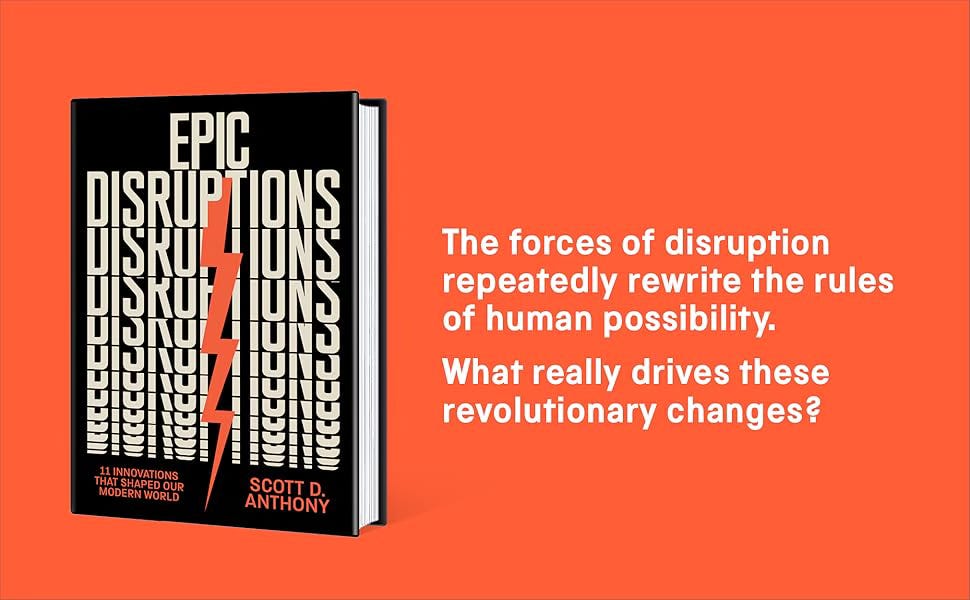
In our conversation, we discuss his new book, Epic Disruptions, which tells the story of eleven innovations that reshaped the modern world—from the printing press to fast food to artificial intelligence. The book is not just a celebration of novelty, but also examines the shadow cast by innovation.
Innovation, in Scott’s account, is predictably unpredictable: it’s patterned enough to study, but never tidy enough to control. Gutenberg, for instance, did not set out to invent the printing press. He tried (unsuccessfully) to make money selling religious mirrors for a pilgrimage that never happened. It was plague, geography, craft traditions, collaborators, and institutional patrons that made the press possible.
Scott also explains how organizations are haunted by “ghosts” of the past, present, and future. Innovation fails not because leaders don’t see change coming—they almost always do—but because they lack the courage and imagination to integrate continuity and transformation. The most successful innovators are those who can say, simultaneously: much will change and something essential will endure.
But is innovation always good?
The printing press democratized knowledge. But it also destabilized authority and accelerated religious conflict. Automobiles transformed mobility, but they also required new norms, new regulations, and new forms of social discipline to prevent chaos. AI promises extraordinary gains in access and productivity—but without guardrails, it risks concentrating power in the hands of elites, eroding trust, and hollowing out human agency.
Scott, by his own admission, is an optimist. But his research has made him more humble. Disruptive innovation, he argues, always produces winners and losers. To pretend otherwise is dangerous.
You can listen to our conversation in two parts (here and here), watch the full video below, or read the unedited transcript that follows.
Brandon: All right, Scott. Thank you so much for joining us in the podcast. It’s great to see you, and I’m delighted that you can be a guest on the show.
Scott: Brandon, I’m really looking forward to the conversation. Thanks for having me.
Brandon: Yeah, great. Scott, I’ve been really enjoying your latest book, Epic Disruptions, which I highly recommend. Super engaging read. I mean, I love your sort of really easy-to-access synthesis of a lot of theory and history. There’ve been a lot of really great case studies here—some of which I’m familiar with, others that are new—and a lot of dad jokes. You have a running commentary in the footnotes. I think you have a really great humorous style of engagement and also very personable. It’s a wonderful book.
Scott: Thank you. I have not heard someone say the footnotes are running dad jokes, but I think my kids would definitely associate with that. I will tell them that tonight. They’ll appreciate it.
Brandon: Yeah. I mean, yeah, they would accuse me of similar things if I made similar comments, you know. Good. Well, let’s talk a little bit about beauty, just to get started. I’d asked you to perhaps think of an example of beauty from your younger days that lingers with you till today. What comes to your mind?
Scott: You know, the first thing that comes to mind when I think about beauty and childhood, it was October 1991. I was in Memorial Stadium in Baltimore, Maryland. It was the last game the Baltimore Orioles were to play in that stadium. We got season tickets in 1984—which, if you’re a baseball fan, is the year after the Orioles won the World Series. But I did get to go to one of the games of the World Series in 1983. Thanks, mom and dad. But you know, we had been there 60 games a year—’84, ‘85, ‘86, et cetera. The team was not a very good team that year, but the last day was pageantry. It was a beautiful early fall day. The sun was shining. I can still hear the fans chanting. We want Mike to bring in Mike Flanagan to get the last out of the game. It’s just one of these moments where you can kind of feel the glare of the sun as you think about it. I love baseball. I love being outside. It’s just a beautiful memory.
Brandon: Wow. What about that in particular was moving? What has made that stay in your mind, do you think? What qualities of that experience?
Scott: You know, I think a lot of the things that stick with me are those moments where there is—I can’t remember the exact term for it—the collective effervescence. I think that’s close to it, right?
Brandon: Oh, yes. Durkheim. That’s right. Yeah, that’s right.
Scott: Right. So you have 50,000 people who are cheering in one voice who are feeling, to some degree, the same feeling. I think in our world today where there’s so much artificiality, the reality when you’re there and things are imperfect. The Orioles lost that game. They didn’t win that game. It wasn’t a triumphant victory, but we’re all there united to see something. And after the game, they rolled out a red carpet. Everyone’s out in tuxedos, and they say goodbye to the old. Of course, you’re then saying hello to the new. So it’s the collective experience and the transition, I guess, that really sticks with me. The weather was really beautiful too, so that helped.
Brandon: Sure, sure, sure. It seems like a combination of a lot of factors aligning. And so even though your team loses, there’s still that kind of harmony of different elements there. In many ways, that does seem to resonate with some of the criteria for successful innovations. But let’s talk about what innovation means, how do you define it, and what does that word mean to you? How did it move from being a term that was pejorative and suspect to now a kind of universal criterion of worth?
Scott: Well, the Nobel Prize was recently awarded to three economists who did research specifically on this, that said we had this move that happened in the 18th century where, prior to that, innovation might not even have existed as a word in many languages—and if it was used, it was a bad thing.
So you asked for a definition. My definition is pretty simple. It’s something different that creates value. You can break that into two parts. Something different is intentionally vague, because that gives space for big things. Hypersonic planes and world-saving medications and so on, and the day-to-day things that make life better, both are forms of innovation. Creates value separates innovation from inputs—things like invention and creativity, which are essential ingredients, of course. But until you translate that into something that solves a problem that matters for someone and therefore creates value, in my mind, you have not innovated.
Now, why was this a bad thing? One of the best finds in the historical research for my book was a 1548 proclamation by King Edward VI, or his team of handlers since he was 10 at the time. It was a proclamation against “Those That Doeth Innovate.” And you ask, why would the king want to ban innovation? Well, it’s pretty simple. Innovation is something different. It questions and challenges the status quo. Who or what is the status quo in 1548? It’s the king, or it’s God. So if you’re questioning the status quo, you’re questioning power structures, that’s bad. It takes the scientific revolution, the enlightenment, the industrial revolution, to say, “Hey, actually, some really good things happen when we ask questions,” like huge increases in life expectancy and wealth and all the things we take for granted today. So that’s my thoughts on innovation.
Brandon: It makes sense if really—again, from the lens of beauty—if maintaining order and seeing the existing order, even social order, as reflective of something eternal, of something divine, pointing to something beyond. That becomes really a sacred thing to uphold. Any kind of challenge to that order is going to be perceived as ugly, distasteful, not too much problematic and worth imprisoning and killing people over, right? And so it really is fascinating to see how our general proclivity for this sort of change has changed over time.
I’ll have more questions to ask you about what gets lost in our focus on innovation. But let’s talk about disruption. Your work builds on the work of Clay Christensen. Tell us a little bit about how you encountered him. What was it like working with him, and how did he come up with this idea of disruptive innovation?
Scott: Well, let me answer that in order. The encounter, the first encounter was 25 years ago. I was a second-year student at the Harvard Business School. I had kind of thoughtlessly signed up for a class called Building and Sustaining a Successful Enterprise. It was a new class. There were no reviews, so you couldn’t judge based on that. The professor was this guy, Clay Christensen, who had written a book. Of course, lots of Harvard professors had written a book, but the description sounded kind of interesting. I took the class, and from day one of that class, I was hooked, because the research that he had done—summarized in his 1997 book, The Innovator’s Dilemma—was just captivating. That research showed that there was a certain type of innovation that he called a ‘disruptive innovation’ that did something really unique. It took things that were complicated and expensive, made them simple and affordable, changed market dynamics and drove explosive growth.
The thing he found is, if you look historically, if you were going to place a bet, when the battle is about disruptive innovation, you bet against the established market leader. Even though they have the resources, they’ve got the capabilities, they’ve got the money, there’s just something about disruptive innovation that made it really hard for incumbents to grab hold of them. And I saw, when I read The Innovator’s Dilemma, when I saw Clay’s research, I saw my own life through different lenses. I was the managing editor of my college newspaper the year the Netscape browser came out. We struggled with it because it was a classic disruptive change in our space. I understood my classes in different ways. Clay gave me, and countless other people, a new lens at which to look at the world.
Brandon: Then you worked for his company for a bit, Innosight, for a number of years. Could you say a little bit about what your work entailed there?
Scott: Yeah, that’s correct. So I graduated from the Harvard Business School in 2001. I spent two years then as Clay’s research assistant. We wrote a book together, my first book, called Seeing What’s Next. Then in 2003, I joined this fledgling consulting company that he had formed with my former colleague, Mark Johnson, called Innosight. The focus at Innosight really is: take research by Clay and other like-minded academics and help executives confront the challenges of disruptive change. Take what historically was a threat and turn it into an opportunity.
I was based in the U.S. from 2003 to 2010. I moved out to Singapore that year. I was in Singapore with Innosight for a dozen years, ran Innosight for six of those years. We sold the company in 2017. It now has a different owner. It still exists as a subsidiary. I moved back to the U.S. in 2022, and that’s when I transitioned from consulting to teaching, where I now teach at the Tuck School of Business at Dartmouth College.
Brandon: Great. So tell us a little bit about what disruptive innovation meant for Clay. I think you mentioned in the book that he sort of regretted using the term ‘disruption.’ Say a bit more about that.
Scott: It was the phrase itself. He was, to a degree, was a victim of one’s own success. The idea really blew up. So when I was a student at the Harvard Business School, Clay ended up getting on the cover of Fortune Magazine with Andy Grove from Intel. It said Intel’s Big Thinker on the cover. Clay was 6’8”, and Andy Grove was more than a foot shorter than that. So it was a pretty iconic picture and a tongue-in-cheek headline. But you know, Intel was a company that took the ideas in Clay’s book and used it to defend against threats and create new growth opportunities. And that’s what Clay really was trying to do with his research. He was saying, “Look, there’s a pattern out there. If we understand the pattern, we can use it to our advantage.” That’s what his life work was—really trying to distill patterns, turn them into frameworks, models, tools, theories, use metaphors and stories to communicate them to people, and help them see what they would otherwise miss. That was what turned into my life’s work as well—really helping people see what would otherwise be invisible.
The underlying view is that you have agency as a business leader. You are not powerless against these forces. You think and act in the right way, you can seize opportunities. You can drive growth that otherwise would allude you. In fact, if you look, over the past decade, what is the big anomaly to Clay’s research, the incumbents are winning. People like Apple and Facebook and Amazon and Google are grabbing hold of disruptive change and driving growth with it.
Now back to the question about the regret. The challenge that Clay had is, he had a very specific meaning in mind when he used the word disruption—innovation that takes complicated, expensive things, makes them simple and affordable, hard for incumbents to grapple with, because they don’t naturally allocate resources towards them. But disruption means other things to other people. You crack open the dictionary, you see other things ascribed to the word. People just put the disruption sticker on everything. The more popular it got, the more people said, “I’m disruptive. I’m doing this. I’m doing that.” Sometimes it was dictionary disruption. Sometimes it was Christensen’s style disruption. The difference actually matters, and it would drive Clay more than a little bonkers because people would misuse his research.
Brandon: There’s been obviously a lot of debate and critique of the concept, right? I remember Jill Lepores’ New Yorker article. I mean, a number of points there, but even certainly, one of those is that the business community seems to have run wild with this concept of disruption. Everyone is trying to disrupt everything—disruptions in higher education. There have been a lot of negative consequences to that sort of approach. What do you make of those critiques? Have you found any merit to any of them?
Scott: I’d say two things. Number one, I think like Clay. Clay had a sign in his office that said: “Anomalies Wanted.” He was a good social scientist. You want things that run counter to your model, because that’s how you make the model stronger and how you learn. So good critique is very valuable. I just read a book, The Innovation Delusion. It came out a few years ago. It made a very similar point. It said, the problem is, when we get so excited about the new, we forget the importance of doing old things well. So in that book, they talked about the importance of maintenance and making sure that our roads still function, that our bridges hold up, that our software systems don’t go down. That’s work that can sometimes get lost if we get too much into a cult of anything—disruption, innovation, whatever.
So I think good critique, very valuable. And for sure, I see examples where companies forget, organizations forget, this is not either-or. This is not either we run today, or we create tomorrow; either we sustain, or we disrupt. It really has to be a both-and. And if you’re not doing both of those things, you’re going to get your organization into trouble. So I think it’s really valuable that people remind us of that. Now, you know, sometimes people have an ax to grind, and they might go a little bit too far. But that’s the nature of the world, isn’t it?
Brandon: Yeah, great. Well, let’s jump into your book. You’ve outlined four key questions which generate some paradoxical answers, right? So you ask: who is it that innovates? Is it random? Is it accelerating? Is it always good? Can you walk us through perhaps one of your examples and answer these questions for us? What are the responses that you’ve come up with to these questions?
Scott: You know, I think the printing press example in chapter two allows us to answer, I think, all four of the questions. We’ll see how we do. But you know, the very short story of the printing press. 1434, Gutenberg moves to Strasbourg not to create the printing press. 1437, he creates a venture to do something very different—to create mirrors that would capture the Holy Spirit during a planned pilgrimage. The pilgrimage gets called off because of an outbreak of the plague. Bad for the mirror venture, good for humanity—because ultimately, the team with Gutenberg on it creates the printing press. So that’s the beginning part of the story.
So what does it teach us about those four questions? Who does it? I say it’s a collectively individualistic activity. Gutenberg, of course, is the hero in the story. But there’s no story unless there’s his partner who works with him—unless Konrad Saspach brings the printing press, unless Johann Fust gives the funding, unless Nicholas of Cusa provides the first commercial opportunity. There’s a lot of people involved in it. That’s important to remember.
Is it predictable? One of the things that I observed consistently through the story is, yes, there are clear patterns. So why did Gutenberg come up with the printing press? Strasbourg was a great location. It was a trade route. There is a bell industry there, so people are engraving on the bells. It’s a wine-growing region, so there are presses. The basic pattern, magic happens at intersections. That runs through all the stories. There’s never a straight line to success though. So you don’t know exactly how it’s going to work, but you certainly can look for those patterns.
The fourth question gets really well illustrated by Gutenberg. Is it a universal good? There are, of course, a lot of good things that happen with the printing press, but one very persistent finding in my research is that disruption always casts a shadow. What was it for the printing press? Well, Nicholas of Cusa, the Catholic Church, is an early customer. Makes sense, right? They want to standardize the missiles that you use for religious ceremonies. It takes three years to hand-inscribe a Bible. They’re super thrilled when they can do that faster. However, they’re less thrilled when it also allows Martin Luther to spread his different views of religion a lot faster. The second order effects sometimes lead people to say, “What have I done?” So you also have all sorts of things that happen because knowledge spreads—many of them good, some of them bad.
The third thing about the pace of innovation doesn’t fully get answered in the Gutenberg story, but I can make a connection. Not an overnight success. So the printing press in 1440, you’ve got the basic pieces there. The first Bible rolls out in 1454, 14 years later. It’s really five or six decades before you really feel the impact. So it’s like a 70-year story. The timelines have compressed today, but it’s not like things happen overnight. As one very simple example, OpenAI introduces the first version of ChatGPT commercially in 2022. It quickly gets to 100 million consumers in the 56th year of artificial intelligence, as artificial intelligence research began in 1956 at a conference in Dartmouth College. So 70 years to have the full impact of the printing press, 56 years before we feel it deeply individually with artificial intelligence. It’s not a massive acceleration, is it? So anyway, those are some of the answers I came up with. It still requires lots of persistence and patience over sometimes very long periods of time.
Brandon: Yeah, to me, those are really important insights there. One of the questions I had, I suppose, reading the printing press story was how deliberative is the pursuit of disruption. I mean, it seemed like Gutenberg was in many ways intentional about wanting to disrupt things. Perhaps he had ambition and a desire to change things. But do a lot of disruptive innovations require some intentionality, or do some of these just happen serendipitously? What is the role of intention, agency versus things that kind of — you do have the sort of question about randomness, but there are a lot of innovations that do seem to be unintentional. I’m just curious to know how you make sense of that.
Scott: It’s a great question, and this gets back to the predictably unpredictable nature of innovation. Certainly, you have people who will say, “I’ve got a strategic intent,” that, “I want to take this hill, take this market, introduce this technology.” Even in that, there’s a lot of serendipity, surprises, things that you didn’t expect.
As a simple example of this, in 1951, Julia Child teams up with Simone Beck and Louisette Bertholle to create a cookbook of French recipes for American chefs. They think they’re going to publish the book in three years. It ends up taking them 10 years. They have to switch publishers twice. They have a near-death experience where their publisher, at the last minute, rejects them. So that’s a twist in the story. What happens next? Well, Julia Child has a friend, Avis DeVoto, who knows someone named Judy Jones, who’s looking specifically for books that have a French-American connection. It feels like luck. But as always, luck is the residue of design, because Julia Child had a network that enabled her to do that. So this mix between there being kind of the lightning strike, how tense the lightning bolt on the cover of the book, and my customized lightning cufflinks that I’m wearing today — they just came a couple weeks ago. So this is a—
Brandon: You’ve got merch. That’s good.
Scott: I’ve got a t-shirt too. I did not wear the t-shirt today, but yeah. But anyway, this notion that both of those things are there. I think one of the things that’s really important, if you’re an innovator and you want to do it, it’s not that you’re going to have a perfect plan and everything is going to go smoothly. That’s just not the way it works. You have to expect the unexpected. You have to expect weird things are going to happen and pounce on them when they do.
Brandon: Right. Yeah, one of the challenges, I suppose, in reading the Julia Child chapter, the thing that comes to mind is, how do you know what it is that people are going to, what problem they’re going to be willing to pay to solve? It probably wasn’t clear to a lot of people at the time that American women were hungering for a book on French cooking. I think you have a footnote about a story about medical tourism, where you learn that people just lie. This is no end of marketing research surveys asking customers what they want to buy and how much they pay for it and how much of that is of any value. So how do you really know, in terms of if you’re trying to innovate, what it is that’s actually going to meet a real problem for people?
Scott: First of all, I have to say I really do appreciate you calling out a footnote because I don’t always get that, so I appreciate. Even though it’s a slightly painful one, the failed medical tourism business. But you know, that was a very good learning experience. So let me just say a little bit about that, and then use it as an answer to the question.
Innosight was, is primarily a strategy consulting company. It works with large organizations, gives them advice about their toughest strategic and innovation challenges. There was a period of time where Innosight also had a venture building and venture capital arm. One of the ventures that Innosight tried to build was this business called Choice Med. Here’s the basic origin story. If you look at the statistics between the United States and Singapore, you see something really interesting. The U.S. spends one in every $5 of GDP on health care. In Singapore, it’s $1 out of every 20. Singapore spends a lot less, but health outcomes are much better in Singapore than they are in the U.S. So healthcare is really affordable, and they get great outcomes. So the idea is pretty simple—medical tourism. Get people who are going to undergo elective procedures in the US, have them fly to Singapore, have the procedure done for a fraction of the cost, have them recuperate in a six-star resort, and have them go back home.
So when Innosight was doing research for the idea, it did the thing you do. Talked to customers and everyone’s like, “Yeah, great. I would love to do it.” Talked to people who worked at insurance companies, we’ll absolutely sign up. So then, Innosight began running little get togethers in Florida where there was a lot of target customers—knee and hip replacements, and so on—with leaflets, advertising the service. Nobody showed up. Once people were faced with the real opportunity to get on a plane and fly 9,000 miles to a place that few had heard of and almost none could identify on a map, the stated interest very quickly disappeared.
So how do you know that you’re targeting a real problem? Well, what I advise—this is in my book The First Mile from 2014. You listen to what people say, but more critically, you watch what they do. If they are already spending time or money trying to solve a problem and they’re frustrated, that’s a good sign. You then try to, as quickly as possible, do what Innosight did, which is put people in a real environment to say, alright. Put your money, put your time where your mouth is. Demonstrate that this actually matters to you. If they demonstrate by purchasing something, that’s good. If they do it more than once, you’re feeling better. If they’re telling their friends about it, okay, you really have hit a nerve. So that’s the basic idea of how you can really know for sure. You only know when you know. You look for the signals beforehand, and you try to demonstrate through action that those signals actually mean something.
Brandon: Thank you. That’s really—
Scott: Choice Med lasted for about one year before it was folded. And you know, the thing I will say in hindsight is, not too much money was burnt with these lessons. We got good stories that we could then use to advise our clients to not do the same thing that we did.
(outro)
Brandon: Alright, everybody, that’s a good place to pause our conversation. In part two, we’ll move from history to practice. We’ll look at how leaders can better recognize disruption and deal with the ghosts that keep organizations from changing. We’ll look at the secret to McDonald’s success, what Clay Christensen got wrong about the iPhone, and how to reckon with the burdens of innovation without losing sight of its promise.
See you next time.
PART TWO
(intro)
Brandon: I’m Brandon Vaidyanathan, and this is Beauty at Work—the podcast that seeks to expand our understanding of beauty: what it is, how it works, and why it matters for the work we do. This season of the podcast is sponsored by Templeton Religion Trust and is focused on the beauty and burdens of innovation.
Hey, everybody. This is part two of my conversation with Scott D. Anthony about his new book, Epic Disruptions. In the first half, we traced how disruptive innovations emerge. Let’s now turn to the leader’s playbook—how to spot real disruption, how to invest across time horizons, overcome the ghosts that hold organizations back, and what disruptive innovation might mean for religious organizations. Let’s get started.
(interview)
Brandon: One of the other sort of misperceptions I think your book dispels is the idea that disruptive changes sort of creep on us unexpectedly, right? And so I think you’re arguing, I think you say that you’ve never met a market leader that didn’t see the disruption coming. As you mentioned, in the case of the Catholic Church, they even funded the disruption. So there is a dilemma certainly, it seems, for leaders. Do they recognize and invest in a disruption, which would be good in the long term but that would come with a short-term pain that they have to endure, right? And so how should they navigate that? What should leaders do in this case? How do they recognize a disruption, and to what extent should they invest in it?
Scott: So, first, on the recognition point, there is a very clear pattern of disruption. There are three big elements to it. One, you have something that is introducing purposeful trade-offs. So taking complicated and expensive things, making them simple and affordable. So you have a purposeful trade-off. Second, a disruption will typically start not in the middle of the mainstream of the market, but at a fringe or at an edge somewhere. And third, what will really drive the disruptive growth is a powerful business model where you can create, deliver, and capture value in new ways.
So if you fast forward to today, where do we see this happening? You look at professional services, you see very clear signs where people say, “We have artificial intelligence that enables us to offer very different forms of services.” We can start not in the mainstream but among people who aren’t using people, like McKinsey, or Deloitte, or big tax providers, or so on. And we’re going to make money in very different ways. It’s just ding, ding, ding. Big warning sign that it’s coming. So that’s the first thing.
The second thing is recognizing, again, this is not an either-or thing. A good executive will say, “Yes, I’ve got a great business that I want to maximize, that I want to strengthen, that I want to make more resilient, and I will recognize that is ultimately a frail, dying business. So I will also go and invest in what will be the next generation for my business.” The key thing in getting this right is to play in your mind with timeframes. If you look at what I should do over the next minute, it’s very clear. You invest every marginal thing that you have in today better. If you look over the next 100 years, it’s also very clear. You invest everything in tomorrow. The trick is to say: how do I span both of those time frames simultaneously? Not easy to do. But if you play with time, you can see it’s very obvious to have a good, balanced portfolio that both sustains today and disrupts and creates tomorrow.
Brandon: Do you have any good examples of companies that have done that, case studies that you’ve seen where they’ve successfully been able to do this?
Scott: Brandon, I’m smiling because I was debating giving the case today. I thought my answer had gotten too long winded. So I’m glad you’ve asked the follow-on question. It’s a case that I teach my students in my class leading disruptive change. I think it’s a really fun one.
In 2014, Masahiko Uotani became the CEO of Shiseido, which is a Japanese cosmetics company. He was the first outsider to helm the company in its then 142 years of history. The company had been stagnant, declining for a couple decades. He launched a very bold transformation strategy that had basically changes to everything—the product portfolio, how it was organized, even the spoken language, going from Japanese to English. It worked. It delivered huge growth, transformed the company, et cetera. One key to it is he had, essentially, a 240 plus year strategy. So he would go forward 100 years and say, “What we are doing is we are laying the foundation for Shiseido’s future.” He would go back 142 years and say, “While it feels like everything is changing, we have always been a place where East meets West. We have always been a place where science meets beauty. We are changing to remain unchanged.” So you give people something to hold on to in the midst of all the change, give them an inspirational destination to get to, and make sure again you’re getting that balance of today and tomorrow right. I interviewed their former CFO. He said, with 100-year timeframe, there were some decisions that would have been hard that became really easy. So should we invest in a new R&D facility? Of course, we needed the new R&D facility for the next 100 years. We had to still deliver the quarter. That’s not a choice. That’s not an option. But that means we have to do great things in the short term, so we can enable everything we want to do in the long term. That view of time, changing that view of time, really changed the way people thought about it.
Now, if you’re a student in an upcoming run of leading disruptive change, cover your ears. What I do in class, which I think it’s super fun, I have a cold call for this class, but the class doesn’t see it coming. I find someone in the class, and there’s always someone who majored in philosophy, and I say, “Tell me about time.” They kind of do a triple take, and they’re like, “What?” I said, just tell me about time. The first time I did it, the student said, “I’m sorry, you’re not going to like my answer. Time isn’t real.” I’m like, “No, no, no, I love your answer. Let’s keep going.”
Brandon: Okay. I mean, this is really resonant with some other research I’ve done with some colleagues in Italy around looking for models of what we call social generativity. We’re trying to find companies and organizations that sort of are paving a way out of consumer society. And what we find, a lot of these cases are very much this sort of what we call inter temporality. So there’s a deep connection to the past, a sense of rootedness in the past, and also a very, very long-term horizon—200, 500 years. Brunello Cucinelli is another firm that comes to mind from the fashion industry, where the firm is really looking to ancient philosophy, the work practices of Benedictine monks and so on, and also trying to build 200 years into the future a sort of revitalized community where artisans continue to thrive and flourish. And so very hard to get that kind of perspective in the face of immense market pressure, especially if you’re a publicly-traded company.
Scott: I don’t know. People will say that. I don’t know that I really believe it. The thing I draw when people say that is, there’s a field called adaptive leadership. Ron Heifetz at the Harvard Kennedy School is kind of the main thought leader behind it. They have this chart that just really — every time I see it, it speaks to me. It talks about the relationship between change and discomfort. What it says is, as you’re going through change, discomfort is induced. At some point, you cross a threshold, it’s good. You have to be uncomfortable to change. You’re working out. You tear muscle to rebuild it. At some point, you cross the threshold, it’s bad. You can’t tolerate it. When that’s a physical threshold, your body tells you, you stop. You recognize it. When it’s an emotional threshold, you get signals, but you don’t really recognize them. So you want to find ways to make it go away. So you find ways, in sophisticated ways, to avoid that, to avoid the work. You create defense mechanisms. You scapegoat. You find other people to blame.
When I hear people say, “Well, I wish I could, but the public shareholders won’t let me,” to me, it feels like work avoidance. It feels like trying to find a reason to avoid doing something that, yes, is very uncomfortable and is hard, but is doable. Jeff Bezos convinced investors that you could be misunderstood for long periods of time. Mark Bertolini, when he was the CEO of Aetna, said, “Basically, I’m going to follow this 20-year plan. If you don’t like it, there are plenty of other stocks that you can invest in,” and then delivered against what he said he was going to do. Michael Mauboussin has done research that shows you can do this. You can change your shareholders if you change the way that you message to them. So those leaders that say they’re constrained by shareholders, I think they’re constrained by their own limitations, to be honest.
Brandon: Right, yeah. So what does it really take then to — I mean, does it just require a leader to really commit to that long-term horizon in the face of whatever seeming pressures or potential objections? Is it an individual characteristic? Is it some sort of virtue, or are there other factors that you think would help companies to actually really invest in this long-term vision?
Scott: So good news, bad news. There’s a lot. So it’s not just individual virtue, which is good. Because if it’s just you have to be touched by whatever in the right way, then there’s a few precious people who can do it. And of course, leadership is critical in all of this. There are heroes in stories. There also are systems and structures and things you need to put in place to do it. I call these all technical tools, very well-documented about how you put in portfolio management and all that.
The hard part of the problem in my mind is the adaptive part of the problem. Because when you are going through something like this, there’s no clear right answer. There’s a possibility that people are going to lose—you’re going to have one division win, one division lose, et cetera—and there’s a certainty that you’re going to struggle. It’s going to be painful. So, to me, by far, the most important thing is dealing with those adaptive challenges. That requires that a team is willing to be patient, a team takes a long-term perspective. A team can become, in the midst of chaos, a team can use multi cognition to be able to see lots of different perspectives and have a paradox mindset, so they see possibilities, intentions. It is a higher order set of skills. Good news: all skills can be developed if people consciously practice them.
The thing I would say the biggest barrier to all of this—I’d say this in the back half of chapter 10 of the book, that chapter on steel—every organization is haunted by ghosts. Those ghosts are invisible and incredibly powerful. And if you don’t see them, spot them and exorcise them, then you will never succeed. It’s really hard. I mean, this is something that I think most organizations struggle a lot with.
Brandon: Yeah, could you say a bit more about that? Because even just that sense of identity is so critical for a lot of organizations, right? It’s not just businesses, right? So any kind of organization that needs to innovate is tied to the ghost of the past. Could you say a little bit about what it takes to overcome that? How do they recognize these things? How should they develop the capacities to move forward? You could use that example there, yeah.
Scott: I think step one is recognizing them. So the Bethlehem Steel chapter, what I did with that chapter is, if you’ve ever studied Clay Christensen, you know his favorite story is talking about steel mini-mills. He’ll talk about how Nucor Steel came up with this electric arc furnace that allowed it to melt scrap steel and sell it for lower prices. It went and disrupted integrated steel producers like Bethlehem Steel. So I said, okay, let me tell that story with some more details around it. I do it, and one of my early reviewers says it’s pretty boring. Can you flip it? Can you look at it through the eyes of the person who’s getting disrupted? I said, huh, that’s interesting. I hadn’t done that. So I went and researched the history of Bethlehem Steel. I had just written an article recently about the idea of ghosts. I’m like, oh my gosh, this is just now clear in plain sight.
So the ghosts of the past, those are traumas an organization has never gotten over. Bethlehem Steel, like everybody in the steel industry, had labor dispute after labor dispute after labor dispute. Steel mini-mills relied primarily on non-unionized labor. So Bethlehem Steel was going to respond in kind. It had to go play the we’re going to go and break the union card. No way. It was too traumatic to do that. Every organization has—it goes to the present—invisible patterns that they’re following without being aware of them. Bethlehem Steel had an amazing 70-year history. Andrew Carnegie going to Charles Schwab, going to Eugene Grace, 70 years of leaders who focused on making sure the mills were run full, who focused not on pioneering but on optimization, who focused on scale. That was their DNA. That’s just what they did.
Then the ghost that you mentioned that I think is the most important one, the ghost of the future, where the prospect of change raises a fear—that your essence as an organization or as an individual is going to be invalidated. So Bethlehem Steel. A rational, logical thing to do would be to shut down the plant in Bethlehem, Pennsylvania, and say, “It doesn’t make sense for us to still do this. Let’s go and go to other geographies and do things that are more economical.” Bethlehem Steel, that’s the company’s name. That’s what the company is. That’s who the people of the company are. You go and talk to people who are working today in automobile companies and you say, what do you do? I’m a car person. I work for a car company. If you get deeper, they’re mechanical engineers. That’s who they are as people. They’re not electrical engineers. They’re not software engineers. They’re not software designers. That’s not the essence of who they are. So these ghosts of the future are really powerful and really hard to address.
Going back to the case study about Shiseido, one of the things that I thought Uotani-san did so well is saying, “Let’s give people something to hold on to. Let’s say, yes, a lot of things are going to change, but let’s be clear about what isn’t going to change.” History can be an anchor. It can hold you back. It can also be a catalyst if you use it in the right sort of way. I thought he and his team were very smart about using it, so the ghost of the future didn’t hold them back.
Brandon: Right. Yeah, that’s great. One of the concepts you use in the book is this idea of competing against non-consumption. Clay talks about that as a key path for disruptive success. Could you say a bit about what that phrase means and why that’s important?
Scott: Well, the basic idea is you have essentially two choices if you’re launching something. One is to compete in established market against what people are already buying. The other is to find somebody who cannot consume because that which exists is too expensive. It requires specialized skills. It requires training and so on. The pattern of disruptive innovation is often finding ways to compete against non-consumption. Because in those markets, something is better than nothing at all.
A modern example of this. So when I break out ChatGPT and think about using it to help my kids with the problem or design something for my students, the choice is: is it better than the excellent teachers that they have in their classes? Is it better than the education I’m providing in the classes? There are pros and cons. You can say, done in the right way, it can be better. But that’s the tradeoff. If you are living in a country that does not have an education infrastructure, that does not have MBA programs, ChatGPT is a lot better than nothing at all. This is where you’re seeing some tremendous growth in ChatGPT and other large language models. Because you now have the ability to have a teacher in your pocket, to have a doctor in your pocket. Because before, you had nothing. Now you have something. And when that’s the choice, you will tolerate something that has all sorts of limitations because, again, something is better than nothing. So would-be innovators, if you can find something like this, where you see a market that is constrained because you need specialized skills, wealth, et cetera to consume something, that can be a great opportunity to drive disruptive growth.
Brandon: That’s great. Another point that you make is the idea of business models—not as fixed things, but as systems. You talked about creating value, delivering value, capturing value. Could you say a bit more about that systemic dimension of innovation? I think the McDonald’s case is one where you really illustrate that.
Scott: One of the proud parenting moments, I had a book launch event at the local bookstore in Chestnut Hill, Massachusetts, and my family was kind enough to join. I cold called my nine-year-old at one point. Someone asked a question about McDonald’s from the audience, and I asked my nine-year-old, Teddy. I said, what’s special about McDonald’s? And like that, he said the speedy service system, which was very good, which was one of the elements. So one of the questions is, why McDonald’s? McDonald’s was not the first burger chain. It was not the first franchise restaurant, but it really was the first to break through and deliver fast food at scale. Well, it really was the system.
So it started with the speedy service system that was created in 1948 by Dick and Mac McDonald. They were running a restaurant that sold many things, and they were frustrated. So they said, “Let’s radically simplify the menu. Nine items. Let’s borrow Henry Ford’s assembly line and bring it to food and make it very simple, very reliable, very affordable, so we can create value for our customers in new ways.” Ray Kroc comes in 1954 and says, “This is amazing. I want to essentially be your master franchiser and bring this to more places.” He then found a unique way to deliver that value. Most people would set up franchise systems in a very extractive way. You try and strike a deal with a local franchise owner where you get as much from them as possible. Kroc and his team embrace mutuality. Let’s create a win-win relationship where we can all grow together. Everything is working great over the next few years—except for one problem: the McDonald’s Corporation, which oversees all of this, isn’t making any money. They made $159,000 the first six years of existence.
Enter Harry Sonneborn, who became CEO of McDonald’s. He didn’t really care about hamburgers. He cared a lot about making money. So he came up with the real estate model. He said, “Let’s find great pieces of land. Let’s lease it. Let’s then sublease it to our franchise owners. Let’s still follow mutuality. So make sure that we only win when they win. But let’s lock in a nice margin on that land.” You put all those pieces together—the speedy service system and a great way to create value, mutuality to deliver that value, the real estate model to capture that value—you create a flywheel that gets bigger and goes faster as you keep growing. Burger Chef, which became Burger King, or other chains, they might make a burger that’s as good. They might have a good relationship with a particular franchise owner, but it’s really hard to get all of that going together because there are links between it. It reinforces. Things are easy to copy. Systems are really hard to copy. That’s what McDonald’s teaches us.
Brandon: Fantastic. Yeah, there’s also just that recognition in a lot of your cases of where a number of these successful innovations are not just a single innovation but a recombination of multiple innovations, right? That you have to have a number of things in place. So let’s talk about the iPhone. I was surprised to learn that Clay Christensen thought that the iPhone would fail. So say a little bit more about why he thought so, and then what that mistake of his can teach us about how disruptive innovation works.
Scott: It’s a pretty famous example. I was not surprised by it because I knew it coming in. So the basic idea, in the middle of 2007, right as the iPhone is getting ready to launch, he talks to someone from Business Week. He says, through my model, the iPhone looks like a late entry in an established category of mobile phones. And my model predicts—if you are introducing what he calls a sustaining innovation which offers better performance along traditional dimensions in an established market—you will fail. So I therefore predict that Apple will fail. He actually would never use “I.” He would always say “the model.” He was very dogmatic about it. The model predicts that this will fail. And of course, the Apple iPhone did anything but fail. It was probably the most successful product in history. What Clay later admitted he got wrong was that frame. He said, well, I was looking at the Apple iPhone compared to other phones. What the Apple iPhone really was was the fourth generation of computers. So you had mainframes, you had microcomputers, you had personal computers, and you had pocket computers. The Apple iPhone was arguably the pioneer of the pocket computing market.
Now, interestingly, Steve Jobs didn’t see this. When Apple launched the iPhone, Steve Jobs was asked: what is the killer app for the iPhone? They said, well, it’s a phone, so the killer app is making and receiving phone calls. And in the early days, the iPhone sales were not that great. Of course, you had people who lined up on day one to get the Jesus phone, but that was a very small group of people. The problem was there were not many apps on the iPhone. It was a closed system. There were only 16 apps on it, no app store. Jobs didn’t want one. He wanted to have control. Ultimately, his team convinced him that he needed to open it up. Then you really have the full power of the computer in your pocket, sales take off. Disruption is in full bloom.
So this teaches us a few things. Number one, even super smart people like Clay Christensen and Steve Jobs don’t get it right 100% of the time. Number two, you have to watch the movie, not the snapshot. The snapshot said, in the middle of 2007, hey, there’s reasons to doubt. The movie says, hey, if we see this, that suggests the odds of success have gone up. And opening up that app store, that was the big moment.
Brandon: Yeah, that’s great. Let’s talk a little bit about the flip side of innovation. Your fourth question is around how innovation is not always a positive unmitigated good. It often casts a shadow. So how do we make sense of the burdens of innovation, and how should innovators and society reckon with these burdens?
Scott: It’s a huge question and a really important one that is just too frequently overlooked. You can think of three categories of things. So, first, when you do have something introduced that truly is disruptive, it will change dynamics in a marketplace. That means there are going to be winners, and there are going to be losers. If we look at one of the ones I name in the conclusion of the book, autonomous vehicles, I was just talking to somebody yesterday who works for a big trucking company. They’re pushing really hard to drive autonomy—no pun intended. And it makes sense. Because a big cost driver for long-haul routes is the driver in the car. Now, the challenge is, that’s also the number one source of employment in many states in the United States. When it goes away—not if—when it goes away, what are we going to do? That’s one shadow of disruption.
The second shadow of disruption is what happens in marketplaces. If we stick with automobiles for a minute, back in the 1920s—I talk about this in the Model T chapter—there’s chaos in the streets of major cities. Because they were built not for cars, but for people and pedestrians. It required technology. It required norms. It required regulation to get through that. You bring this to modern times, and I really worry that we are blowing it when it comes to artificial intelligence, saying, “Hey, we don’t need to worry about anything. Let technology work itself out.” History says that is not a very good approach.
Then the final shadow is for the individual. As humans, we all suffer from what’s known as the status quo bias—all things being equal. We would like things to remain exactly the same. When disruption drives changes, that’s scary. I remember the first time I got into a Waymo, into a Robotaxi. I do this for a living. I teach, I preach, I talk about it, and still, my palms got sweaty. I was nervous because I’m a human being, and new stuff can be kind of scary. You add on top of that, if we’re in a company and our identity is being threatened, this is really important stuff. So I think the very first thing is: recognize these three categories of shadows exist, and don’t expect they’re just going to work themselves out without a lot of pain. Because they won’t. So we need to have people being thoughtful about it. We need to have government and regulators helping out with it. The alternative is very dark.
Brandon: Well, you mentioned AI which is on everyone’s mind these days. Are there lessons from your case studies that could be applied to helping us think through the ongoing development of AI systems more wisely?
Scott: I sure hope so. If I just echo off the idea of what it really took for the automotive age to come in, it took technology like traffic lights. It took norms. Like when we get to an intersection, we turn in a wide way so other cars can come. It took regulation, like driver’s licenses. So I’d argue, by analogy, we might want to think about: what are technologies that can control or limit, what are norms that ought to be followed related to ethics, and what are regulations that ought to be put in place to make sure some of the downsides that could come with AI? You can think about a lot of them. We don’t see too many of them. Now, I can’t say that I’m particularly optimistic that we’re going to see a lot of this in at least the short term, but I hope in the medium and longer term, we see more of it. Because otherwise, I think it’s going to get pretty ugly. Maybe we need that. Maybe we need a period of ugly before we get to the period of beauty. I don’t know. There’s a lot that I love about AI. I love playing with it. I use it in my classes. There’s many, many beautiful things about it. But like everything, there’s a shadow to it.
Brandon: Are there points at which we start to realize that certain innovations are just not worth it? I mean, I think of now the kind of backlash against social media, which I think rightly so has been growing in part due to the work that Jonathan Haidt and others are doing about the disruptive — not disruptive but destructive.
Scott: Dictionary style. See, there you go. This is why Clay hated the word in the end. But it is. It is, dictionary style, disruptive and destructive. Sorry for talking over you.
Brandon: But then you take a more extreme example of something like smoking, where tobacco for centuries was very popularly used. You could call it an innovation. Its widespread use, that was solving a particular problem, adding value for people, helping them at least experience in their own subjective views a better quality of life. Now it’s almost universally recognized as harmful, right? And so I wonder whether you see ways in which innovations, at some point, just we start to judge their overall benefit as really being not worth their costs.
Scott: You’ve named some examples, and I think there’s others. McDonald’s is a chapter in the book. And so McDonald’s is not without its critics. I think people at McDonald’s would be the first to admit. One of McDonald’s main products that it sells is Coca-Cola. Coca-Cola’s purpose is to refresh the world and make a difference. There are a lot of people who say and also push a lot of sugar and create a lot of things that are hard to recycle. And so I think there are lots of categories of things where genies get out of bottles and we say, what have we done? And again, in my view, I’m not an expert in public policy, so admit your limitations. But in my view, this is the role of government: to say that there is a tragedy of the commons that might come. There are market forces that, if they push too far, actually lead to consumer downsides. You have addictive things that really make our lives worse. I’m a huge fan of Jonathan Haidt and all of his work. To my point about AI—I’m channeling him—he says, we’re about to do it again. We’ve seen this movie now. The idea that we’re going to allow AI companies to create friend-bots for kids is horrific. Horrific. Just an awful idea. So, again, I think for many of these categories, there’s a really important role for governments and for regulators to check some of our worst instincts as humans or as business leaders.
Brandon: If I may ask you to extend your framework of disruptive innovation to another domain which is religion and spirituality, do you see ways in which religions that are trying to survive in a changing world, particularly in the modern West where you see simply a lot of decline in the importance of religion, what lessons could religious institutions or spiritual organizations, communities learn from this theory of disruptive innovation that might be helpful? Do you perhaps see any signs where maybe some of this is at work already?
Scott: One of my favorite things about doing interviews is when you’re asked a question you’d never been asked before. This is a question I’ve never been asked before, and I love that. I am not an expert in this space, so I will not be able to give you here are three examples of what different religious organizations are doing. But if I go to the theory and go to the models, what would it tell me? It would say, well, this idea of non-consumption. You certainly have a growing population of people, if you just look at the statistics, who are not choosing to engage with religion. I would always want to understand why. What is the barrier? Is it that it takes too much time, they perceive it as something that doesn’t fit their lifestyle, et cetera? And can you then innovate in ways to make things simpler, more accessible? More affordable isn’t quite the right metaphor. But that would be a thing that you think about. And what I would then look for is, okay, what are people doing on — despite the downsides, what are people doing on platforms like TikTok and YouTube and so on to try and engage populations in different forms of ways?
I would also want to look for different geographies and say, you’ve got religions that have very strong bases in particular geographies and almost no presence in other geographies. How do you think differently about playing in different geographies? I would think about that time-tested view, that magic happens at intersections when you bring different mindsets and backgrounds together. What might happen if you intersect religion with other fields? Maybe the revival of independent bookstore or something that nobody saw coming, is there something that we can learn from that about how you might revive religion in particular communities? So those would be at least some of the things that I would think about. This idea that there’s always something to learn from different places, I think, is a really powerful thing. One of the things I always will tell innovators: if you’re ever stuck on anything, get out of where you are. Go to a different place. Go to a different industry. Read a magazine in a different field. Stop reading the nonfiction book you’re reading, and read a fiction book. Stop reading the fiction book you’re reading; read a non-fiction book. If you’ve got a problem in your head, in your head, you’ll see a connection when you go and look in those different places.
Brandon: Great. Thank you. Lastly, were there any big surprises as you were doing the research on this book? I mean, there’s certainly a lot of history here. Anything that perhaps changed your mind about some aspect of the theory, or the model, or added a complication or nuance that you weren’t expecting?
Scott: Well, the thing that really struck me, the fourth question we’ve talked about a few times, is innovation a universal good? Look, I’m a believer. I’m a proselytizer. I go and spread the gospel of disruption. I really do think it makes the world a better place. The research has made me more humble, that there is another side to it. The shadow that we talked about is a very real thing, and there are good reasons to have things that can buffer and catch some of that shadow. So I go in now, eyes wide open, that yes, disruption remains a powerful force for democratization, development, and progress—and it comes at a cost.
Brandon: Well, let me leave you with the last word. Perhaps, if there’s anything else that you really want to drive home about your book, any other key points that we’ve not discussed yet that you’d really want to make sure that you share with our audience, what might they be?
Scott: Oh, we’ve covered a lot of great territory. I think the one thing that I would just emphasize: it is at its core an optimistic book. So it is easy right now to not feel optimistic for lots of reasons. There’s so much going on. Some of it is pretty ugly in some places. I am a believer that disruption drives progress. Disruption enables more people to solve more problems, do new things, and live better lives. It’s easy to feel fear. The status quo bias, the king’s proclamation from 1548—we don’t live it, but we still kind of feel it. My wish for is that people find the fun in it. I love playing. I love playing with new technologies. I love playing with new ideas. When you view something as fun as opposed to something that’s fearful, you just look at things a lot differently. So that’s a message I hope they take from the book.
Brandon: That’s great. That’s great. Well, Scott, thank you so much. It’s been such a delight. Where can we drive our audience to learn more about your work?
Scott: So LinkedIn is the social media platform that I spend my time on. There’s also a companion website for the book, epicdisruptions.com. Disruptions is plural. There are 11 of them in the book after all. Epicdisruptions.com.
Brandon: Yeah, fantastic. Thank you, Scott. This has been great.
Scott: Brandon, thank you very much. I’ve enjoyed the conversation.