

In earlier posts I shared some highlights of the Beauty and Belief survey that my team and I conducted with Gallup this spring. We just published the official report today, which you can download here.
Our study is the first large-scale, nationally representative look at where people encounter beauty in ordinary life, how often, and what that has to do with their wellbeing, faith (or lack of it), work, and relationship with technology.
Gallup surveyed 4,968 adults in the United States in March-April 2026, and their UK partner Verian surveyed 5,727 adults in the United Kingdom in April-May. Both are probability-based panels weighted to national benchmarks, so these are real population estimates, not an online convenience sample or opt-in panel. Gallup has also been conducting 100 in-depth interviews in both countries, and some of what people said in those conversations is scattered through the report (The US interviews are completed and the UK ones are in progress).
Americans and Britons encounter beauty in the same places. Americans find it more.
We asked people to identify where it is they personally encounter beauty, however they define it. The ranking is nearly identical in both countries. Nature comes first (96% in the US, 94% in the UK), then music, then relationships and moral beauty (virtuous behavior) of other people. Work and digital environments (including social media) are at the bottom.
But Americans are more likely to encounter beauty across every domain. They also find beauty in more domains of life than Britons do on average. The two largest gaps are that Americans are 29 percentage points more likely than Britons to find beauty in spiritual or sacred moments, and 15 points more likely to find beauty in their work. When asked how often they’d experienced something beautiful in the past month, 22% of Americans said several times a day. In the UK, it was 11%. So a third of U.S. adults encounter beauty at least daily, against a fifth of U.K. adults. Almost nobody in either country says never.
More frequent encounters with beauty are associated with greater wellbeing, and the effect is strongest for those who are financially struggling the most.
We measured wellbeing with Harvard’s Secure Flourishing Index, a 0 to 120 scale covering happiness, health, purpose, character, relationships and financial security. People who never or almost never experience beauty average 66, while those who experience it several times a day average 92, and the slope is a steady rise. The relationship holds in the face of statistical controls. After adjusting for age, income, country, gender, education, and religious or spiritual identity, each step up in the frequency of encountering beauty is still worth about five points of flourishing. One of our interview respondents, a retired sailor in Idaho, told us that beauty is “almost like oxygen.”
Examining psychological distress, the figures are starker. Using the Kessler K6 scale, 29% of people who rarely encounter beauty meet the threshold for serious psychological distress. Among those who encounter it several times a day, it’s 5%.
One of our most surprising findings is that the association between beauty and flourishing is strongest among people who say they are finding it very difficult to get by on their present income. Our survey asked respondents how often they encountered beauty in the past month, on a scale from “never” up to “several times a day.” For those who are financially struggling the most, moving one category up that scale (starting from never or almost never) is worth about six points on the Harvard flourishing index, compared to four points for those living comfortably. We also find that people under financial strain encounter beauty less often (22% encounter it daily or more, vs. 39% of the financially comfortable), but when they do, it seems to count for more in relationship to their flourishing.
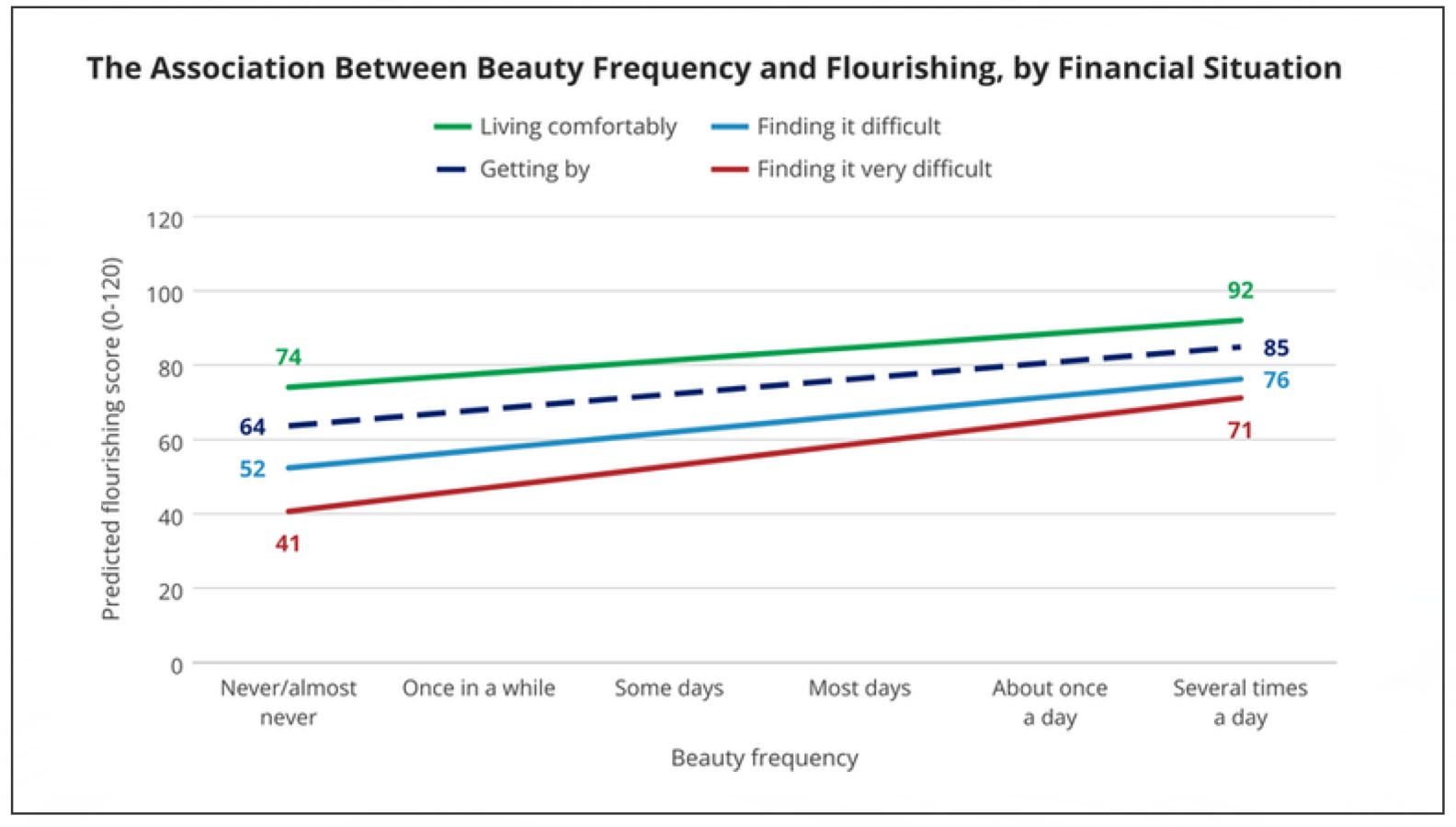
Since this is a cross-sectional study—it’s a snapshot at one point in time and cannot examine changes over time— we can’t say which way the causal arrow runs. People who are flourishing may simply notice beauty more. Or it could be that hardship makes it difficult to notice beauty. A salon owner we interviewed in Florida told us that when you’re in survival mode, the small beautiful things get harder to see. But the consistency of the relationship, across two countries and every subgroup we looked at, is hard to dismiss.
Political identities shape what beauty means to us.
In both countries, the left is far more likely to call the arts “very important” to society: 66% of Democrats versus 35% of Republicans, and 66% of left-wing versus 32% of right-wing respondents in the UK. The left also reports finding beauty in literature and the visual arts at higher rates than the right.
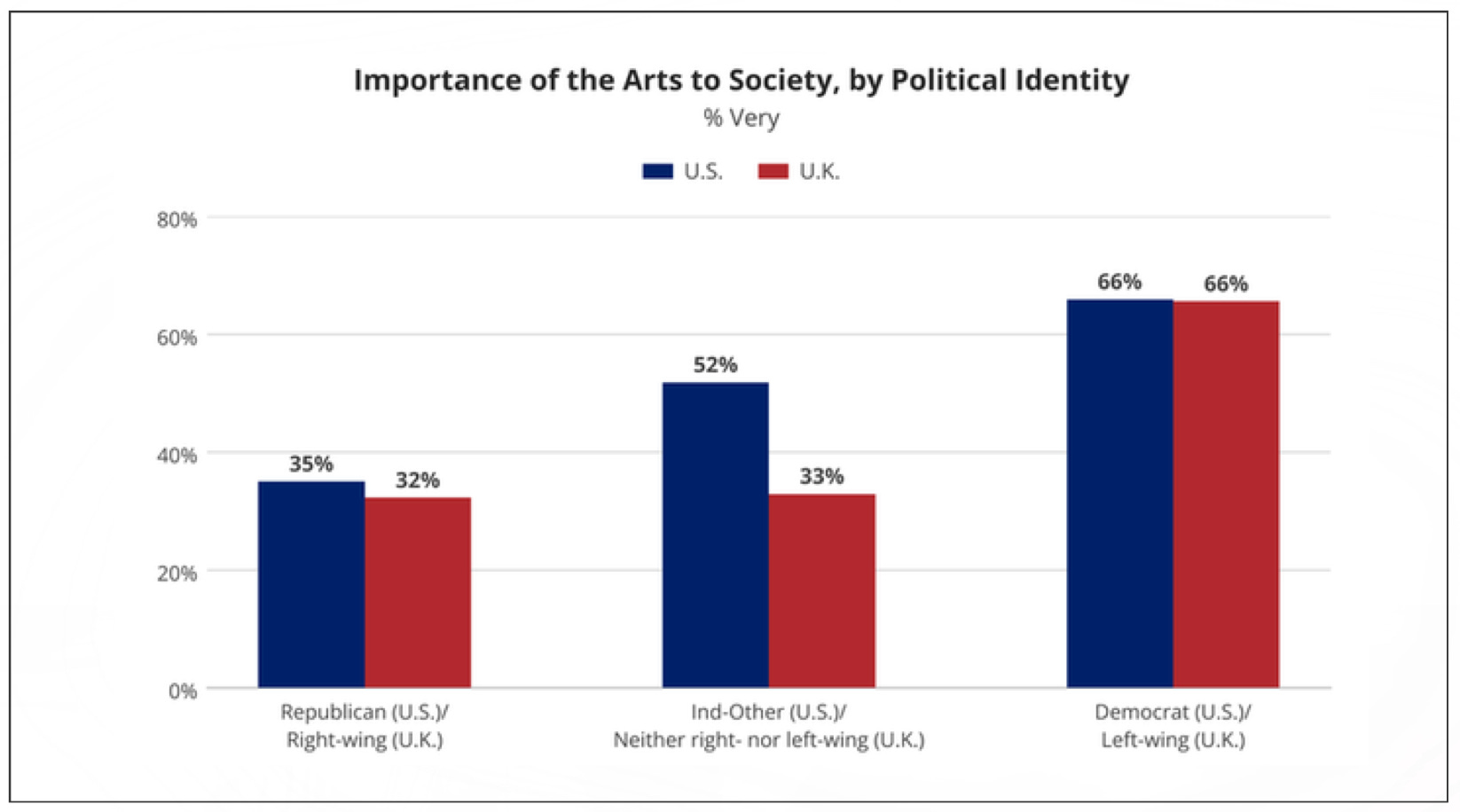
One notable difference is when it comes to the sacred. In the US, Republicans are 21 points more likely than Democrats to find beauty in spiritual or sacred moments. In more secular Britain, there’s no equivalent divide across the left and right. Religion has become a partisan marker in America in a way it hasn’t across the pond.
Spirituality, not religion, predicts whether people think beauty matters.
We asked respondents to indicate whether they identify as (a) both religious and spiritual, (b) religious but not spiritual, (c) spiritual but not religious, and (d) neither religious nor spiritual. Among those who say beauty is very important to a meaningful life, the two spiritual groups lead (41% and 40%) over a wide margin against the non-spiritual (26% of the neither-religious-nor-spiritual and 24% of the religious-but-not-spiritual).
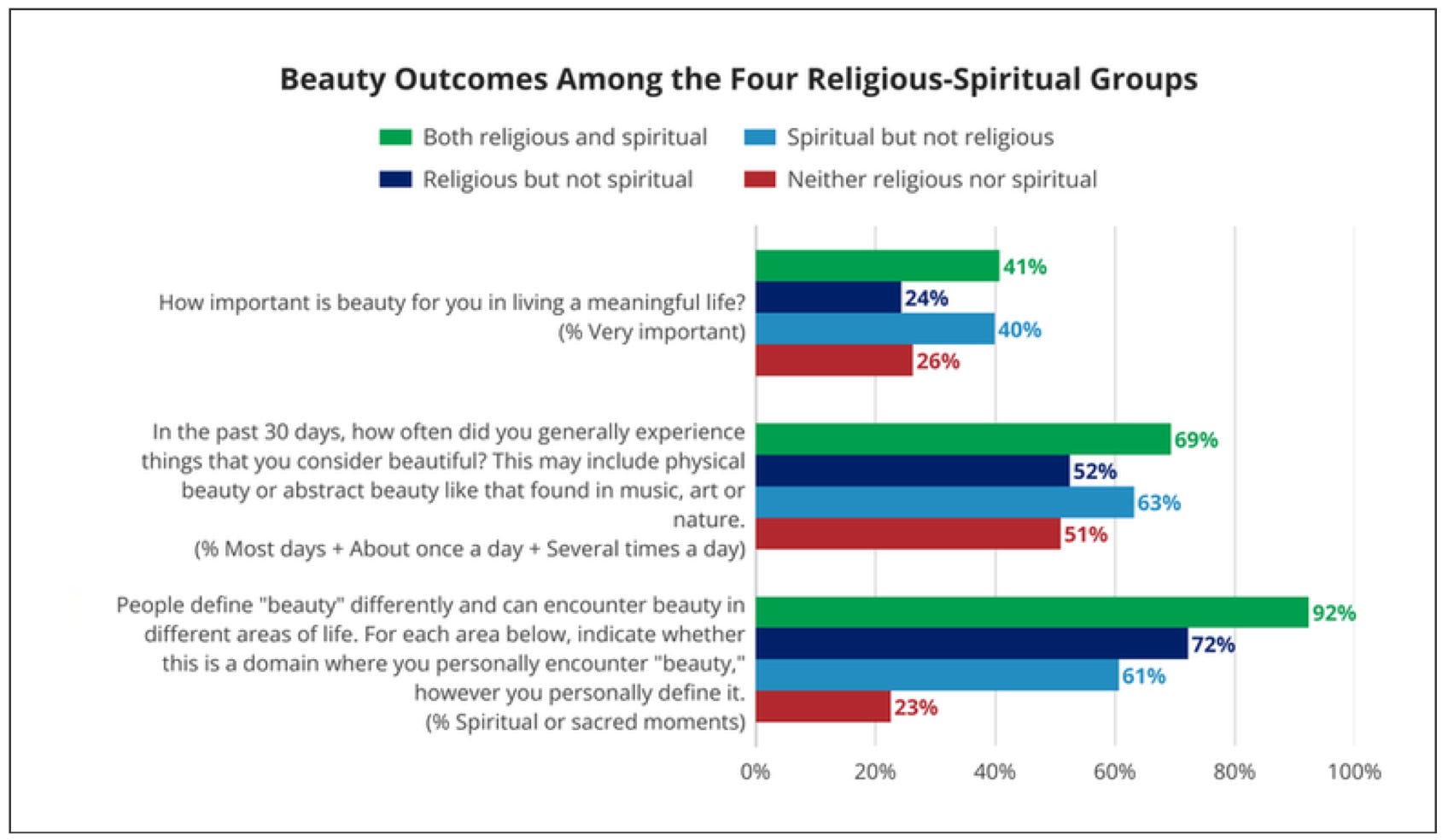
But if we examine instead who finds beauty specifically in sacred moments, religious identity takes over: 92% of the religious-and-spiritual say yes, compared to 72% of the religious-but-not-spiritual, 61% of the spiritual-but-not-religious, and 23% of those who are neither.
Women and men find beauty in different places.
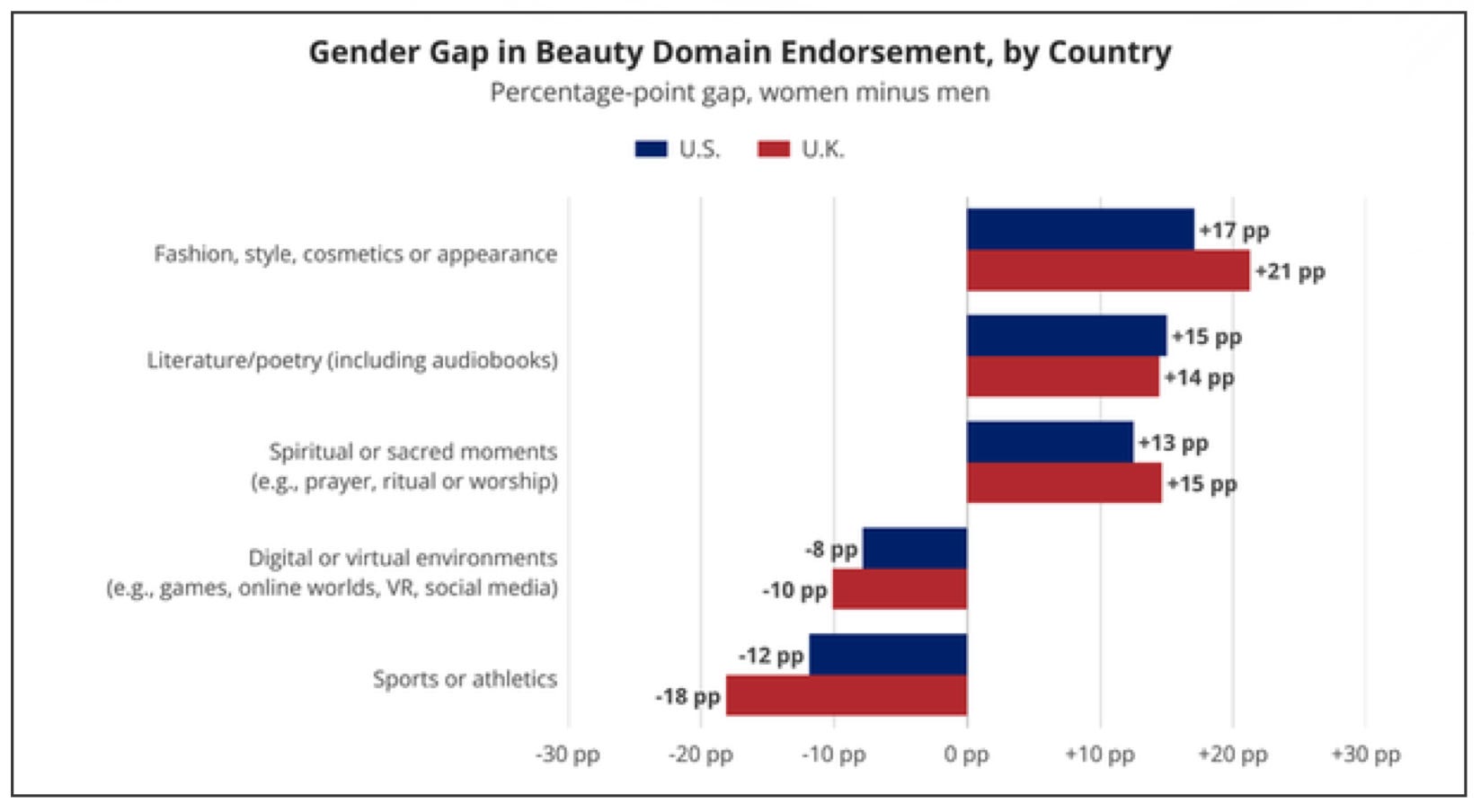
In both countries, women are more likely than men to find beauty in fashion / style / cosmetics, literature, and in sacred / spiritual moments, while men are more likely to find it in sports and digital / online environments. The size of the gender gap in each domain is remarkably similar on both sides of the Atlantic.
Beauty is relatively scarce at work, which is where it may matter most.
In our survey we defined work broadly, to include what retirees, students, homemakers and volunteers spend their time doing. A third of Americans and 42% of Britons say their work never felt beautiful in the past month. Only 24% of Americans and 14% of Britons experience it at least three or four times a week. The frequency of finding beauty at work is associated with significantly higher flourishing and lower burnout.
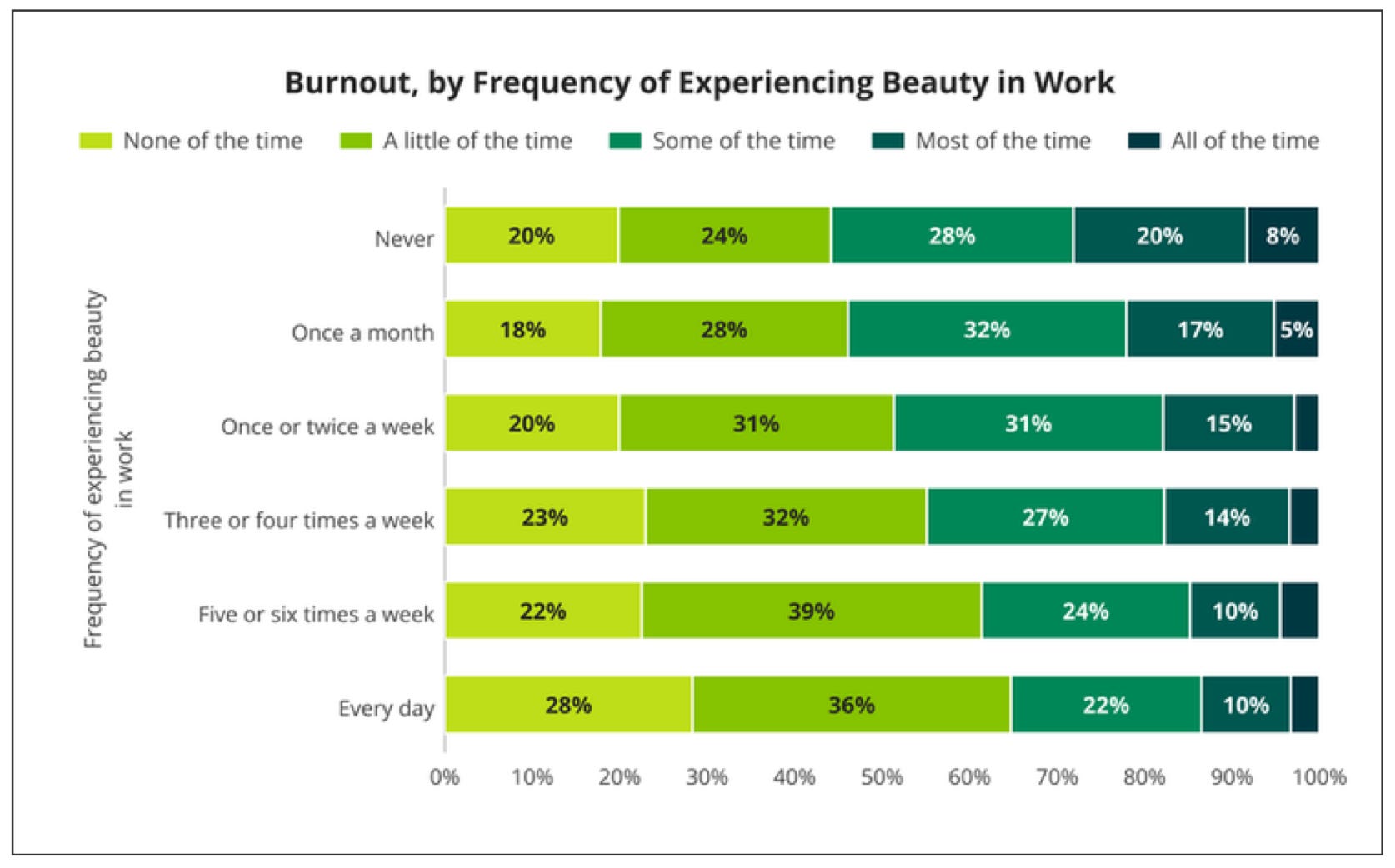
Among those who do find beauty in their work, it is primarily in relationships and interactions. However, once we account for statistical controls, it is beauty found through success or accomplishment—perhaps the satisfaction of seeing things through to completion—is the source most strongly tied to flourishing. An asphalt technician in Georgia described a freshly paved road as “a beautiful, crisp, clean black top.” We also find that more frequent beauty at work is associated with lower burnout.
We’re deeply ambivalent about technology.
People who think beauty is important to a meaningful life are more likely to say AI’s long-term risks outweigh its benefits (57%, vs. 49% among those who don’t think that beauty is important). But they’re no more or less likely to think AI helps them be creative (28% versus 27%). At the same time, daily chatbot users are more likely than non-users to find beauty in digital environments (46% vs. 32%). And people who encounter beauty several times a day are more positive about social media’s effect on their lives (42%) than those who rarely encounter it (30%). The frequency of encountering beauty in daily life has no relationship with whether people think social media hurts their mental health. Technology use does not seem to be crowding out beauty as far as we can tell.
Visit our website to learn more about our project and report and to download the full report.
We hope these findings can be the start of some serious discussion about the role of beauty in our lives and in our work, and about what it would mean to take it seriously as something people need rather than something they get to when there’s time. Our survey can tell you that beauty is associated with flourishing—in our work and in our lives more generally. But it can’t tell you what to do about that in a hospital or school or a parish or a company. That’s where we’d love to pursue further discussion and would welcome your help. If you’d like us to present the study findings to your group or organization, lead a discussion around them, or think with you about how they might apply to what you do, please do get in touch.