

Where do you think the vast majority of Americans encounter beauty? This is a question I’ve been asking friends lately to see what they come up with. Some of them start with nature. Many are quick to bring up fashion and cosmetics, which is, after all, what comes up first if you Google “beauty.” Many say fine art. And movies.
On nature, they’re right. On the rest, the data turn out to be stranger than you’d think.
I was surprised too when I saw the results of a large nationally representative survey of the US population (nearly 5,000 adults) that we fielded through Gallup in March 2026, as part of a major research initiative funded by the John Templeton Foundation.
While there’s been growing interest in aesthetic experiences and their links to wellbeing, our survey provides what may be the most detailed map yet of where members of the general public actually encounter beauty across the domains of everyday life.
We asked people, among other things, where in their lives they encounter beauty, how often, and how much it matters to them. (To prevent bias in survey recruitment related to beauty or aesthetics or spirituality, we called it the “Experiences in Life” survey. In the public release, we’re calling it the “Beauty and Belief” study).
It turns out that beauty for most Americans has less to do with luxury or the various superficial connotations many of us attach to the term, and much more to do with relationships and meaning. Beauty also turns out to be one of the better predictors we have of who is flourishing and who is not.
Over the next few posts, I’ll share some key themes from our data. More substantial analyses are underway, and we’re presenting wrapping up a 5000-person UK population survey as well. For now, here are some highlights of what we found.
1. Where do Americans find beauty?
We asked respondents the following question: People define “beauty” differently and can encounter beauty in different areas of life. For each area below, indicate whether this is a domain where you personally encounter “beauty”, however you personally define it.
We gave them 15 prompts, and allowed them to write in other options as well. Three things stand out to me from these results.
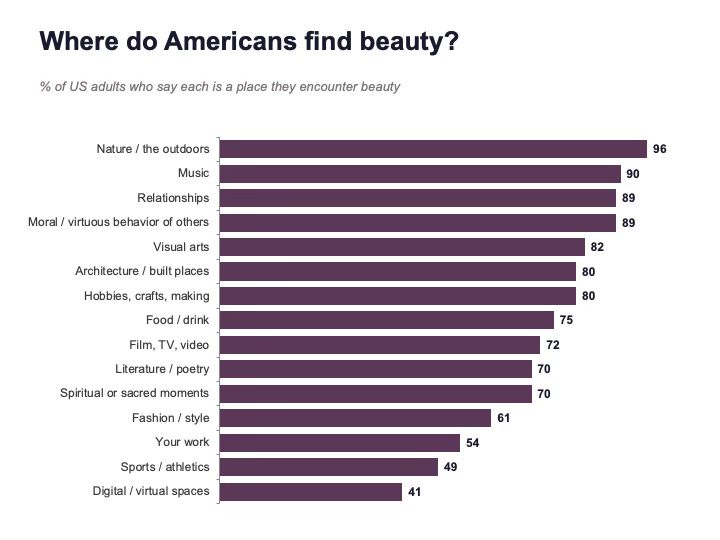
The first is that nature is essentially universal as a source of beauty: 96% of Americans say they encounter beauty in the outdoors. There is no age, gender, class, or political subgroup in our data where this drops below 90%. Whatever else divides Americans, looking at the natural world doesn’t.
The second is that 89% of Americans find beauty in relationships and in moral/virtuous behavior of others. I thought “virtue” might be seen as old-fashioned and outmoded, but that doesn’t appear to be the case. This echoes Dacher Keltner’s finding that the most universal form of awe is moral beauty. In the long history of writing about aesthetics, the beauty of moral character is one of the oldest categories, and one we’ve mostly stopped talking about. It’s curious that we’ve largely abandoned aesthetic vocabulary about character and virtue in public conversation but it remains something that ordinary people are still attuned to. This may be more interesting to philosophers and theologians than to social scientists, but it’s the kind of finding that should reshape how we talk about virtue, recognition, and public role models (and I’d be curious to know what my colleagues Luke Burgis and Dr. Andrew Abela who are experts on mimesis and virtue respectively would make of this finding).
The third is what’s at the bottom of the chart: work (54%), sports (49%), and digital/virtual spaces (41%). Two of those three (work and digital) are domains where Americans spend an increasing share of their waking hours. The places we spend most of our days are not generally the places we find beauty.
2. Most Americans encounter beauty almost every day
We also asked: In the past 30 days, how often did you generally experience things that you consider beautiful? This may include physical beauty or abstract beauty like that found in music, art, or nature.
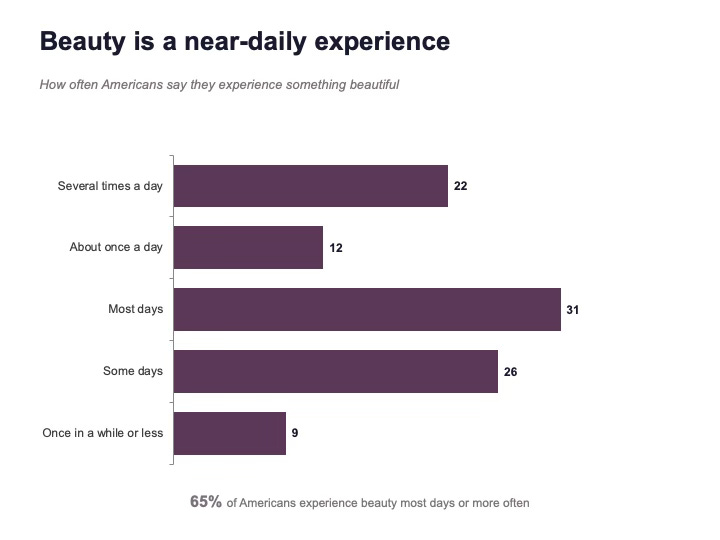
Beauty, it turns out, is not a rare experience: 34% of US adults say they experience something beautiful at least once a day; another 31% say “most days.” So two-thirds of Americans encounter beauty at least on most days. Fewer than one in ten experience it less than weekly.
I don’t know about you but this is a lot more frequently than I was expecting.
3. People who encounter beauty more often are flourishing more
We measured well-being using the Harvard Flourishing Measure, a 12-item, 0-to-120 scale that captures happiness, health, meaning, character, relationships, and material stability. When you plot flourishing against how often people experience beauty in the past month, you get a straight, steep line. People who experience beauty several times a day score 92 on the Flourishing Index; people who rarely or never experience beauty score 68. Those 24 points are a huge gap on a 120-point scale.
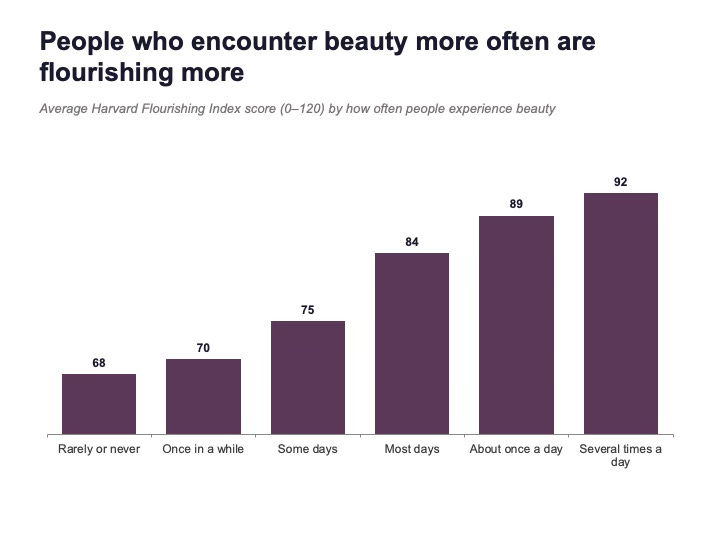
Something important to note is that this is a cross-sectional association; it tells us about correlation but not causation. The data don’t prove that experiencing beauty causes people to flourish. It could be that flourishing people are more attentive to beauty. Or that some third factor that we haven’t measured drives both. But the relationship is substantial and clean and is not explained away even when we control for age, sex, race, education, income, region, religion, and personality. Whatever the mechanism, beauty and flourishing travel together in American life. (In our earlier research, we found this relationship between higher frequency of aesthetic experiences and flourishing to hold in a global study of scientists, so our present finding confirms that there’s indeed something generalizable to this relationship).
4. Beauty matters for a meaningful life
Beyond frequency, we asked Americans directly: how important is beauty to a meaningful life? The answer is decisively yes. Fully 83% say it’s either somewhat or very important; only 2% say “not at all.” This is a near-universal claim about what makes a life meaningful.
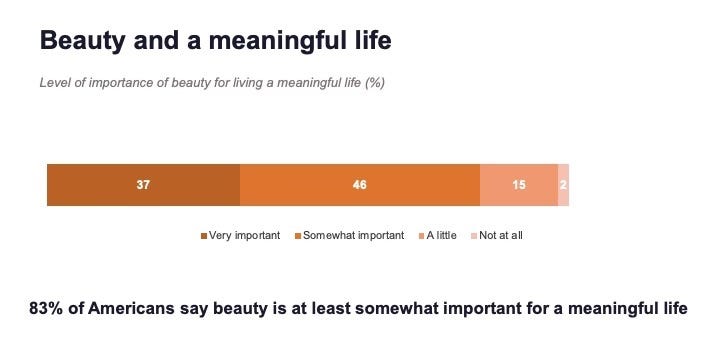
Women are far more likely than men to call beauty “very” important (43% versus 30%). Importance of beauty for a meaningful life also rises modestly with education (from 33% to 43% across education levels for “very important”), but is essentially flat by age and political categories.
5. Beauty matters across age groups
We might be tempted to think that the young are more apt to encounter beauty and are less jaded; or conversely, that older people are more attuned to beauty in ordinary life. But age, it seems, doesn’t make much of a difference when it comes to the importance of beauty or the frequency of encountering it.
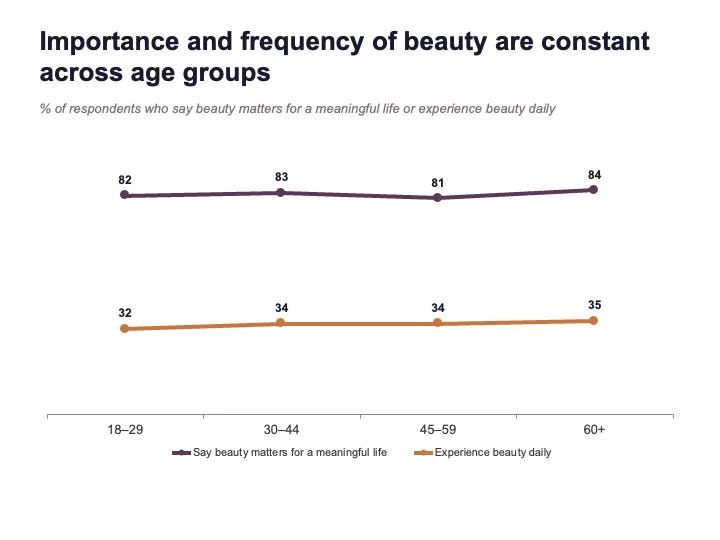
At every age, between 82% and 84% of Americans say beauty matters for a meaningful life; between 32% and 35% experience it daily. The lines are essentially flat from age 18 to 85+.
That doesn’t mean nothing changes with age, though.
6. There are differences between the young and the old
When you ask what kinds of beauty people are encountering, age shapes the answer substantially. Younger adults are nearly twice as likely as older adults to find beauty in digital/virtual spaces (55% vs 29%) and 20 percentage points more likely in fashion, style, and cosmetics (72% vs 52%). The picture inverts for what you might call the older domains: moral character of others is endorsed by 93% of adults 60 and over, compared with 84% of those under 30, and spiritual or sacred moments show a similar edge for older Americans.
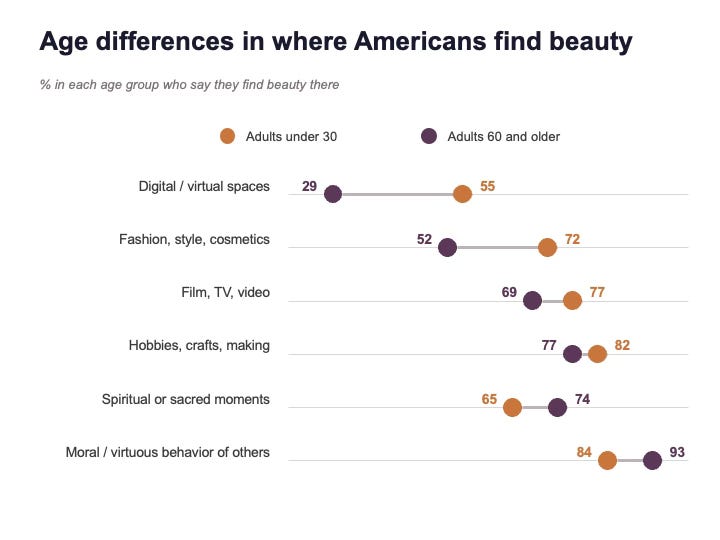
To be clear, both groups find some beauty in all of these domains. Even in digital and virtual spaces, the widest gap, is endorsed by 55% of young adults and 29% of older Americans, so it’s not a question of presence vs absence of beauty. Not surprisingly, younger Americans skew toward digital and expressive arenas, and older Americans toward character and the sacred.
7. Men and women differ on certain domains of beauty
Nature, music, relationships, food, and moral character are basically gender-neutral. On other points, there’s some divergence.
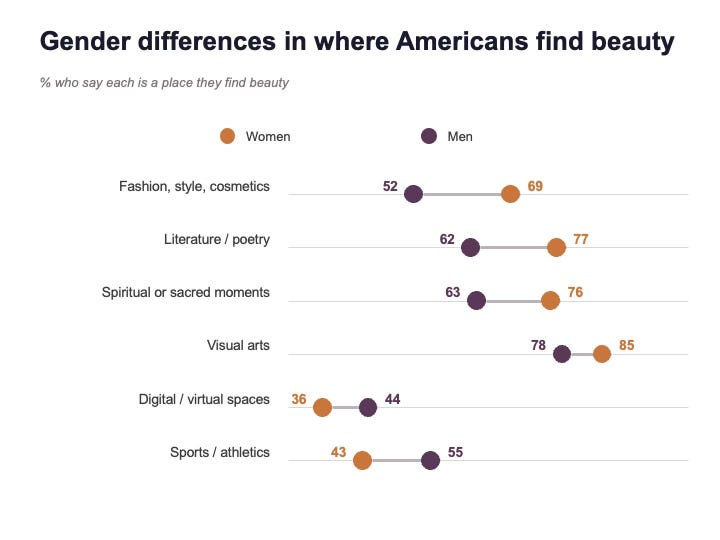
Women lead in the expressive and contemplative domains: fashion, literature, spiritual moments, and visual arts. Men lead in the two domains that have the least overall endorsement when it comes to beauty: sports (55% vs 43%) and digital/virtual environments (44% vs 36%). The gender pattern doesn’t suggest that men and women substantially disagree about what counts as beautiful. It’s that women find beauty in more of the expressive, spiritual, and cultivated domains than men do, and that the things men disproportionately endorse are minority domains for both genders.
This matches the earlier finding that women are more likely than men to call beauty “very” important for a meaningful life. They engage with more domains, more intensely, on average.
8. Where social class matters (and doesn’t)
Another assumption we might have is that beauty is heavily patterned by social class. Here, we find that encountering beauty in nature is essentially universal at every education level: 94% among Americans with high school or less, 98% among graduate-degree holders. But the arts are a different story.
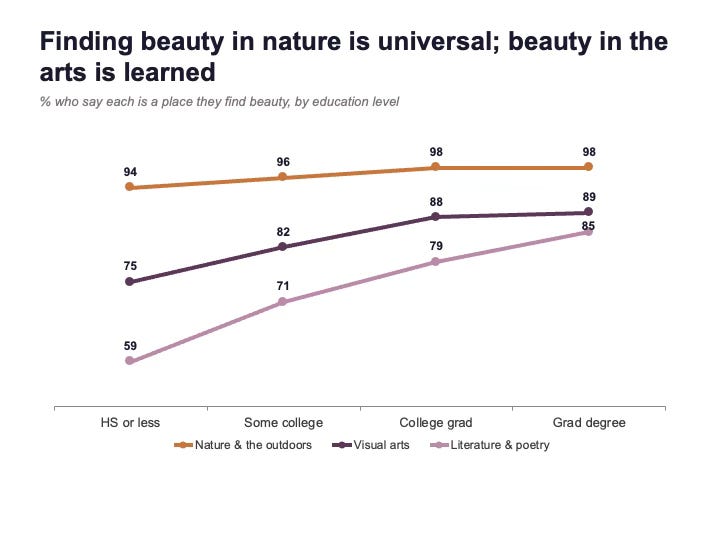
Visual arts as a source of beauty climbs from 75% to 89% across education levels. Literature and poetry climb steepest of all, from 59% to 85%. The more “cultivated” the domain, the steeper the slope.
Beauty itself is broadly distributed in American life, but particular aesthetic domains (or traditions really: the literary, the artistic, the architectural) track education. We could spend a lot of time arguing whether this is because schools cultivate aesthetic capacity or because the educated were already predisposed to engage with these traditions. What the data tell us cleanly is the descriptive fact: nature is shared; the arts are not.
What’s coming next
These are just a few of the key highlights for now. There’s lots more data to explore and analysis to be done, and I’m especially looking forward to comparisons with the UK once those data come in. Here are a few more things I’m planning to explore.
The work problem is real, and probably getting worse. Only 54% of Americans find beauty in their own work. And the frequency of encountering beauty at work turns out to be one of the strongest correlates of flourishing we measured. (I haven’t shown that in this post; I’m planning a separate one because there’s a lot more to say about these data). But in an economy increasingly dominated by remote work, AI, and disengagement, this looks like a structural problem in how American adults spend their days, and I don’t see it getting better. I’ll say more about this in a future post.
How, if at all, is beauty related to our use and views of AI? Next week, Pope Leo XIV is releasing a new encyclical, and I’m eagerly looking forward to it. Our survey has some data on how people use AI, what they think about it, and how it does (and doesn’t) intersect with social media use, religious practice, and wellbeing. Some of those findings may speak directly to what the encyclical will address.
That’s all for now; stay tuned for more.