

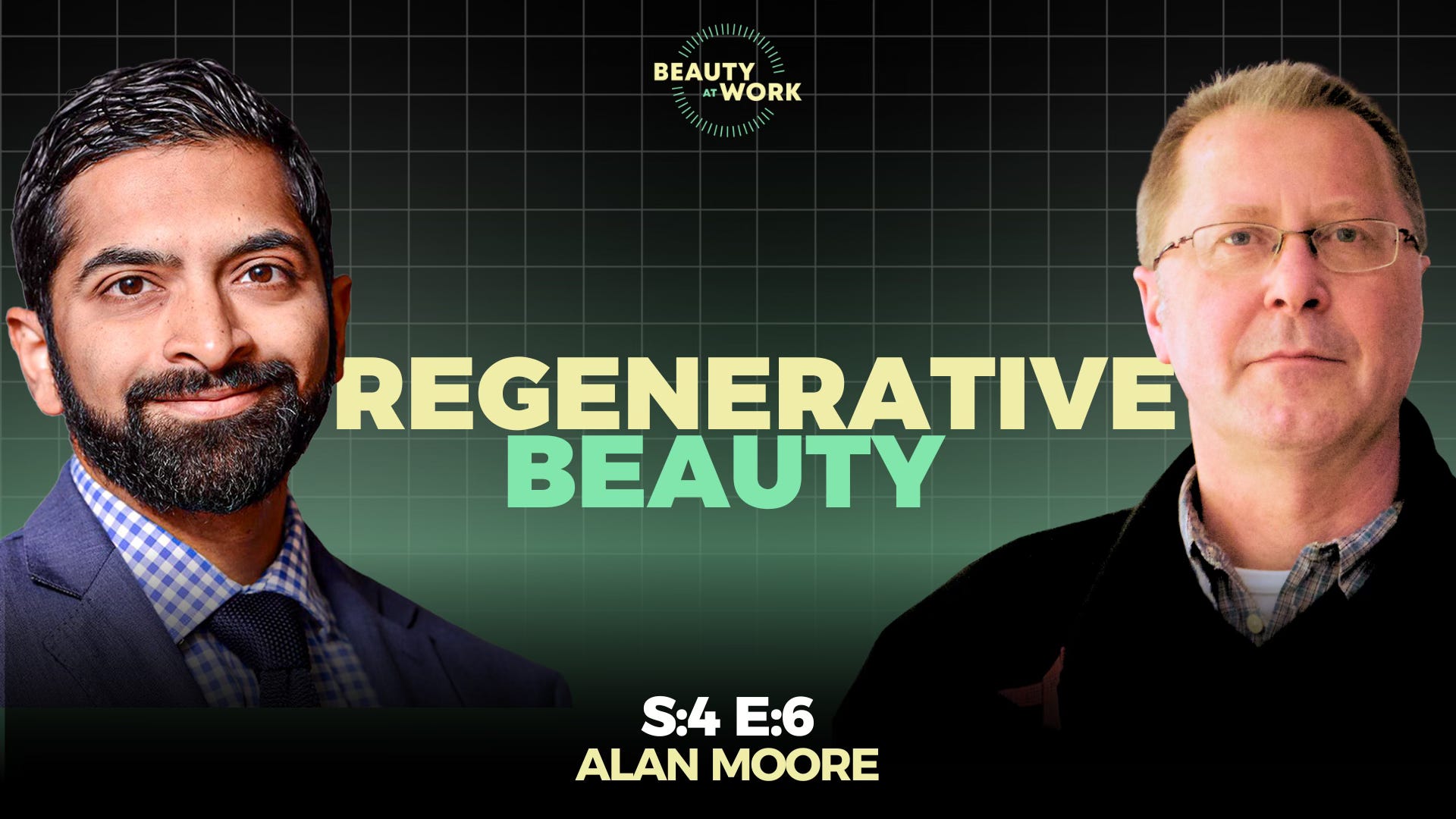
When Alan Moore sent me a copy of his book Do Build: How to Make and Lead a Business the World Needs, he signed it with a phrase that has stayed with me: “Beauty is the ultimate metric.”
Indeed, what if beauty—rather than efficiency or growth or profit—were treated as the ultimate metric for business decisions? What if beauty were not simply an afterthought, or relegated to surface-level aesthetics, but treated as a criterion that could tell us, from the beginning, whether the work is worth doing at all?
Alan Moore calls himself a craftsman of beautiful business—a business innovator, author, and speaker whose life’s work centers on one simple but radical idea: beauty is not a luxury in business, but a necessity. He has designed everything from books to organizations, working across six continents with artists, entrepreneurs, and leadership teams. He has advised companies including PayPal, Microsoft, and Interface, taught at institutions such as MIT, INSEAD, and the Sloan School of Management, and helped guide some of the world’s most innovative enterprises. Alan is the author of four books, including Do Design: Why Beauty Is Key to Everything. His work has been featured in outlets such as the BBC, The Guardian, Stanford Social Innovation Review, and The Huffington Post.
Alan describes beauty as a kind of homecoming: a return to self, to others, and to the natural world that sustains us. Alan’s work helps organizations rethink innovation through the lens of beauty. Drawing on decades of experience working across design, publishing, technology, and business, Alan reflects on the transition from an analog to a digital world, and on what we gained and lost along the way.
Innovation, he insists, is not primarily about disruption or novelty. Rather, it is about seeing latent potential: unmet human needs waiting to be recognized and served. The danger of our current economic imagination is that it rewards speed, scale, and extraction, often at the expense of truth, dignity, and long-term flourishing. Beauty, by contrast, asks a different set of questions. Does this matter? Is it truthful? Is it regenerative? Will it endure?
When beauty is present, things tend to last. When it is absent, even the most efficient systems eventually collapse under their own weight.
We talk about Shaker furniture and why it still feels right centuries later; about inevitability in design—when something feels as though it could not have been otherwise; about nature as the longest-running R&D program humanity has ever known; why regeneration (rather than sustainability) should be our guiding aim; and about the courage it takes to ask, in moments of decision: Is this the most beautiful choice we can make?
You can listen to my conversation with Alan Moore in two parts (here and here), watch the video below, or read the unedited transcript that follows. Let me know what you think of Alan’s argument and the episode.
Brandon: Hello, Alan. It is wonderful to see you. Thanks so much for joining us on the podcast.
Alan: It’s fantastic to be here with you, Brandon. Thank you for the invitation. I’m very much looking forward to our conversation.
Brandon: Yeah, me too. Yeah, there’s so much I’ve learned from your work. But before we talk about your books, I want to ask you—as I do with all my guests—could you share a memory of beauty that lingers with you since your childhood, something that stays with you till today?
Alan: So this is a very easy one for me to answer. Actually, it links right back to me writing Do Design. When I was thinking about writing the book, I really had this question in myself about being feeling very lost and how could I write my way home to where I was. We’re going back to, well, more than 10 years actually, because the book was published 10 years ago, or nearly 10 years ago. And I sat with this question, which was: there’s an answer within me that I need to go and find. So how do I come home? That was the question—how do I come home?
A couple of years before I wrote Do Design, I remember having this very powerful memory of being on the beach with my family at the age of 7. So I kind of saw my mother on the beach. She was wearing a skirt and a nifty jumper, bare-legged. She was incredibly happy and playful. My mom wasn’t always like that. It’s not to say she was a bad person, but she struggled with lots of different things. How do you put food on the table? How do you manage the complexity of this family that we’ve got going on here? I saw my father, who actually never had a lot of money in his life. He was dyslexic like me, but he was an incredibly emotionally intelligent man. He was always there for us as a family, as individuals. You could never put a Rizla paper between my mother and my father. It was something that I kind of reflected on. They were married for the best part of 50 years. They’re both sadly gone now, but there they were. Then I thought about my brother and my sister, and I saw them—unconditional love for both of them in many ways.
Then I saw myself. In those days, I had long blonde platinum hair, a very different hairstyle to the one I’ve got these days. I’m playing with my toys on the beach. I thought I’m at one with those I love the most. I’m at one with myself. A part of my journey is not being at one with myself. In many ways, actually, the writing of Do Design was very much about not being in a good place at all and I’m at one with the natural world. So you imagine, like if you had a drone shot, this image on this little boy in his red shorts with his long blonde platinum hair pulling back on this beach in Cornwall, which is where we were. Nobody else is on the beach. We seem to specialize in finding beaches that nobody else was on, which I kind of love. The sea is twinkling like diamonds. The sky is blue. Then you’re pulling back on this kind of family, which is in union. I thought, what is the one word that could describe that experience? The word that I found was beauty. It was that kind of idea of coming home to myself, my family, the natural world around me—thinking even about the kind of we are atomic. We are also in a large cosmos that kind of compelled me to feel that I had to go on that journey to write about beauty as something as an exploration of myself and a homecoming—this is what I call it—to what was meaningful. So that’s my story about beauty.
Brandon: Yeah, it’s a word that I’ve only encountered in some context—beauty as related to a sense of home. I’ve come across it often among people in the hospitality industry—restaurateurs, cocktail bar owners, et cetera. And even, I suppose architecture, in some elements of architectural design, they talk about hominess. But it’s generally not commonly mentioned as an aesthetic principle, right—the sense of feeling at home, being at home? But I think it’s so central to so much of our experience of beauty, you know.
Alan: I completely agree. I mean, I say beauty is our homecoming. In pretty much these last eight years that I’ve been researching and working on that idea as a concept, it’s very rarely that I find someone that is not engaged with the principle of beauty could be something of immense value to people. So the kind of way that people would dismiss you is, well, beauty is in the eye of the beholder. It’s only about ephemeral things.
Actually, when I wrote Do Design, why beauty is key to everything, I did no research. I just wrote from my heart and my knowledge and my wisdom of what I knew. I mean, I’ve written a number of books beforehand and did a lot of research around those things. This is something I wanted to do very differently. And what is very clear to me is that if you turn up to talk about beauty with people—albeit, yes, I agree with you—it makes people a little bit uncomfortable. It makes people a little bit — I don’t know. What would be the word? A little bit guarded to begin with, because where are we going with this? But actually, intuitively, people understand that beauty is something that links to them not up here. It’s not in the brain. It’s actually within the body. It’s a soulful reaction and need, actually. There’s a need.
There’s a lady called Fiona Reynolds who wrote a book called The Fight for Beauty. She was Director-General of the National Trust for many, many years. In her book, she says, People will strive for beauty, given half the chance, if they know that it is a possibility—or a potential—for them to get their hands on. But it’s a spiritual thing. I think even before organized religions were created some two and a half thousand years ago, I think man, mankind, had an understanding that this idea of beauty was something that was absolutely fundamental to them, their lives, their well-being. It connected them to the cosmos, to the stars. It connected them to the land. They were absolutely part of this entire ecosystem that was creating a life for all to thrive well, is what I think.
Brandon: Yeah, there’s some really interesting research by anthropologists who studied primates. They found if they put video cameras on the heads of macaques, they actually end up going all the way up to the top of the forest canopy and just stare at a sunrise or a sunset. It’s built into us, right? I mean, we really are built for beauty in many ways.
Alan: Yeah.
Brandon: Alan, could you talk a little bit about your career trajectory? What has led you eventually to the point where you’re writing about beautiful business? What has that story been like for you?
Alan: Well, I’ve always led a very creative life, albeit that my mom—bless her—really didn’t think that I would ever earn any money from being creative. So I was discouraged from doing anything creative at school. But actually, I was playing the guitar from the age of 12. I was writing songs, poetry. I did a lot of acting, et cetera, et cetera. But then into my professional career, I studied book publishing at college, which is purely serendipitous. So I became a typographer, a book designer, a graphic designer. I became an artist. I worked as an art director, a creative director. I sat at the transition between analog and digital in my creative life.
So we were doing things like creating the customer journey, UX, designing brands, product services—when all of these things weren’t specialisms by any stretch of the imagination. We just worked at, what I would call, a communications agency. Someone would come in the door one day and say, “Could you help me launch a global car brand? Could you help us design a 3G mobile phone service? Could you help us launch smartphones on a global basis around the world?” And how would you do that? I was very privileged in many respects to kind of have that ability to sort of touch all of those different things, which now I think has become very siloed. But in the days that we were working, you didn’t have all of those different specializations as all companies. You just did what needed to be done. We were pioneers in many respects.
Then my side projects were the writing that I was very interested in. Because I could see a world that was being profoundly changed by—initially, that was 2004—digital technologies in those days, particularly mobile. It was interesting to then also see lots of incumbent companies that weren’t really interested in the amount of disruption that was going to come into the world. So 2005 to 2010, one of the keywords that you would come across was the word “disruption.” We certainly have been. There’s no doubt about it.
Brandon: Well, that’s a word that’s often used to describe innovation, right? And so, I mean, Clay Christensen’s concept of disruptive innovation really sort of captured people’s imaginations. I’m wondering if you could talk a little bit about your experience in the field of innovation. I know you did some work on that area. What did that entail? What does innovation mean to you? What did it look like in practice, in your work?
Alan: I mean, we worked on physical products. We worked on digital products. I mean, I was writing papers for Microsoft, back in the day before mobile really was a big thing, in terms of trying to help them understand what potential of mobile was. I suppose that whichever client it was, when you were developing those products and services, you were assimilating a lot of information. That is one of the benefits of
being dyslexic, in that you kind of start to compute things in different ways. You could see the potential, I suppose. For me, innovation is about seeing the potential of being out to organize and produce products and services that were never before seen in this world. What you were creating were things that were releasing potential.
I have a slightly different point of view on economics these days. But back then, it was, well, how are you going to help this business grow? What are the needs that people have? And so you were really looking at, if you could design a product and/or a service or both. I work both on the B2B side, business to business, as well as business to consumer side of things. You were working incredibly hard to find answers to those questions, which was: what is the fundamental need that is not being met that you could create, that is actually going to kind of go with people, “I really need this to work in my life”? The reality is that there are very few organizations in this world where, to really innovate, you have to go off paced, as a sense. You need to go into uncharted territory. You’re going to into no man’s land. There’s no guarantee of success, other than the fact that you are absolutely convicted that what it is you’re going to deliver is going to be absolutely right for this organization and/or this company.
I have always operated on a gut feeling. There’s a comedian, a guy called Bill Bailey. He’s not on the telly so much anymore. But I always remember him doing this sketch. He says, people come up to me and they say, “Bill, how do you start your jokes? How do you create your jokes?” He said, “Well, I start with a laugh and I work backwards.” How many people do I need to kind of make this? What I realized was, is, in my journey, there were times when creatively you’re taking a massive leap. Because you can see what that vision is in terms of how it’s going to work. So I’ve had many conversations, heated ones sometimes, where actually it’s the storytelling of how you convince people to get over this gap, this leap of faith in a sense, to get them to where they need to get to. Because actually, organizations aren’t really designed for innovation. That’s not why their designed. That’s not their M.O.
Brandon: Yeah, they want to be stable. They want to grow and not deviate too much from what’s working.
Alan: Yeah, which is why you have M&As. Because actually, it’s easier to go and just hoover up a bunch of companies that have gone through the pain, raise their VC money, whatever. They’ve proved the point, which is a shame, I think, actually. Because also, in a sense, my wider vision is: it’s not just then about commercial activity, but it’s about political activity. It’s about communal activity. Even at a city level or a town level, there’s still the need of innovation in terms of how do we solve. For me, the question is: how do we solve this pressing problem? To me, the answer is, well, we’ve got to go all in to find the absolute best answer to that question.
In a sense, it’s a very artistic position that you take. Because when an artist, whoever it is — let’s say it’s Picasso creating the amazing image of Guernica, the German bombing of the Spanish town which became such an icon. Or you could think about Anselm Kiefer as a German artist, for example, or Theaster Gates, an African American artist. These people worked without compromise. I feel that’s where, within a kind of commercial or political context sometimes, we are let down very badly. Because there are too many constrictions on the ability to find that innovative answer to the one that we’re facing.
Brandon: How can beauty be a guide then to the process of innovation, or could it help us sort through which kinds of innovations we need? If there might be an example, even in your own work, where you found beauty to be actually valuable as a decisive criterion.
Alan: Well, it is. I mean, I think that there’s a lot to unpack there. But for me, the principle of beauty is based on nature’s incredible design model, which creates the conditions for all life to thrive. So I say nature has run the longest R&D program we’ve ever witnessed. She’s been around for a long time. She has created conditions for all life to thrive. She’s not interested in sustainability. She’s interested in this idea of regeneration, that also kind of then — but there’s a generosity. Albeit we’re living in some difficult times now because they’re all man-made, I think, in terms of climate change, in terms of the economics, the political economy that we live in, which you are witnessing in America at the moment, which people are witnessing around the world at the same time. There are people that are much more interested in. Nature is powerful, but she’s not interested in power. I think there is a generosity in terms of how she kind of turns up in the world and how we’ve been accommodated. So for me, the grounding of it is: beauty is not about aesthetics. Beauty is about the fundamental laws of how our cosmos and our nature works. And as a specie, we seem to have forgotten that that’s the reality.
Brandon: Yeah, one of my other guests, Lisa Lindahl—who is the inventor of the sports bra—she has a book on beauty where she argues that it’s about cosmology, not cosmetology. That’s the kind of shift, right, that we really need to get people thinking about. It’s not just about superficial, the kinds of things we typically if we do a Google search on beauty, you’ll get everything from the beauty industry, about various makeup products, and so on. That’s not what we’re talking about. It’s hard to get people understand that.
Alan: Well, as I said, I’d go back to my experience over the last years, which is: when you turn up to talk about beauty and you kind of frame it — I talk about my journey into writing about beauty, I connect it to a universal idea. You are talking to people’s souls. You’re not talking to people’s heads. You’re certainly not talking about the color of what’s on people’s fingernails or any other kind of aesthetic things. I mean, ultimately, there is an element of design which is about the aesthetic value of something.
Brandon: Sure.
Alan: But it absolutely, for me, is so much more fundamental than that. We kind of nudged in a way not to want to have this conversation because it’s such a fundamental part of who we are as people. It gets us to ask lots and lots and lots of questions, which I think talk true to power, question so many different things, where people really start to understand that the value of the quality of their lives—from the get go to the end of life—if you were to frame all of that around beauty, people would be making completely different choices and decisions around the type of life that they would be leading, I think.
I woke up to it a little later. Then you wake you up and then you’re in debt. You got a mortgage on your house. You’re making more sorts of choices and decisions, where you to say, what was the most beautiful life I could have led from when I was conscious? I genuinely believe that people were making very different decisions. But it’s anti in terms of the neoliberal kind of story that we’re being fed in terms of what actually a successful and good life looks to us. And in a part, what we’re witnessing at the moment is a complete failure of that narrative and that story, which is why I think we see what we see in terms of
people struggling with politics, with society, with their own personal identities, men’s health. Just a few examples, it’s what I think.
Brandon: Yeah, the criteria that we value—the criteria for success, the criteria for a good life—I think have somehow left out beauty, which is why I think your work is immensely important.
Alan: Thank you.
Brandon: Let’s chat about your first book—or at least the first in this series—Do Design, which I really want to commend you on just the quality and the thoughtfulness that’s gone into even the production of this book. Obviously, you’ve come from a publishing background. Could you say a little bit about what the thought process was behind designing it this way? Because it really feels like a treasure, an object you can treasure—everything from the page quality to the images that have been chosen, to the fonts. Could you say a little bit about what you put into that?
Alan: Well, I mean, that’s got nothing to do with me because that’s The Do Book Company. There’s a publishing company called The Do Book Co, which is run by Miranda West, who I say is the best publisher in the world. People say, “Well, why is that?” And I said, well, she published my book. A very small operation. I think there’s only three of them. They designed the format. So I have no input in that. I just wrote the words.
Brandon: Oh, wow. Okay. Well, it’s very well aligned with — it really does convey everything you’re saying in here to the physical medium in a remarkable way.
Alan: Well, yeah. I suppose the serendipity was, is when I wrote that book, as I said, I’d already written a couple of books before, alongside all the other work that I was doing. But it felt very important to me. I made three key decisions. One was that I would only write in what my friend calls “threepenny words”—threepenny words, as opposed to sixpenny words.
Brandon: Sure.
Alan: Plain English. I wanted to write in a way where if it only took 50 words to say what it is I wanted to say, then I would say that. You know, I got to the point where having read many, many books over my lifetime that were 100,000 words long (and some change), that’s a big dedication. Sometimes you come out with the end of it and you go, “I don’t know what I’m really getting out of this.” And so I felt that that was important. Then the third writing decision was, is, if I could elevate this writing that felt somehow universal, it could elevate it to a form of poetics that could feel that would open a door for people. So I’ve always described Do Design as like, it’s like a TARDIS. There’s not a lot of words, but it covers a lot of ground.
Brandon: Right. Right.
Alan: But it’s a kind of invitation for people to kind of move into, reflect on the ideas and concepts that I’m laying out in that story. Because as you know, telling a story about beauty is a bit complicated because it touches so many different aspects of people’s lives. I mean, that’s really my contribution—the words. You know, all Do Books are published in exactly the same format. There’s variations, I think, in whatever. I mean, I contributed a lot of the pictures, which is what it did.
But the important thing about that book was, two weeks after it was published — I mean, I’ve got a few people that follow me on LinkedIn, but I wouldn’t say I’ve got a massive following. Miranda’s got a small team. There were some goodwill within the community. She called me up two weeks after the book had been published and she said, “You’ve given me a problem.” And I thought, “Oh my God. What have I done?” She said, “Well, the book is sold out. That wasn’t in the business plan, so now we need to go and find the money to republish it.” Even this last quarter, we’re still selling significant quantities of that book. I know it’s gone on and inspired a whole bunch of different people to set up businesses and festivals and whatever. There’s some magic in there, which even I am still a little bit confused about in terms of what it is. Because as I said, I wrote it for myself, to write myself home. But that homecoming — quite often, if I sign a book for people, I will say: “Beauty is our homecoming.”
Brandon: Amazing.
Alan: You should take it a bit more seriously, perhaps.
Brandon: Well, I want to ask you. I mean, you signed my copy Beauty is the Ultimate Metric.
Alan: Indeed.
Brandon: Could you say a little bit about that?
Alan: Well, I mean, there’s this famous saying that everything that gets measured gets made. It was in a workshop that we were running with an organization, and I asked people to give me feedback at the end. This one person wrote on a card: “Beauty is the ultimate metric.” This was from someone that, at the beginning of the session, I think was perhaps a little bit more circumspect in terms of the benefit that they would get from this experience and what it would mean to them.
And so, in a sense, it’s a bit like you watch the dying of the day. You watch the sunset go down. You watch the sun go up. You have a smell that, I don’t know, it’s your mum’s favorite dish that she cooks for you. For me, that’s beauty. That’s the metric. Trying to get people to think about it in terms of that it has an immense value is very important. Because everything else in our lives are measured, you know? You go to the petrol pump. You have a price per liter or a gallon for the diesel or the petrol you’re putting in the car. You go to the supermarket, and you buy some vegetables. They are measured in terms of a price, a value, an equation, whatever of that.
For me, beauty is kind of part of that very important idea of its immense value to all of us in big and small ways. It’s a hug that someone gives somebody else when they really need it—to spend time with someone when they really need it. They’re doing something very beautiful for that person through their generosity. The language around beauty for me is also a very important kind of aspect of how we expand that idea as a concept and a possibility.
Brandon: Yeah, that’s amazing. One of the things you say in the book is that beautiful things endure. You’ve given examples of Shaker chairs—which I was not aware of them until I read your book, actually—and then the insistence of William Morris, that you should have nothing in your house that you do not know to be useful or believe to be beautiful. Can you talk a bit about those principles? I mean, what makes something endure? What are the qualities of timeless design, perhaps?
Alan: Well, there is, in a sense, no easy answer to that. I mean, the Shakers are interesting because they never wrote about beauty. What they wrote about was truth. Because they were a religious cult, for want of the better word, you know. You might say that their closest relationship will be something like the Amish.
Brandon: Yes.
Alan: The Shakers made everything—from hairpins to chairs, to desks, to houses, to barns, whatever. I mean, they literally made everything. They had a particular style which is very simple, but it was incredibly elegant and very beautiful. Their obsession about truth was, is through their act of their craft and their making. They would reveal the truth and the spirit in whatever it is that they were creating. Because they had the view that if an angel was ever to come and sit on one of their pieces of furniture or craft making, they would understand the purity of the religious truth in their work.
I’ve always been fascinated by the Shakers. I mean, I came across them as a young man, as a designer. We’ve got some Shaker stuff in the house actually, and it just endures. It’s that quest for truth, I think, is is very important. There’s a story that I can tell you, which was, when I was a young designer, in those days, I was working for some very big contemporary art galleries in London. So I got to work with the likes of Ansel Kiefer, Richard Long, the estate of Andy Warhol, and Helen Chadwick, who’s sadly no longer with us. I got to work with these amazing artists. One of them was a guy called Cecil Collins, who did die many, many years ago. He was a very famous painter, an English painter, born, I think, in about 1908. So when I met him in the ‘80s, he was a very old man. He painted these incredibly spiritual paintings. I can remember Anthony, who was the gallery director, was going away on a holiday—which I was rather pleased about because he was a bit of a tyrant. We sat there, and he said, “You know, Alan, Cecil’s work...” I said, “Yes?” He said, “Well, Cecil’s work...” He said, “They’re quite like jewels. Do you think you could design a catalogue like a jewel for me.?” I was very early on in my design career at this point, my graphic design career at this point. And I said, “Of course, Anthony. I can do that.”
But it was a really interesting brief. Because I went back on the train from London to where I was living in Letchworth, and I thought, “What is a jewel?” Well, a jewel is a gift. It’s priceless. It’s unexpected. A jewel is something that is enduring. It could live forever, like a diamond. A great deal of work goes into creating these very precious objects. They give joy to people. They bring beauty. So I kind of had this kind of conversation with myself about designing a catalogue like a jewel. And so I made all the decisions about this catalogue that I was going to design for Cecil around the idea of making a jewel for him—choice of typeface, format, paper, how it was going to be printed, what the cover was going to look like. Everything, right? At the private view—I got the privilege of going to private views, which sometimes were a little bit overawing, I have to say, actually, because I was so young. But this elderly gentleman comes up to me, and he says: “Are you Alan Moore?” I said I am. He said, “Well, I’m Cecil Collins.” I said, “I know who you are.”
Brandon: Oh, wow.
Alan: He said, “You designed the catalogue.” I said I did. He said, “Well, I have to tell you it’s the most beautiful catalogue anyone has ever designed for me.” And I went, “Well, Cecil, you know, I’m really grateful for what you’ve said.” And so, in a sense, when you quest for the truth — so I teach people, and I talk about the poetic brief. So there’s a brief. It’s like it needs to be this size, this weight, this volume. There’s all sorts of metrics or specifications. There’s money that’s associated to those things. But I say to people that I mentor or teach or work with, I say but there’s another brief. It’s called the poetic brief, and you cannot put a quantitative measure on it. But it’s something that you are questing for. That’s, to me, the heart of beauty also. There is something magical within it. But if you quest for it, it will reward you in extraordinarily wonderful ways.
Brandon: Yeah. Wow. That’s very helpful. I want to ask you about another quote that you have from a mentor of yours, Derek Birdsall: “I design something to be inevitable.” What does inevitability mean? What does that look like in practice? Could you give us an example?
Alan: I mean, again, well, you could look at the Shaker stuff and say there’s an inevitability about their design. You know, I can remember touching the first iPhone. I worked a lot in technology, bizarrely enough, right up until that point. I can remember touching that iPhone, and it just blew my mind. They did something extraordinary in terms of the user experience. But you could say, what is the experience of walking into a hotel that feels inevitable? What is the user experience that you would create for someone that feels inevitable? To me, it’s frictionless. I remember asking Derek. Because he was an incredible man. I remember saying to him, “Well, Derek, you know, what does it look like if a piece of design is inevitable?” He said, “Well, it means that your client cannot imagine it looking any other way.” I suppose the poetic brief, the idea of inevitability were things that I carried through all of my commercial practice and working career—not maybe something that in those days I would brief or talk to people that were working with me or reporting into me or whatever. But I always had this complete vision. The experience should be frictionless. It should be aesthetically beautiful.
I suppose there’s another quote in the book, which is: “Beautiful things are made with love.” And with that becomes this idea that you are achieving the ultimate potential of what it ever is that you’re creating and you’re making. It goes back to, you know, ceramics for me is something that’s very important in my life. There is so much that I look at which is not made by love. It’s got a lot of technical skill, but there’s no truth and there’s no beauty in it. When you pick that thing up, when you pick that object up, it should be giving you joy. And actually, it should give you a direct communication to the maker that made that piece of work. And so, for me, inevitability can manifest itself in all of those kinds of different ways.
You know, I talk about utility. There’s beauty in utility. I’ve lived in enough hotels in my life to see enough knives and forks and spoons which weren’t made by love and certainly didn’t feel inevitable, and all the meal, and all the experience. In a sense, it’s like these things shouldn’t cost you any money. They’re just common sense in terms of what you’re doing. So when you go into a place and, I don’t know, you’re not being served well—the food comes out cold, or the hotel room is kind of not what you expected—the promise of what you’ve offered and what you’ve delivered are two completely different things. Inevitability could actually be surpassing all of that. It should be superlative. It’s the way that I look at it. Because I think it’s possible.
Brandon: Yeah, that seems like a really valuable criterion for thinking about innovation too, right? I mean, I think, often, innovation promises some kind of beauty but underdelivers or brings with it some unintended consequences or maybe shallow novelty, which doesn’t really get to the heart of things.
Alan: Yeah, I mean, I’ve been in enough rooms where—I won’t say the name of the company—there would be a number of occasions when I’d walk into the room and the person would say, “Well, Alan, if we’re not going to talk about a really big number, then there’s no point having this conversation.” It kind of really frustrated me. Because I felt that the question should we be asking is: what is the most amazing experience that we could create for people that would actually give you the big number that you really want? And so people are kind of in a very short term. I mean, that said, just jumping along from that, I got a very good friend who runs a big VC firm here in Cambridge. We were talking a while back. He said, “Your problem, Alan, is your horizon line is completely different to most VCs. You see things in a completely different capacity.” For us, medium term is 5 years. Long term is 10 years, where we need to exit the company and get our money back times 10 what we’re getting. He said, whereas you’re looking at something different. To me, that’s a huge problem. Because when you look back at, say, indigenous culture, indigenous innovation, all of those things that did amazing stuff, that took them a long time to work that stuff out—by looking and observing.
Brandon: Yeah, hundreds of years, right? I mean, really long, long term horizons. I had an interesting conversation a few days ago at Climate Week in New York City. I was part of this conversation around valuing the intangible beauty of nature. We were trying to get impact investors to think about how we can better take beauty into account, in investment decisions and so on. I got a question I sort of pushback from somebody who is running a pension fund and saying, “Look, I mean, this all sounds very nice. But ultimately, I have to still maximize returns for the people I’m serving. I really can’t take something like beauty into account. I mean, it really has to be hard returns in the short term. These are people whose livelihoods depend on me.” Right? And so do you have anything that you might say in response? How would you encourage folks who are trying to think this way?
Alan: I can remember I spoke to a very old friend of mine, a Dutch guy called Jurgen. We would work with a guy that would do a lot of workshopping with pension fund holders, institutional pension funds. Pip would like me to come along. He would call me the wild card, which I always found a bit insulting personally. But there you go. Jurgen and I had not spoken for a long time. I had completely forgotten this conversation. We were in Lisbon, I think it was, and doing this workshop. Pip asked me to give a point of view on something that he had been working on. Jurgen reminded me of this. He said, you stood up. You said to these people that, basically, in this room, we’re managing trillions of dollars, right? And I said, so you have the capacity to actually make change in this world. You have the capacity to get people to make better choices and better decisions about the type of legacy that you want to create. And so you need to think very differently about how you are investing and who you’re investing in. Jurgen said, “I really remember that.”
And so, in Do Build, the second book, we’ve got the 30 designed questions that I formulated after kind of looking at loads and loads of businesses and thinking about their ability to really make meaningful change in this world. I mean, I struggle with the word “impact” because it just feels so masculine, whereas I think that we need a better word. The first question I ask is: does it matter? People talk about a lot of purpose. But I’d say there are various people in various administrations in this world at the moment who have a lot of purpose, but I don’t really think they’re involved in the concepts of beauty and regeneration. And so my question is: does it matter? Does it matter to me? Does it matter to the world? Does it matter to us as a community? So the mattering, as I call it — beauty is a verb. The mattering in a sense is part of that. Does it matter?
There’s another one which is, is it transformative? So are we bringing in technologies, new innovations, solutions that are transformative to the world that we live in? So you could be looking at, say, green jobs, green energy, a different way of doing things in that sense. Is it regenerative? So to the core for me in terms of business is, is what you’re creating regenerative? You could look at that from a technological perspective, an economic perspective. It could be an ecological perspective. So rather than your principal model of it being extractive, it’s regenerative.
The last one is: how will you create legacy? You know, I’ve got a friend of mine who he lives in his five-million-pound house. He’s done very well. I celebrate him for that. I went to see him a couple of years ago. We were sitting there having a catch up. He said, “I don’t know. I love your books. I think they’re great.” He said, “But why should I care?” That made me really sad because he’s got a daughter. She’s five. If he thinks his five-million-pound house is going to protect him from climate change and all the other things that we’re witnessing at the moment, then he’s got another thing coming. He may be lucky. He may have his fortress. But to me, well, as the French will say when they were writing in 1968, “La beauté est dans la rue.“ The beauty is in the streets. It’s every person that is contributing to kind of making that change. So I think those questions that I felt needed to be asked. Because the concept of beauty in that sense is multidimensional. It is complex. It doesn’t need to be complicated, but it requires us to think in a systemic way. It’s not a word I like to use because that makes it hard for other people sometimes too. Well, how do I think in a system? But to me, those questions are really important then in terms of your friend or colleague or participant in your panel asking you that question, which is whether a number of very important questions we need to ask, if actually you’re going to make a significant contribution to what the future looks like. We choose to use the word beauty. Actually, it’s a much richer — when I fight back, it’s like we don’t need to sustain what we’ve got. What we’ve got is rubbish. We’re in a worse place now than we were 20, 30 years ago.
So sustainability is not what we need. What we need is a world where we can describe a better future for all than the one we currently have. That, to me, is the power of potential of beauty. It may not fit into your nice Excel sheets that you can kind of do all this kind of calculations. So it doesn’t really work like that. But what you can see is that if people are happier, if you start to look at loads of studies, if people are happier, then they go to hospital less. People eat healthier. They go to hospital less. The reality is that nature supports all diversity. So trying to turn things into narratives where you’re trying to exclude certain types of human beings from what is acceptable. You’re an immigrant. You’re undocumented, whatever. To me, it seems a completely forced narrative. It’s reductive, as opposed to expansive. That freaks some people out. But actually, I think that’s just how the way the world works. That’s what I would have said to your—
Brandon: Yeah, thank you. The distinction you’re making between — this is, again, your other book there on how to really build essentially a business that is beautiful, does pose, I think, a lot of important questions but also this important distinction between the extractive and regenerative approaches. I think that we really have to make the shift. One of the questions that you raised in the book or that you say that you challenge business leaders to ask—which struck me—is: is this the most beautiful decision we can make? I’m curious to know what responses do you get to that. How do people process that?
Alan: It’s quite a disarming question. I was being interviewed once by someone, and they asked me that question. I said, well, let’s just say there’s a car company that’s in a lot of financial distress. The board is meeting together to discuss how they’re going to deal with what it is they’re going to do. The leading tool is the idea that they’re going to sell the idea to their global marketplace, that diesel cars are much more efficient and a lot less polluting than petrol cars. Then someone on the board sits there and says, “Do you think this is the most beautiful decision that we could make?” The interviewer looked to me, and I said, “So this is all unpacking for you now, isn’t it?” Because the reality is you’re being asked a question about your own honesty, your own ethics, the ethics of this board, the longevity of the impacts that, were you to be found out, would have huge and significant ramifications. Of course, that company is Volkswagen. Ten years after all that happened, I remember meeting a lawyer and he said, “We are still making hay out of the classed actions. I mean, in Germany, they passed the law in Parliament for the first time where a class action could be taken against a company because of what it is they did.
And so, for me, again, it’s a way of really challenging people to think very deeply. So it’s not then about a cerebral exercise. Because actually, your ethics sit in a much deeper heart of the body, is how I believe it. And so I use that as a challenge in terms of the quality of decisions that people might want to take. Yeah, you’re rushing for the short term. That’s still a kind of reality. But the fact is, the time it takes to clear up the consequences of all those awful decisions that people make are incalculable. The money is spent mopping up all of the spilled milk, all of the damage, whatever. To me, it’s a tragedy. Because you kind of look at it and you think, “Well, it didn’t need to be like that in the first place. You just needed to be a little bit more patient.” I don’t know. But people run on the quarterly numbers. They run on their 5-year and 10-year cycles. I would always point them back to, well, nature’s run this incredible design project.
In fact, I was watching this film called Megalith the other day, which is all about the standing stones that have been built all through Europe at incredible scale. Before really there was any form of society that you would call it, there weren’t any big towns or cities. These were just people that were prepared to somehow wherever come together to collectively bring stones that weighed two tons, four tons, five tons, ten tons, to erect places in Brittany, in France, that were just extraordinary, or Stonehenge—which is the most famous one in England, where they obviously understood that there was something about collective transcendence. There was something about our relationship to the stars, to the universe, to the land that was important. That somehow, their collective efforts would be transcendent against anything else that they kind of held in as a belief.
There’s this wonderful book called The Dawn of Everything, written by a guy called David Graeber and David Wengrow. Unfortunately, David Graeber died just before it was published. It really challenges the concept and idea of what an organized society could look like. So the story that we’re being told at the moment, I think, is just but one story of immense possibilities of how we could live our lives. Those things still stand as an incredible monument to human capacity to organize, come together, be together, and transcend together. In a sense, albeit the beauty thing for me is immensely spiritual—that was something that I discovered on my journey—it’s not an organized religion in the sense of whether it’s, well, all the religions that you could throw your hat in the ring at the moment. But we understood that we could transcend and be together. I think beauty plays that role. I think it’s why it’s so important to people, and then it’s why we need to reclaim it for what it needs to be. So I’m really thrilled about the work you’re about to embark on and to go on because I think that story really needs to be brought to people.
Brandon: Yeah, thank you. That’s wonderful. Well, let me ask you perhaps one final piece of advice you could leave our viewers and listeners with. You talk about beauty as a verb, doing beauty. You offer a manifesto of regeneration and the concept of Re. Could you leave us with perhaps some practices? You do offer a number in Do Design, but maybe one or two that could help our viewers and listeners to concretely in daily life do beauty.
Alan: Well, yeah, I mean, I think that maybe in a simple way, find something every day that you believe to be beautiful. It could be a small thing. It doesn’t need to be a big thing. Do you walk every day? Do a 20-minute walk. Just take a walk and say: “This walk is going to be for beauty. It’s going to be for me.” How do I bring beauty into somebody else’s life? So your act of generosity, I think, is very important. Do you write a letter to yourself in terms of, to make my life more beautiful, what would that look like? And to sit with that question, which is, I mean, when I wrote the Do Design: Why Beauty Is Key to Everything book, I mean, I sat with that for a long time. I mean, it was four years, I think, where I just thought there’s something in this that’s really important. I didn’t even know the word was beauty then. I mean, we started off with the question of my experience around beauty.
Your best guide to your best future is within yourself. It’s not within other people. It talks to you if you’re prepared to be patient. Just ask that question. Were I to go home, what would that beautiful home look like to me? Spiritually, work-wise, whatever, rather than feeling that there are opinions and ideas of lots of other people, that I actually know you better than you know yourself. Because no one knows you better than you know yourself. It’s the truth of it.
Brandon: Right. Well, thank you, Alan. This has been really enlightening. Where can we point our viewers and listeners to your work? Where can we learn more about what you’re doing?
Alan: Well, there’s the website www.beautiful.business. Then there’s a new website coming also which is thebeautifuldesignproject.com. That’s about to go live. You can find my books at The Do Book Co. So if you just Google Do Design: Why Beauty Is Key to Everything or Do Build: How to make and Lead a Business the World Needs. Actually, at the Do Book Company, it’s great because you can get a physical paperback, and you can get an e-book at the same time. There’s lots of information on there about me too. So there you go.
Brandon: Fantastic. Wonderful. Thanks again, Alan. This has been such a delight.
Alan: You’re welcome. Okay. Thank you.