

A few weeks ago, I shared highlights from a nationally representative survey of nearly 5,000 Americans showing where it is that they encounter beauty in their lives, and the ways in which it matters to them. We found that for the majority of Americans, beauty has far less to do with the sorts of things we tend usually associate with it such as fashion, cosmetics, museums, and so on, and much more to do with nature, relationships, and moral character (though music and visual art are very much in the top categories).
We’ve now fielded the same survey in the United Kingdom: a nationally representative sample of more than 5,700 British adults in May 2026, again through Gallup, sponsored by the John Templeton Foundation. Here is a first look at where UK residents find beauty. At the end, I’ll offer a brief glimpse of what we’re seeing when we compare the two countries.
Where Britons find beauty
As we did in the US, we asked UK participants the following question: People define “beauty” differently and can encounter beauty in different areas of life. For each area below, indicate whether this is a domain where you personally encounter “beauty”, however you personally define it.
We offered respondents fifteen domains of life. I found it striking that the British map looks very similar to the American one, with almost the same items ranking at the top and the bottom.
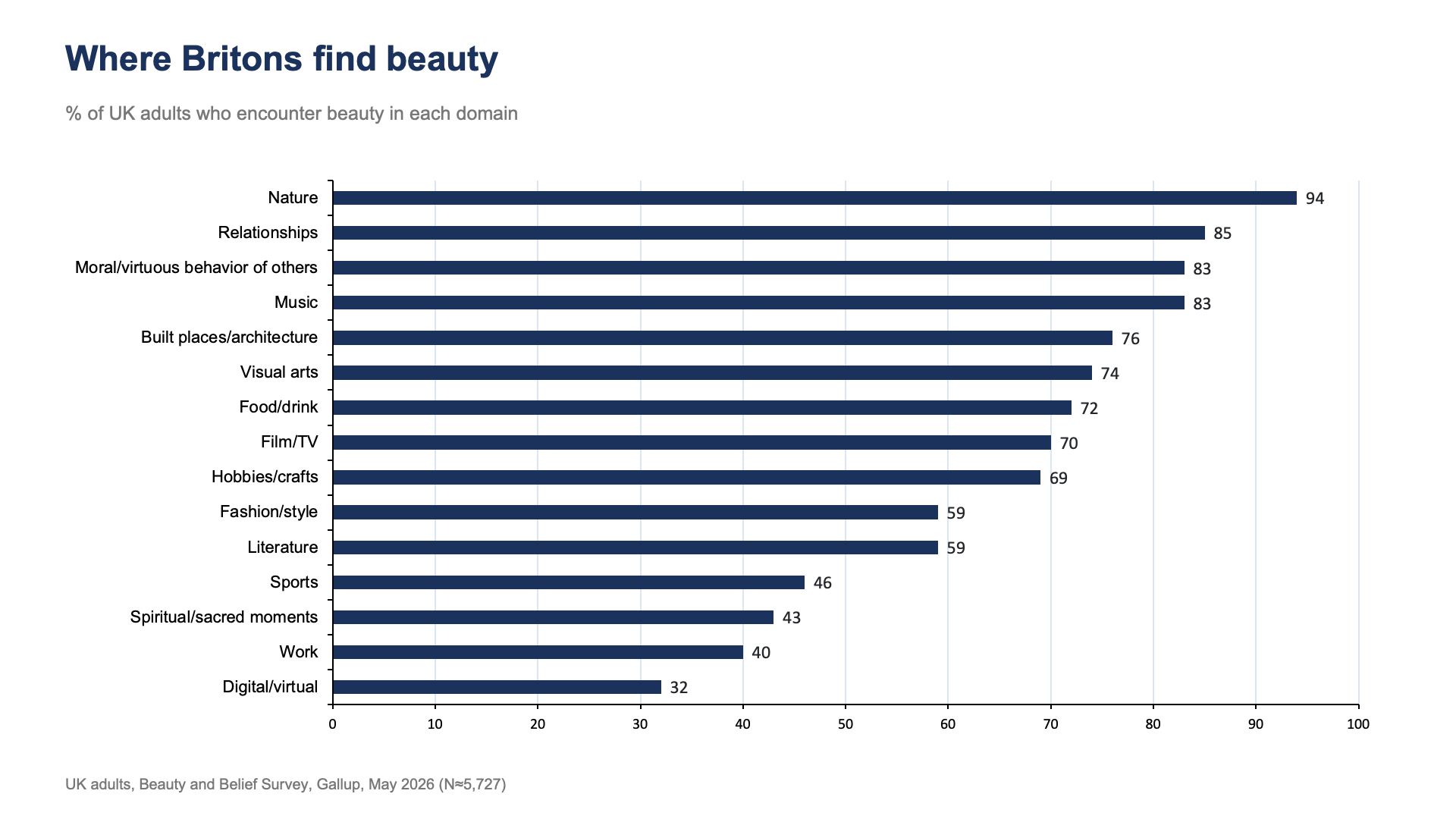
Nature is essentially universal: almost everyone says they find beauty in the natural world. Close behind come relationships, the moral/virtuous behavior of others, and music. Once again I find the moral character result just as striking here as I did in the US.
And at the bottom of the distribution, we see the same pattern as in America: two of the places Britons now spend the largest share of their waking hours—i.e., at work and on screens—are among the least likely to be experienced as beautiful. What is different, quite strikingly, is that sacred and spiritual moments are much less important in the UK as a locus of beauty. Even less than sports!
More beauty is associated with greater flourishing
We measured wellbeing using the Harvard Flourishing Index, which includes indicators of happiness, physical and mental health, meaning, character, relationships, and stability. When you plot it against how often people encounter beauty, you get the same steep line we saw in the US: the more often people experience beauty, the more they flourish.
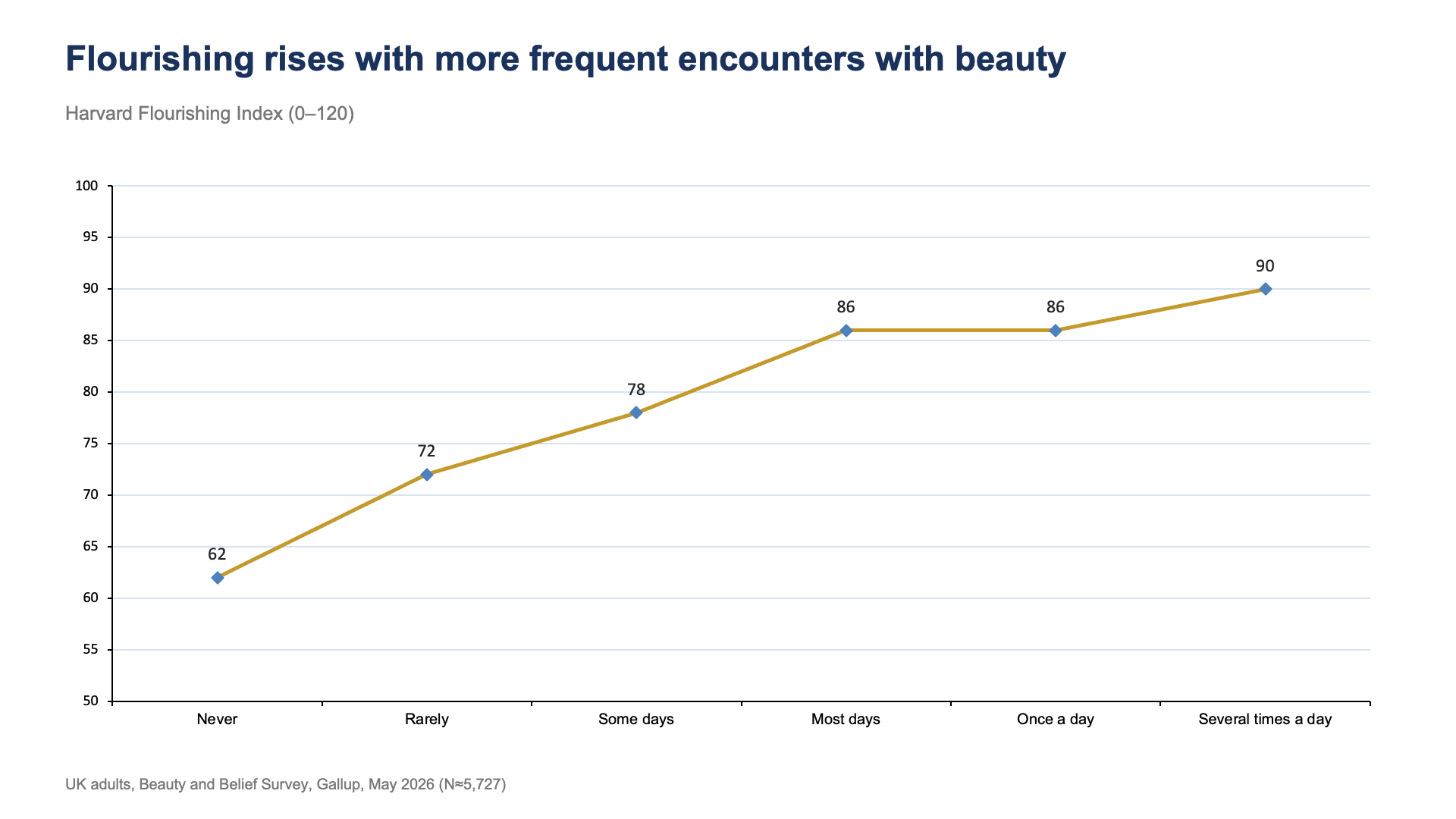
The caution I raised in the initial post from the US is worth restating: this is only a cross-sectional survey, a snapshot in time; it doesn’t mean that beauty necessarily causes flourishing. We have a strong association but cannot confirm the causal direction—it may be that people who are flourishing are also capable of being more attuned to beauty, or that something else drives both—and it would take longitudinal research to figure that out. But the relationship is strong and holds up even after controlling for age, sex, education, income, ethnicity, region, religion, and personality. The fact that it appears just as strongly on both sides of the Atlantic makes it harder to wave away as a quirk of one culture.
Beauty and serious psychological distress
Positive and negative mental health aren’t opposites; psychologists find that they are separate continua, and the presence of one doesn’t indicate the necessary absence of the other. So we also measured serious psychological distress, using a standard clinical screening scale (the Kessler K6). Among Britons who say they almost never encounter beauty, serious distress is dramatically more common—roughly six times the rate found among those who experience beauty several times a day—and the decline is steady across every step in between.
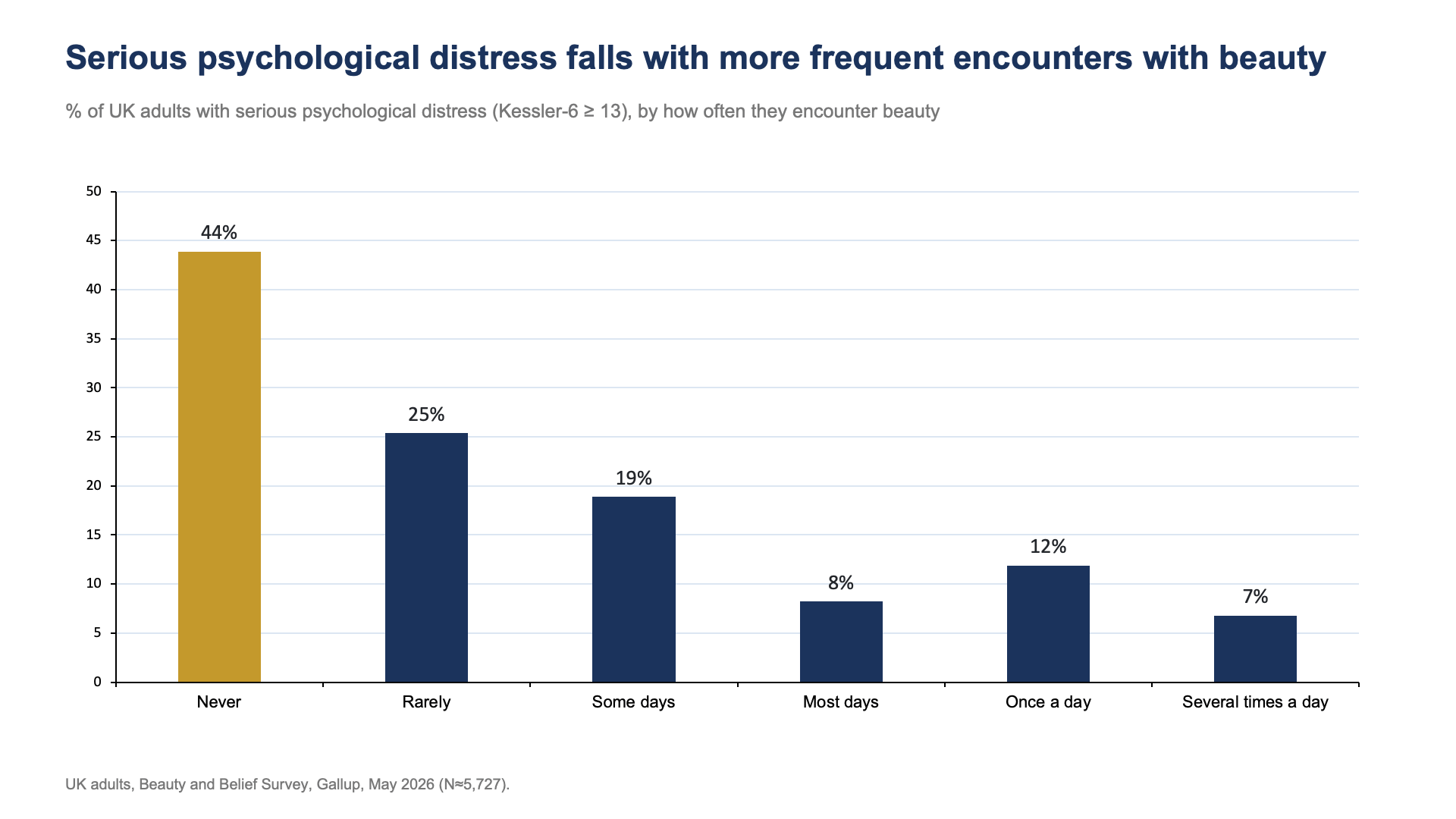
Again because this is a cross-sectional association, it’s possible that the causal arrow could also run the other way. Serious distress may dampen a person’s very capacity to notice beauty, rather than a lack of beauty producing distress. It’s likely that the mechanisms work in both directions, but in any case, we can’t tell from a single snapshot. But whichever way it runs, the finding is that a life with little beauty in it turns out to be a life that is under serious strain.
The frequency and meaningfulness of beauty
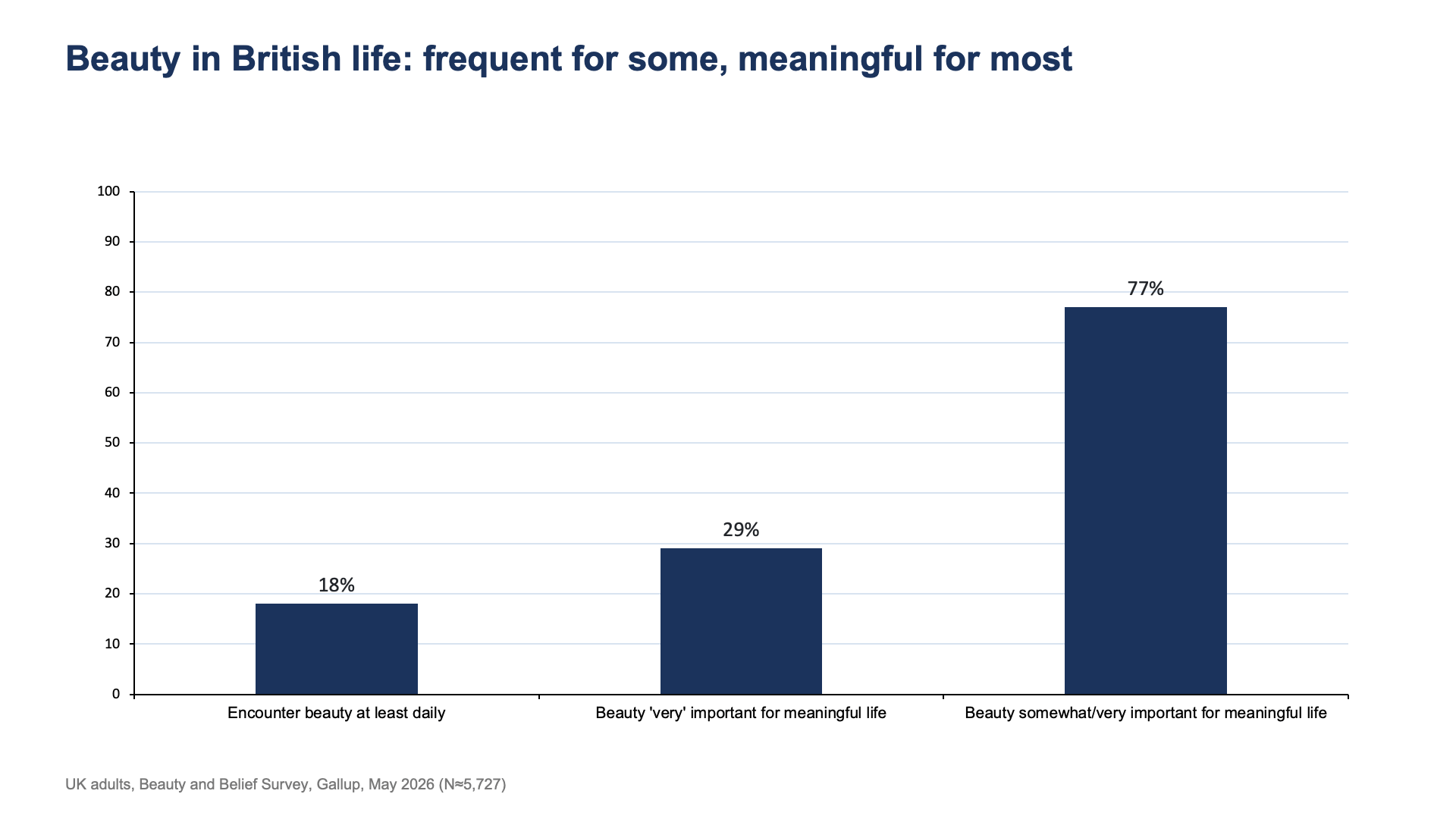
A little over one in six Britons say they experience something beautiful every day, roughly half the American rate. But it’s still widely held to matter: most Britons say beauty is important to a meaningful life, and a sizable minority call it very important. Beauty in British life is, we might say, less of an everyday event but still broadly cherished; it’s frequent for some and meaningful for most.
UK residents who describe themselves as spiritual (whether or not they’re religious) are far more likely to call beauty very important to a meaningful life (roughly two in five, versus one in five among the non-spiritual) and to encounter it daily. Notably, it’s the spiritual dimension that matters here: those who consider themselves religious-but-not-spiritual look much like those who are neither.
A quiet stirring? Beauty and religious/spiritual change
There’s been a lot of recent controversy around the reports of a “quiet revival” of religion in the UK. The main claim from the Bible Society’s Quiet Revival report (based on YouGov data) was retracted in early 2026 after YouGov confirmed that key quality-control safeguards on the sample weren’t activated, leaving the results unreliable. Critics had also warned that opt-in online panels are especially vulnerable to junk respondents when measuring hard-to-reach groups like young people. Whether a genuine shift is underway remains an open question that merits ongoing inquiry.
Our study overcomes the specific problem of opt-in panels by using a probability sample fielded through Gallup. However, because ours was a web-only survey, it likely under-represents the least connected and also some of the more religious segments of the population. The population weights Gallup applied help correct for this, but weighting can only adjust for who is in the sample and not fully recover those a web survey never reaches. If anything, that means the religiosity levels we report should be read as conservative. (One more note: our religion data at this point, reported below, are weighted to the UK Census benchmark; that may change in the final version of the dataset once our internal methodological debates are settled. I will update results if anything changes).
Keeping that caution in mind, let’s take a look at self-reported religious and spiritual change in the UK. We asked people whether they’d become more spiritual or more religious over the past five years. A striking share say they’ve become more spiritual, and a smaller but nontrivial share more religious. The two are related; 75% of those who became more religious also became more spiritual (although only 46% of those who became more spiritual also became more religious).
It’s worth noting that the shift is led by the young: the under-thirties are the most likely to say they’ve grown more spiritual and more religious, and the figures fall steadily with age. Whatever’s happening here, it isn’t the old growing nostalgic for faith but it’s the young who are reaching for something.
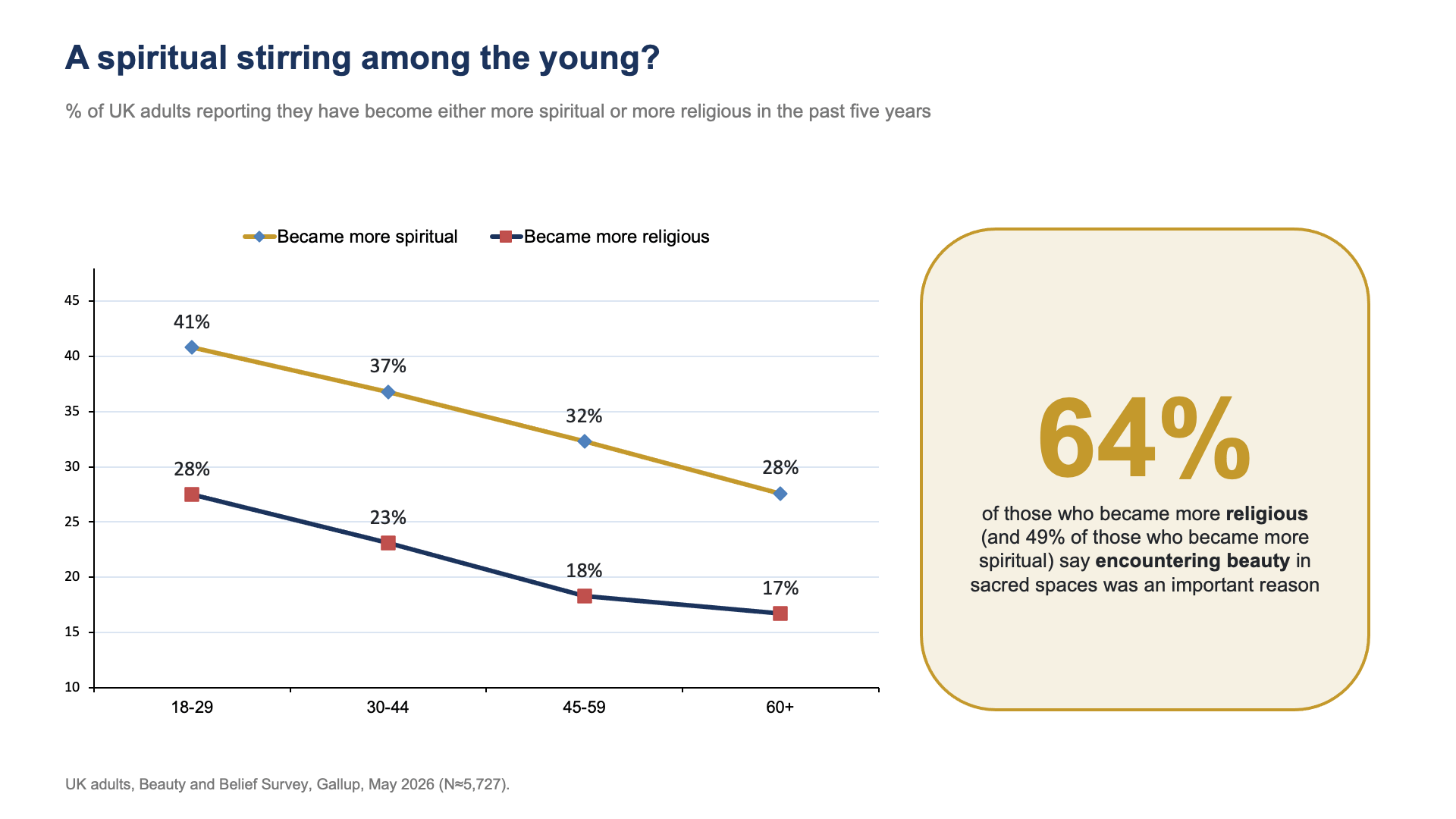
Beauty, it turns out, is an important part of what’s drawing them. Among Britons who became more religious, nearly two-thirds say that encountering beauty in sacred spaces and rituals was an important part of that change; it’s cited about as often as worship itself. (By comparison, 49% of those who became more spiritual cited the beauty of sacred spaces/rituals as a reason). For a great many people, it seems that beauty isn’t incidental to the religious life but rather one of the doors in.
Keep in mind here that this is self-reported change over five years, so there’s also the simple fact that the young have lived through more formative years recently than the old have. Young adults are the most likely to report recent intensification in spirituality or religion, but this is not strong enough to count as a full blown “revival” (not yet anyway).
So now have two large, parallel portraits of aesthetic life, with nearly 5,000 Americans and more than 5,700 Britons, and the most interesting findings are emerging from holding them up against each other. The two countries draw almost the same map of where beauty is found, but Britain experiences it a little less often, noticeably less so when it comes to the realm of the sacred. Some of that difference is about religion/spirituality—Britain’s more secular population explains much of why beauty feels less meaningful there. But that doesn’t explain why beauty is encountered less often. That seems to point to something more cultural. It may be partly a matter of British reticence—a lower inclination to call an experience beautiful rather than a real difference in experiencing it. Or it may be something else. What do you think?
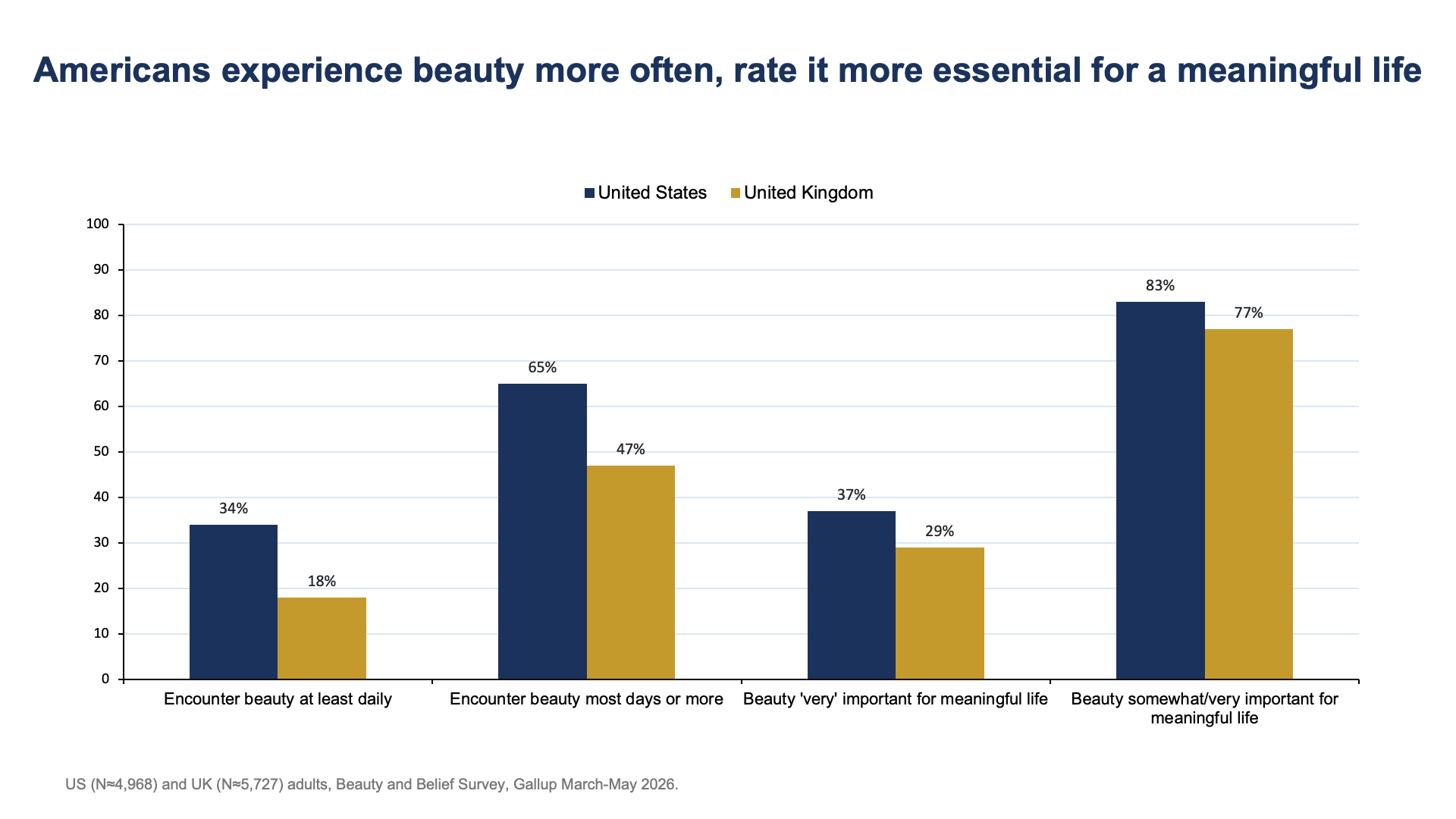
In any case, in both countries, beauty is positively associated with flourishing and negatively with distress, and it’s the youngest adults who are reaching most toward the religious and spiritual.
We plan to explore all this and more in a forthcoming report with Gallup, as well as in more peer-reviewed publications under development. Stay tuned.